Strings are the one part of an instrument that is designed to be consumed, and the only specification that must match the instrument is the type: steel on a steel-string guitar, nylon on a classical, long-scale on a 34-inch bass. Gauge is a preference — lighter sets bend easily and sound thinner, heavier sets hold tuning under a hard pick and pull harder on the neck. A change of more than one gauge step usually means the setup needs revisiting, which is worth knowing before the strings arrive rather than after.
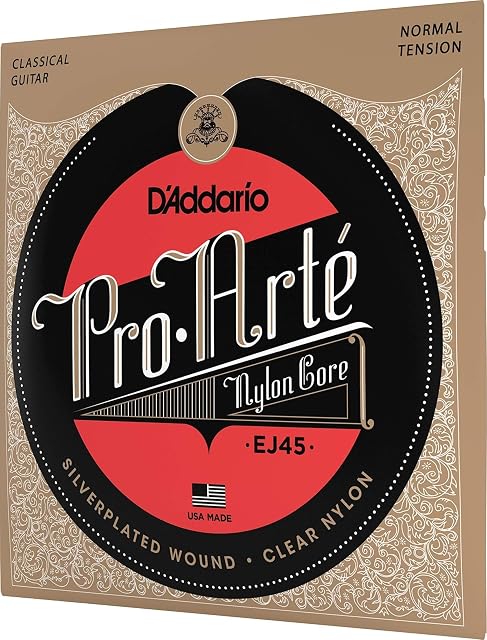
A normal-tension nylon set for classical guitars. Normal tension is the middle of three grades, and it is the one to fit unless the instrument or the player asks otherwise.
Material
Nylon
Tension
Normal
Instrument
Classical and concert guitars
End type
Tie end — for a classical bridge
Amazon reference
B000EEL6J6 (identical on 6 markets)
EAN
0019954121266
Normal tension is the safe default: enough volume, without loading the neck
Sold on all six Amazon stores at near-identical prices
Tie-end strings take longer to fit than ball ends, and the knot has to be learned
Best for: A classical or concert guitar — and no other kind.
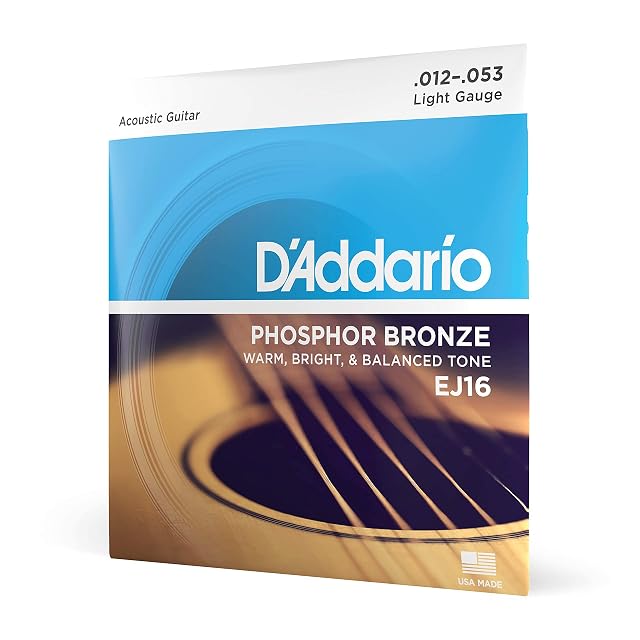
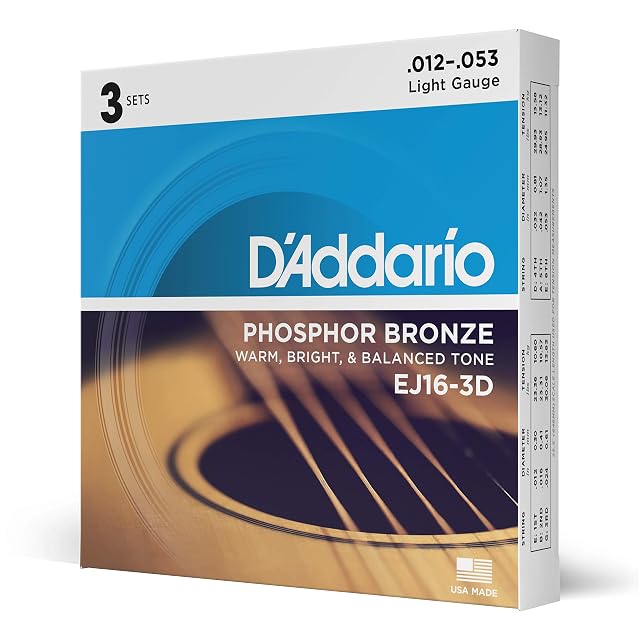
A single set of light-gauge phosphor bronze, 12 to 53, precision wound over a hexagonal high-carbon steel core and made in New York — the string that became the acoustic standard.
Gauge
Light, 12-53 — one of four gauges published on this shelf. The two already here publish *normal tension* and nothing
Wrap wire
Phosphor bronze, which D’Addario states gives a warm, balanced tone. It pioneered the alloy in the 1970s and it is now the acoustic standard
Core
A hexagonal high-carbon steel core, precision wound — one of three strings on this shelf to publish a core shape
Corrosion
Stated corrosion-resistant, in a recyclable VCI bag
Made in
The USA, drawn at D’Addario’s New York facility — one of four strings here to publish a country
Quantity
One set. Two packs on this shelf contain three, and the price per set falls accordingly
Instrument
Acoustic. This shelf also holds classical nylon and two electric sets, and the three are not interchangeable
End type
Ball end. The classical set on this shelf is tie-end, and its page notes that a knot has to be learned
Amazon reference
B000EEJ8CS
EAN
0019954121143
Publishes a gauge — 12-53 — where the two strings already on this shelf publish none
Publishes the core shape, which is what holds the wrap in place and decides whether a string settles
One set, where the same string in a three-pack works out at $8.30 a set
Best for: A single restring on a steel-string acoustic, where the gauge should be the standard one.
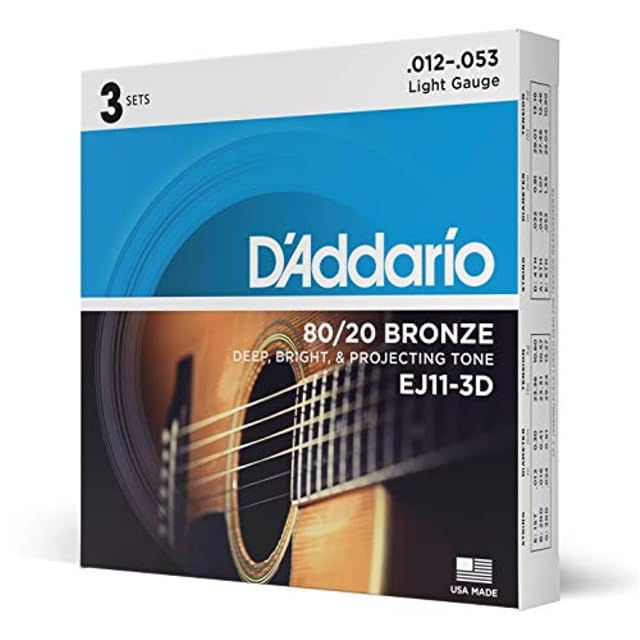
Three sets of light-gauge 80/20 bronze at $6.66 a set — the lowest price per set on this shelf — in the bolder and brighter of the two acoustic alloys, created in the 1930s.
Quantity
Three sets — which works out at $6.66 a set, the lowest price per set on this shelf
Gauge
Light, 12-53 — the same gauge as the two phosphor bronze sets here, so the comparison is purely about alloy
Wrap wire
80/20 bronze, which D’Addario states gives a bold, bright sound with crisp projection — the other acoustic alloy, against phosphor bronze’s warmth
Core
A hexagonal high-carbon steel core, precision wound
Origin
Created in the 1930s by John D’Addario Sr. and the guitar maker John D’Angelico — the earlier of the two dates published on this shelf
Made in
The USA, drawn at D’Addario’s New York facility
Packaging
A recyclable VCI bag with a Players Circle code
Instrument
Acoustic. Not for the electric or classical guitars this shelf also serves
Amazon reference
B0783QYRV5
EAN
0019954255855
The lowest price per set on this shelf — $6.66, against $8.30 and $9.99 for the same gauge
The same 12-53 gauge as the phosphor bronze sets here, so the only variable is the alloy
80/20 bronze is brighter and loses its brightness faster than phosphor bronze
Best for: A played acoustic whose owner has decided they want bright rather than warm, and wants a year of strings.
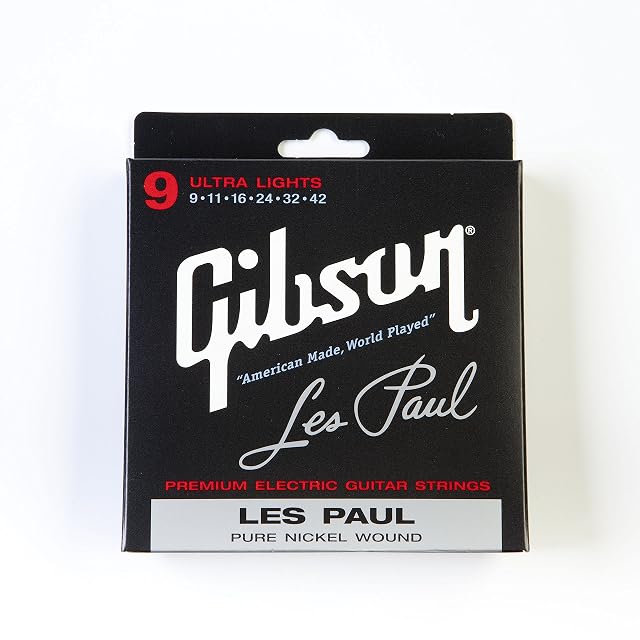
The only pure nickel strings on this shelf and the only ones with silk-wrapped ends, in ultra-light 9-42 for electric guitar — on a listing that prints one of its five bullets twice.
Instrument
Electric. This shelf also holds three acoustic sets and one classical nylon, and none of the three is interchangeable
Gauge
Ultra light, 9-42 — the lightest gauge published on this shelf, against 12-53 on the three acoustic sets
Wrap wire
Pure nickel, which Gibson states gives a smooth warm tone that still delivers a punch — the only pure nickel on this shelf
Ends
Silk-wrapped, stated to reduce ambient noise — the only silk ends on this shelf
Made in
American made, in Gibson’s words — one of four strings here to publish a country
Core
Gibson puts nothing in writing on this. Three strings on this shelf publish a hexagonal high-carbon core
Quantity
One set. Two packs on this shelf contain three
Listing repetition
Bullets three and four are identical: *Silk-wrapped ends to ensure the least amount of ambient noise*, printed twice. Five bullets become four
Amazon reference
B0002D0CC6
EAN
0711106532080
The only pure nickel strings on this shelf, which is a warmer alloy than the usual nickel-plated steel
The only silk-wrapped ends here, which Gibson states reduce ambient noise
One of its five bullets is printed twice, so there are really four
Best for: An electric with a set-up for light strings, where a warmer nickel voice is wanted over a modern bright one.
A light gauge hurts the fingers less and bends more easily. The best choice for the first months.
Rhythm chord work
A heavier gauge projects more and holds tuning better on an acoustic. It tires the hand more.
Strings that corrode fast
Coated strings last markedly longer on hands that perspire. They cost more and sound slightly different.
What you gain and what you give up, on guitar strings
Heavy gauge against comfort
A heavy gauge sounds fuller and asks for more strength. On an electric, a light gauge allows bends a heavy one rules out.
Coated strings against tone
Coated strings last far longer and lose a little initial brightness. On hands that corrode strings fast, they work out cheaper.
Changing often against stability
New strings sound better and need a few days to settle in tune. Changing them the day before a gig is a bad idea.
Frequent questions on guitar strings
When should strings be changed?
When they lose their brightness, become hard to tune, or show grooves under the fingers. Frequency depends mostly on perspiration.
Can I change gauge freely?
A big change alters the tension on the neck and often calls for a fresh setup. One step either way generally passes without intervention.
Should all the strings be changed at once?
Yes, except for a single breakage. A mismatched set gives uneven tone and tension.
Why do new strings go out of tune?
They stretch as they bed into the tuners. Gently stretching them by hand speeds up settling considerably.
Nylon or steel?
It depends entirely on the guitar: fitting steel strings to a classical guitar built for nylon can tear the bridge off.
How do I make strings last?
Wash your hands before playing and wipe the strings after every session. More effective than any product.
Are coated strings worth the price?
On hands that corrode strings fast, they last several times longer and work out cheaper overall.
Does the guitar need a setup after changing gauge?
Yes, as soon as you go up or down a step: the tension changes, the neck moves and the string height with it. A truss-rod and intonation setup follows any change of gauge.
What stays with you, on guitar strings
The gauge decides the tension on the neck and the comfort: a big change calls for a fresh setup. Wiping the strings after every session does more for their life than any product, and new strings need a few days to settle.
Summed up: guitar strings
The full table of guitar strings
A column is opened only if four devices in five publish the figure. Below that, it would set blanks against blanks.
Ultra light, 9-42 — the lightest gauge published on this shelf, against 12-53 on the three acoustic sets
Electric. This shelf also holds three acoustic sets and one classical nylon, and none of the three is interchangeable
Sources, and how the order is set
Specifications: manufacturer sheets for musical instruments and gear and the matching Amazon product pages. Prices and availability: Keepa. Every figure in this table names its source.
Most recent revision in this category: October 7, 2026.