Skip to content

The best effects pedals and DI boxes for 2026

Pedals are simple to compare and easy to get wrong at the mains. The convention is 9 V DC, center-negative, and a supply of the wrong polarity or voltage can damage a pedal in seconds. Current draw is the second number that matters: digital pedals can ask for several hundred milliamps, and a daisy chain feeding four of them from a small adapter will hum or drop out. We report power requirements and current draw as published, along with bypass type, stereo capability, and whether a supply is in the box — most of the time it is not.

What we recommend

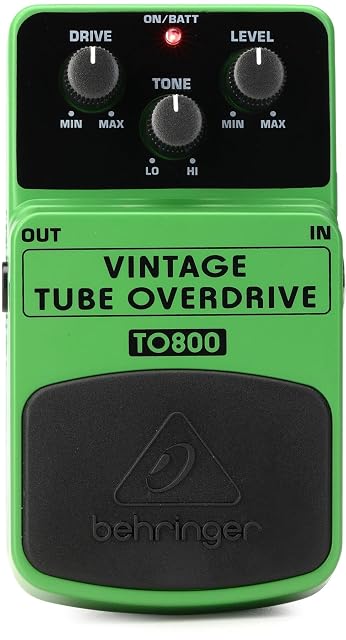
  1. Behringer TO800 vintage tube overdrive guitar pedal

    Behringer TO800 Vintage Tube Overdrive

    A vintage-voiced overdrive at a price where the pedal costs less than the cable to it. Like almost every pedal, it expects 9 V DC center-negative — the convention that destroys pedals when it is ignored.

    Type
    Overdrive
    Voicing
    Vintage tube-style (Behringer states)
    Power
    9 V DC, center negative — supply not included
    Amazon reference
    B000KIRT74 (identical on 6 markets)
    EAN
    0689076111812
    • Forty-three dollars for the effect most electric players want first
    • The classic overdrive voicing, which is the reference sound for blues and rock rhythm
    • No power supply included, and the wrong one can destroy it in seconds

    Best for: A first pedal, in front of a clean amplifier.

    ≈ $43
    Check price on Amazon
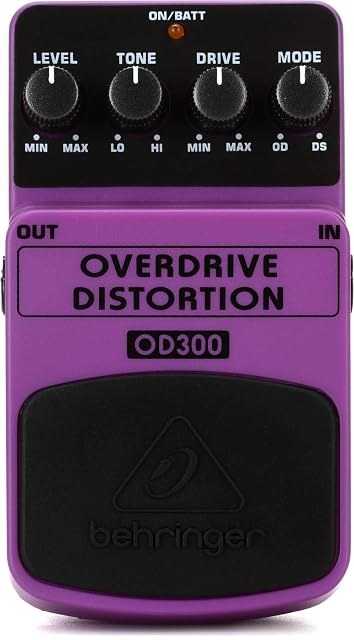
  2. Behringer OD300 two-mode overdrive and distortion pedal in purple

    Behringer OD300 Overdrive/Distortion

    Two gain characters in one enclosure: overdrive for a pushed amplifier sound and distortion for something heavier. Same 9 V center-negative rule, same absence of a supply in the box.

    Type
    Overdrive and distortion, two modes
    Power
    9 V DC, center negative — supply not included
    Amazon reference
    B002EWM1EA (identical on 6 markets)
    EAN
    0736211844170
    • Two distinct gain characters for the price of one pedal
    • Distortion mode covers heavier styles the TO800 deliberately does not
    • No supply included, like almost every pedal at this price

    Best for: A player covering several styles who does not want two pedals yet.

    ≈ $34
    Check price on Amazon

Need by need, within effects pedals

Starting to color your sound

A well-chosen pedal transforms an entry-level amp for a modest cost. The best effect-to-price ratio in the chain.

Behringer OD300 Overdrive/Distortion

Running off the supply you already have

A shared supply hands out a fixed milliamp budget, and one digital pedal takes a third of it. The stated current draw decides what fits on the same brick.

Behringer TO800 Vintage Tube Overdrive

Who each family suits, across effects pedals

Overdrive
An overdrive pedal gives a sound an amp’s clean channel does not have. The first pedal for the vast majority of guitarists.
A reverb to dress a dry sound
Reverb and delay fill out the sound and give it space. They go at the end of the chain, after the gain effects.
Modulation
Chorus, phaser and tremolo color the sound without distorting it. Supporting effects, rarely the first bought.

What you gain and what you give up, on effects pedals

Separate pedals against a multi-effects unit
The multi-effects offers everything for a modest price and is set through menus; separate pedals cost more and are set with a foot, in one movement.
Batteries against a power supply
Batteries save a power brick and go flat at the wrong moment; a multi-output supply feeds everything and adds a risk of ground hum.
Number of pedals against noise floor
Every pedal adds hiss and a point of failure. A long chain becomes noisy and fragile.

Frequent questions on effects pedals

In what order should pedals be connected?

Generally tuner, then gain effects, then modulation, then ambience at the end. That order is a convention, not an absolute rule.

Does a pedalboard need its own power supply?

Past two or three pedals, a multi-output supply is more practical than batteries. Check the polarity, which is not universal.

Why do I get a hum with several pedals?

A ground loop through the shared supply. Isolated-output supplies exist for exactly that.

Multi-effects or separate pedals?

The multi-effects to explore cheaply, separate pedals for instant foot control and a more personal sound.

Does a pedal work without an amp?

No, unless it has speaker simulation and a headphone output. A pedal alone produces no sound.

Do batteries last long?

Not long, especially in digital pedals. Unplugging the input cable cuts the power on most analog pedals.

Do I need a pedalboard?

From three pedals on, it saves setting everything up each time and protects the cables. A real time-saver in rehearsal.

Does a pedal cut the sound when it is off?

True-bypass pedals pass the signal with no electronics in the way; the others run it through a buffer. The stated bypass type matters once several pedals follow one another.

What stays with you, on effects pedals

The conventional order is tuner, gain, modulation, ambience — a convention, not a law. Check the polarity of the power supply, which is not universal, and know that a hum with several pedals almost always comes from a ground loop.