A stand fails in three ways, and all three are in the specification. The thread is either 3/8 inch or 5/8 inch, and a microphone mount that does not match needs an adapter — often the small brass part missing from a delivery. The load capacity has to cover the microphone plus its shock mount plus, on a desk arm, the leverage of full reach. The desk clamp has to fit the actual thickness of your desk. We compare thread size, stated load, reach, base or clamp type, and whether a shock mount is included or assumed.
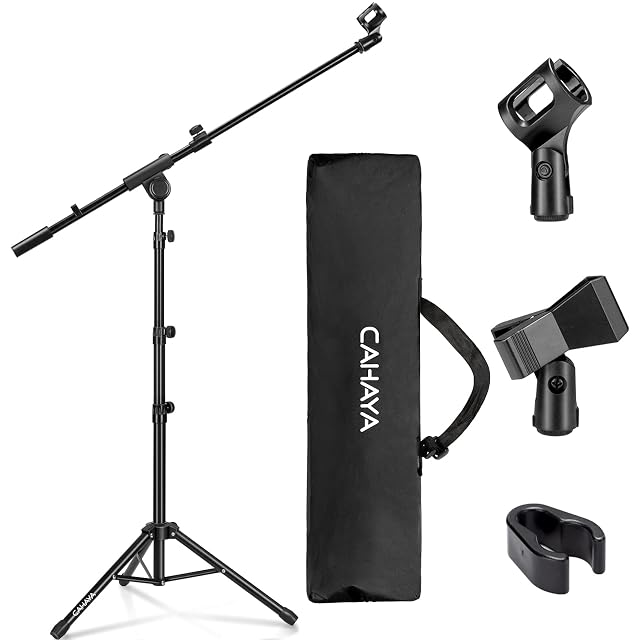
A two-in-one stand: a straight floor stand, or a boom arm when the top section is fitted horizontally. Adjustable between 64 and 158 cm (62.2 in), which covers both a seated desk and a standing vocalist.
Type
Floor stand, converts to boom
Height range
64 – 158 cm (25.2 to 62.2 in)
Base
Tripod
Amazon reference
B09J2CXPDW (identical on 6 markets)
EAN
5060987649925
A floor stand does not transmit desk knocks into the microphone the way a desk arm does
The 64 cm (25.2 in) minimum is low enough to use seated at a desk
A tripod base takes floor space that a desk clamp does not
Best for: Recording vocals seated or standing, in a room where the floor is free.
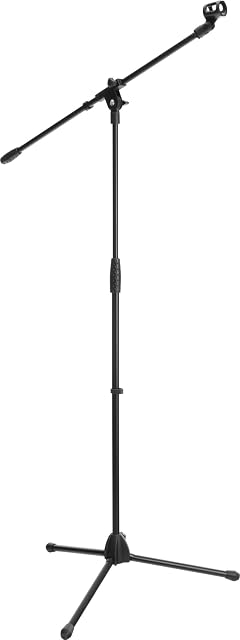
A conventional tripod boom stand with a swivel arm of about 75 cm (29.5 in), height to roughly 154 cm (60.6 in), and — the part that is often missing — a microphone clip and cable clips in the box.
Type
Tripod with boom arm
Height
Adjustable to about 154 cm (60.6 in)
Boom length
About 75 cm (29.5 in)
Included
Microphone clip, cable clips
Manufacturer reference
00034629
Amazon reference
B00LW6TI22 (identical on 5 markets)
EAN
4260368344888
A microphone clip is included, which a surprising number of stands leave out
Cable clips keep the lead off the floor and away from feet
No UK offer at the time of writing
Best for: A first microphone stand where nothing else should have to be bought.
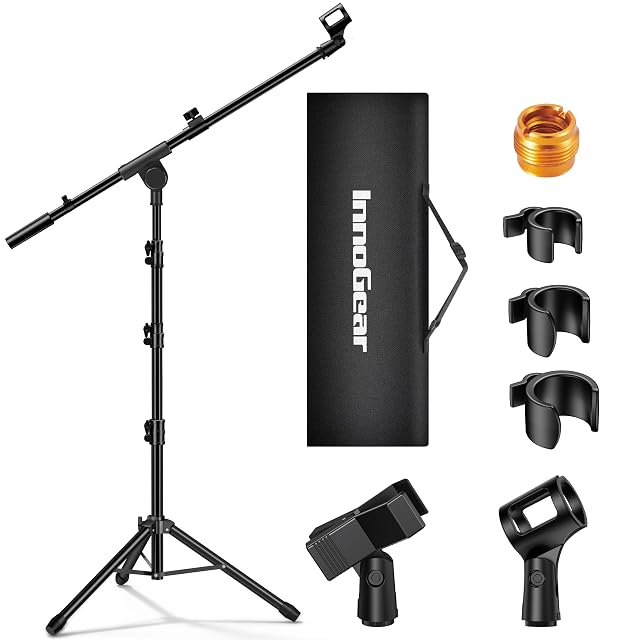
The only stand here whose boom changes length — 16 to 30 inches — on a tripod that reaches 228 cm (89.8 in), rotating 360 degrees on two axes, with two microphone clips and a carrying bag.
Height range
28.1 to 89.8 in — 71 to 228 cm (28 to 89.8 in). The two stands already here reach 158 cm (62.2 in) and about 154 cm (60.6 in)
Boom length
Adjustable from 16 to 30 in — 41 to 76 cm (16.1 to 29.9 in). The only adjustable boom on this shelf; the other two are fixed
Boom movement
Rotates 360° horizontally and vertically, and detaches — the only two-axis rotation published here
Base
Tripod, in thickened steel poles which InnoGear states give more stability than lighter stands
Clips
Two different styles supplied, stated compatible with Shure SM58, SM48 and PG58 among others — the only stand here to name a microphone
Portability
A carrying bag is included, and the stand disassembles into several pieces
Thread size
InnoGear puts nothing in writing on this. No stand on this shelf publishes a thread size, and 3/8 and 5/8 in are both common
Counterweight
InnoGear puts nothing in writing on this. The page for another stand here notes that a long boom needs its counterweight balanced or the stand will tip
Weight
1,896 g (66.9 oz) in the product record. Neither stand already here has a figure
Manufacturer reference
TS186
Amazon reference
B0C61MKJK5
EAN
0810015622698
The only stand on this shelf whose boom length adjusts — 41 to 76 cm (16.1 to 29.9 in), rather than one fixed reach
Reaches 228 cm (89.8 in), where the two stands already here stop at about 155 cm (61 in)
No thread size published, which is the one figure that decides whether a microphone fits a clip
Best for: A room where one stand has to serve a seated desk, a standing vocal and an overhead position.
A straight stand with a weighted base is enough and takes little floor space. The simplest format.
Recording seated
A boom arm lets you bring the mic close without the base fouling your legs. It is what makes the position bearable.
Desk
An articulated arm clamped to the desktop frees the whole surface. It does transmit the desk’s vibration to the mic.
What you gain and what you give up, on mic stands & arms
Tripod base against round base
The tripod is more stable and takes up floor space; the round base takes less room and tips more easily under a loaded boom.
Boom against balance
An extended boom places the mic ideally and unbalances the stand. A counterweight or a heavy base becomes necessary.
Desk arm against vibration
An articulated arm frees the surface and passes every keystroke to the mic. A shock mount reduces without removing it.
Frequent questions on mic stands & arms
Tripod or round base?
The tripod is markedly more stable, especially with a boom. The round base takes less room and tips more easily.
Do I need a counterweight?
As soon as a boom is extended with a heavy mic, yes. Without it the stand goes over at the first knock.
Are the threads standard?
Two formats coexist, with screw-in adapters that are very common. Check the thread on your mic clip.
How do I stop the stand sliding?
Rubber feet in good condition, and a mat under the stand on a smooth floor. A stand that slides during a take ruins the result.
Does a desk arm transmit vibration?
A great deal: every keystroke reaches the mic. A shock mount reduces it without solving the problem entirely.
How tight should the knobs be?
Firmly but without forcing: plastic threads strip and the stand then sags in the middle of a take.
Do I need one stand per mic?
Yes as soon as you record several sources. T-bars for two mics exist for specific cases.
Is a heavy stand better than a light one?
For a fixed mic, yes: mass holds the boom and absorbs floor knocks. For a stand moved between every song, weight becomes the main flaw.
What stays with you, on mic stands & arms
A stand that falls costs more than the gap between two models: tripod rather than round base as soon as there is a boom. Counterweight on an extended boom, rubber feet in good condition, and knobs tightened without forcing — plastic threads strip.
Summed up: mic stands & arms
Mic stands & arms, side by side
There is no table here, and the reason is in the listings. The figure published most often across these 3 products is base, given by 2 of them — short of the four in five a column needs to compare rather than to display gaps. Each product page says what its own maker published.
Sources, and how the order is set
Specifications: manufacturer sheets for musical instruments and gear and the matching Amazon product pages. Prices and availability: Keepa.
Most recent revision in this category: October 7, 2026.