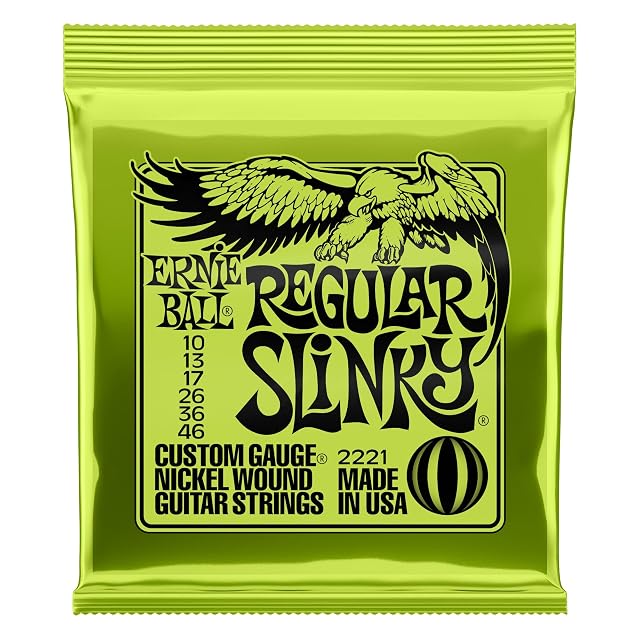
If an electric guitar sounds dull and feels sticky, it needs strings before it needs anything else. This is the set most of them left the factory with.
Ten to forty-six is the reference gauge for electric guitar: light enough to bend, heavy enough to stay in tune under a pick, and the assumption behind almost every setup guide written. Nickel wound is the standard construction for magnetic pickups.
Strings are a consumable and they die quietly — tone goes first, then tuning stability. Playing a few hours a week, a set lasts one to three months. Nine dollars against a guitar that suddenly sounds new is the best value in this entire catalog.
If you are tempted to move gauge, do it one step at a time. Jumping from 9s to 11s changes the tension on the neck enough that the action and intonation need revisiting.
The questions players ask
What do 10-46 mean?
The thickness of the thinnest and thickest strings in thousandths of an inch. A 9-42 set is lighter and easier to bend; an 11-49 is heavier and holds up better under a hard pick. Ten to forty-six is the middle, and the factory default on most electrics.
Do I need a setup if I change gauge?
One step either way is usually fine. More than that changes the pull on the neck enough to alter the action and intonation, and the guitar will want adjusting — which is a job for the truss rod and the bridge saddles, not for the strings.
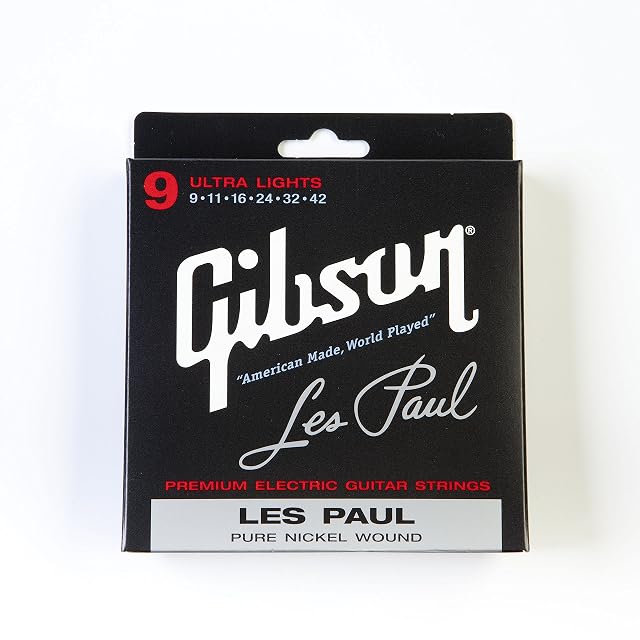
The only pure nickel strings on this shelf and the only ones with silk-wrapped ends, in ultra-light 9-42 for electric guitar — on a listing that prints one of its five bullets twice.
Instrument
Electric. This shelf also holds three acoustic sets and one classical nylon, and none of the three is interchangeable
Gauge
Ultra light, 9-42 — the lightest gauge published on this shelf, against 12-53 on the three acoustic sets
Wrap wire
Pure nickel, which Gibson states gives a smooth warm tone that still delivers a punch — the only pure nickel on this shelf
Ends
Silk-wrapped, stated to reduce ambient noise — the only silk ends on this shelf
Made in
American made, in Gibson’s words — one of four strings here to publish a country
Core
Gibson puts nothing in writing on this. Three strings on this shelf publish a hexagonal high-carbon core
Quantity
One set. Two packs on this shelf contain three
Listing repetition
Bullets three and four are identical: *Silk-wrapped ends to ensure the least amount of ambient noise*, printed twice. Five bullets become four
Amazon reference
B0002D0CC6
EAN
0711106532080
The only pure nickel strings on this shelf, which is a warmer alloy than the usual nickel-plated steel
The only silk-wrapped ends here, which Gibson states reduce ambient noise
One of its five bullets is printed twice, so there are really four
Best for: An electric with a set-up for light strings, where a warmer nickel voice is wanted over a modern bright one.
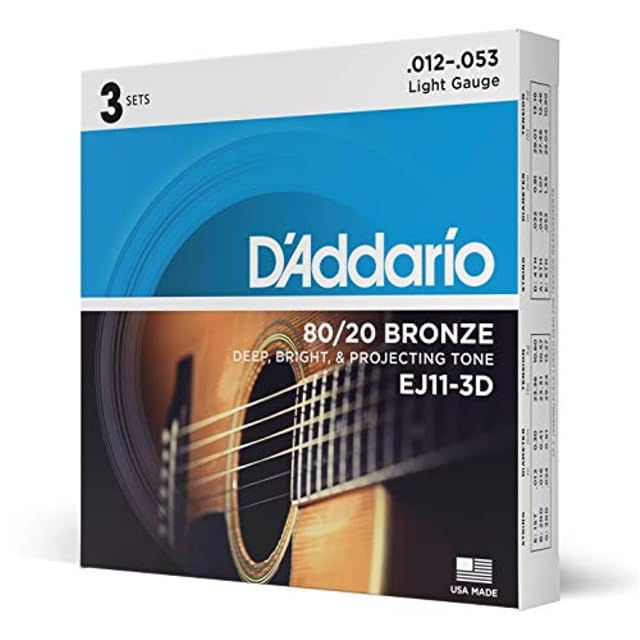
Three sets of light-gauge 80/20 bronze at $6.66 a set — the lowest price per set on this shelf — in the bolder and brighter of the two acoustic alloys, created in the 1930s.
Quantity
Three sets — which works out at $6.66 a set, the lowest price per set on this shelf
Gauge
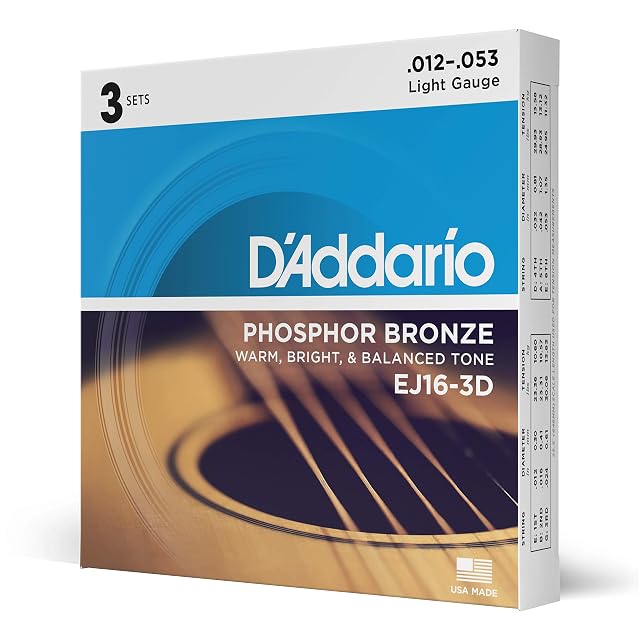
Light, 12-53 — the same gauge as the two phosphor bronze sets here, so the comparison is purely about alloy
Wrap wire
80/20 bronze, which D’Addario states gives a bold, bright sound with crisp projection — the other acoustic alloy, against phosphor bronze’s warmth
Core
A hexagonal high-carbon steel core, precision wound
Origin
Created in the 1930s by John D’Addario Sr. and the guitar maker John D’Angelico — the earlier of the two dates published on this shelf
Made in
The USA, drawn at D’Addario’s New York facility
Packaging
A recyclable VCI bag with a Players Circle code
Instrument
Acoustic. Not for the electric or classical guitars this shelf also serves
Amazon reference
B0783QYRV5
EAN
0019954255855
The lowest price per set on this shelf — $6.66, against $8.30 and $9.99 for the same gauge
The same 12-53 gauge as the phosphor bronze sets here, so the only variable is the alloy
80/20 bronze is brighter and loses its brightness faster than phosphor bronze
Best for: A played acoustic whose owner has decided they want bright rather than warm, and wants a year of strings.
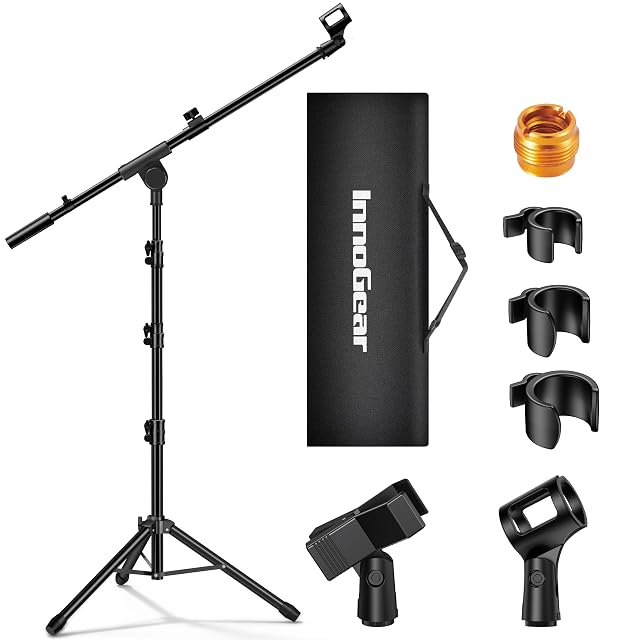
The only stand here whose boom changes length — 16 to 30 inches — on a tripod that reaches 228 cm (89.8 in), rotating 360 degrees on two axes, with two microphone clips and a carrying bag.
Height range
28.1 to 89.8 in — 71 to 228 cm (28 to 89.8 in). The two stands already here reach 158 cm (62.2 in) and about 154 cm (60.6 in)
Boom length
Adjustable from 16 to 30 in — 41 to 76 cm (16.1 to 29.9 in). The only adjustable boom on this shelf; the other two are fixed
Boom movement
Rotates 360° horizontally and vertically, and detaches — the only two-axis rotation published here
Base
Tripod, in thickened steel poles which InnoGear states give more stability than lighter stands
Clips
Two different styles supplied, stated compatible with Shure SM58, SM48 and PG58 among others — the only stand here to name a microphone
Portability
A carrying bag is included, and the stand disassembles into several pieces
Thread size
InnoGear puts nothing in writing on this. No stand on this shelf publishes a thread size, and 3/8 and 5/8 in are both common
Counterweight
InnoGear puts nothing in writing on this. The page for another stand here notes that a long boom needs its counterweight balanced or the stand will tip
Weight
1,896 g (66.9 oz) in the product record. Neither stand already here has a figure
Manufacturer reference
TS186
Amazon reference
B0C61MKJK5
EAN
0810015622698
The only stand on this shelf whose boom length adjusts — 41 to 76 cm (16.1 to 29.9 in), rather than one fixed reach
Reaches 228 cm (89.8 in), where the two stands already here stop at about 155 cm (61 in)
No thread size published, which is the one figure that decides whether a microphone fits a clip
Best for: A room where one stand has to serve a seated desk, a standing vocal and an overhead position.
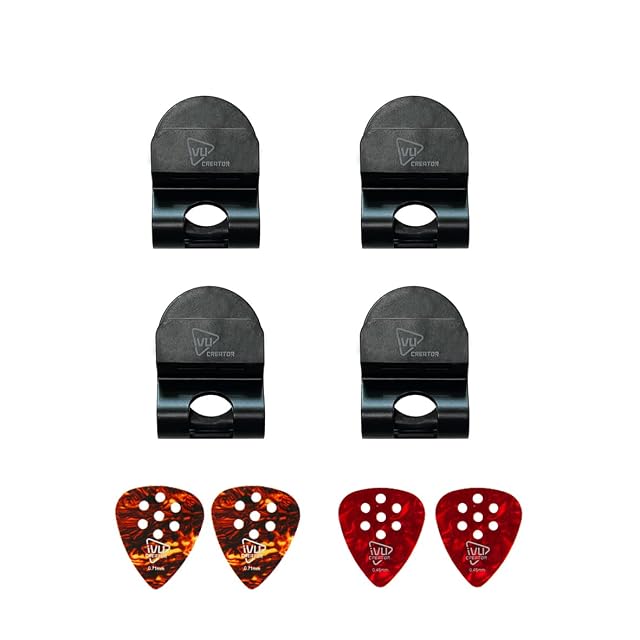
Four blocks that clip over a strap button to stop the strap coming off, with no drilling and no hardware changed — plus a channel that anchors the lead and a holder with four non-slip picks in two gauges.
What it does
Blocks that slip over an existing strap and button to stop the strap releasing, stated to protect against accidental drops and slips. The only strap locks on this shelf, and the product answer to this shelf’s own question about them (maker’s bullet)
Modification
None. Stated to need no permanent modification, so vintage and valuable instruments keep their original buttons — which is the difference from traditional locks, where the button itself is replaced
Quantity
Two pairs, four pieces — enough for two instruments (maker’s bullet)
Cable hook
A channel that anchors the lead to the lower block, stated to keep the cable plugged in and tidy underfoot. The only cable anchor on this shelf (maker’s bullet)
Pick holder
The upper block can hold picks (maker’s bullet)
Picks included
Four non-slip picks — two at 0.71 mm (0.03 in) and two at 0.96 mm (0.04 in). One of three listings on this shelf to publish a millimeter figure (maker’s bullet)
Fitting
Stated to clip onto the strap button, reusable across instruments (maker’s bullet)
Material
IVU CREATOR puts nothing in writing on this — no polymer, no metal, for a part whose whole job is not to fail
Manufacturer reference
IVU CREATOR publishes none. The listing carries no maker’s code at all, only the Amazon reference below
Recorded size
115 × 85 × 15 mm (4.53 × 3.35 × 0.59 in) in the product record, for four pieces
Weight
18 g (0.6 oz) in the product record — the lightest figure recorded on this shelf
Amazon reference
B0B12GXLQR
EAN
0767235257844
Strap locks that change nothing on the instrument: no drilling, no replaced button
A cable anchor on the lower block, which nothing else on this shelf offers
No material published, on a part whose only job is to not let go
Best for: A guitar played standing, or any instrument whose original buttons should stay original.
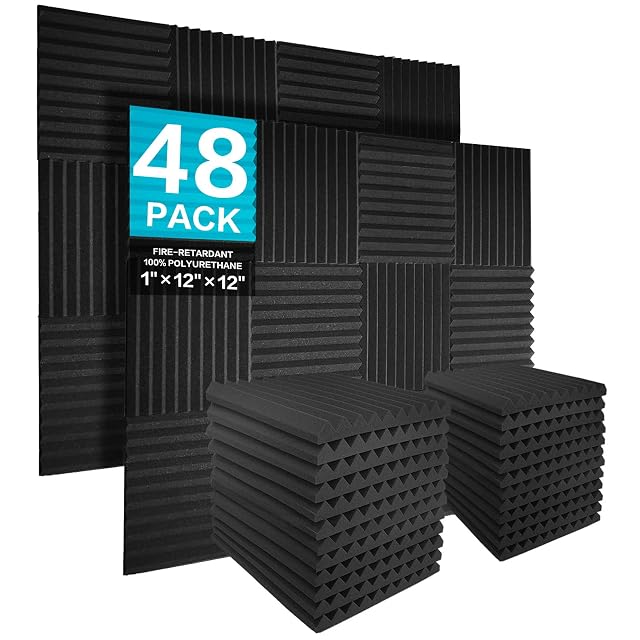
A large quantity of thin acoustic foam. It absorbs high frequencies and flutter echo effectively and does nothing at all about low frequencies — which is exactly what to expect from foam this thin.
Quantity
48 tiles
Material
Acoustic foam
Absorbs
High frequencies and flutter echo
Amazon reference
B07PB1L2ZK (identical on 6 markets)
EAN
0742939246295
Enough tiles to cover the first reflection points of a small room in one order
Kills the flutter echo between parallel walls, which is what makes a room sound like a bathroom
Thin foam does nothing below a few hundred hertz — bass problems need thickness or traps
Best for: A first treatment pass on a small recording corner.