Room treatment is decided by thickness, not by surface area. Thin foam tiles absorb the top end and leave the low frequencies that actually make a small room misleading; a thick panel or a corner trap addresses those. Placement follows the same logic — corners first, then the wall behind the speakers, then the first reflection points — and a handful of thick panels in the right places outperforms a wall covered in 2 cm tiles. We compare thickness, density, published absorption figures where the manufacturer provides them, fire rating and mounting method.
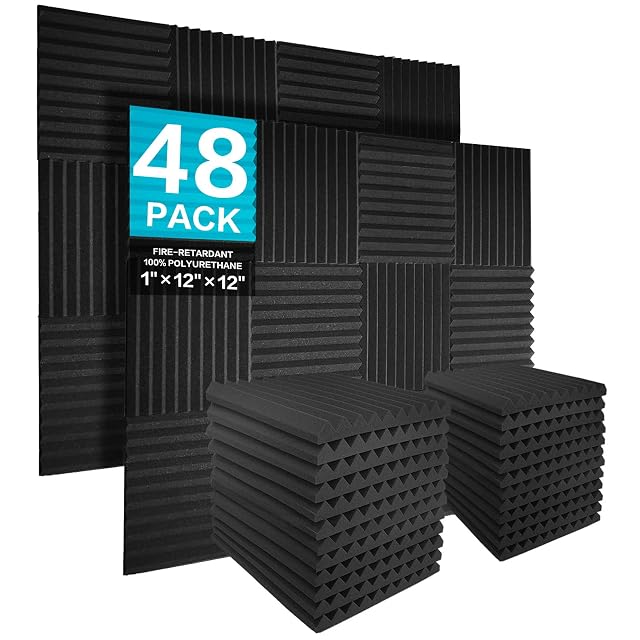
A large quantity of thin acoustic foam. It absorbs high frequencies and flutter echo effectively and does nothing at all about low frequencies — which is exactly what to expect from foam this thin.
Quantity
48 tiles
Material
Acoustic foam
Absorbs
High frequencies and flutter echo
Amazon reference
B07PB1L2ZK (identical on 6 markets)
EAN
0742939246295
Enough tiles to cover the first reflection points of a small room in one order
Kills the flutter echo between parallel walls, which is what makes a room sound like a bathroom
Thin foam does nothing below a few hundred hertz — bass problems need thickness or traps
Best for: A first treatment pass on a small recording corner.
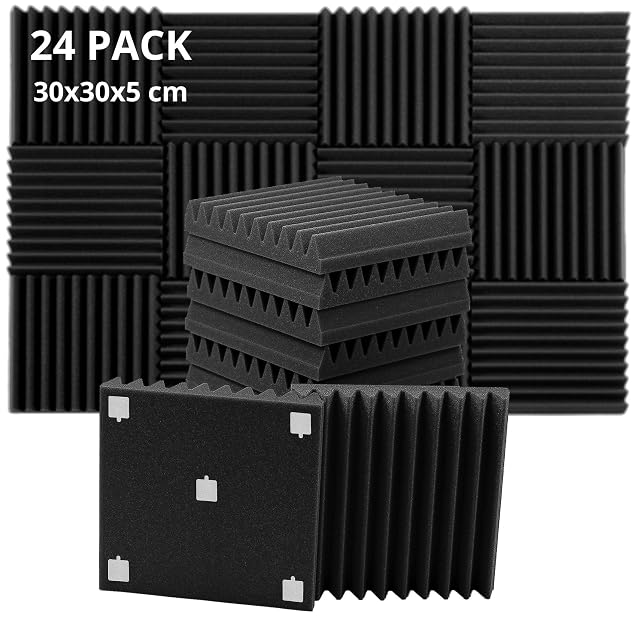
Twenty-four high-density panels, 5 cm (2 in) thick, with adhesive supplied. The thickness is the specification that matters: 5 cm (2 in) reaches noticeably lower than the thin tiles sold in larger quantities.
Quantity
24 panels
Dimensions
30 × 30 × 5 cm (11.8 × 11.8 × 2 in)
Density
High density (ROVSON states)
Included
Adhesive
Amazon reference
B0D2XWQDBG (identical on 6 markets)
EAN
8436614640325
Five centimeters of high-density foam absorbs usefully lower than 2 cm (0.8 in) tiles
Adhesive supplied, so nothing else is needed to mount them
Adhesive mounting takes paint off a rented wall when removed
Best for: A room you own, or one where the panels can be mounted on frames.
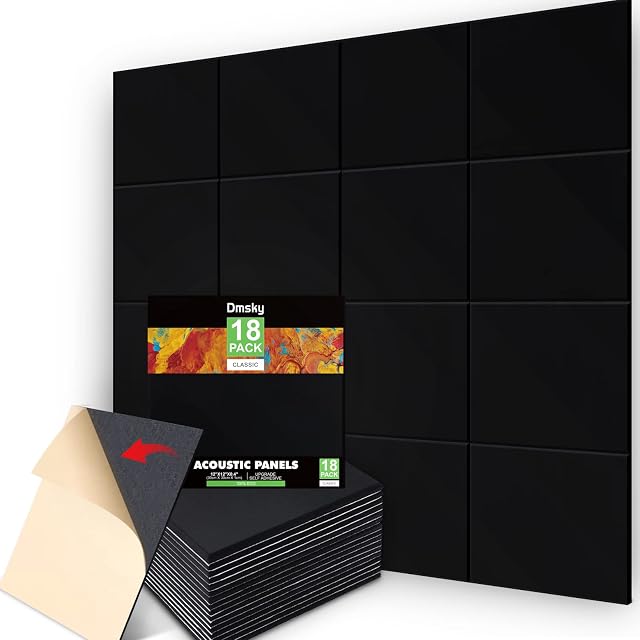
Eighteen polyester-fiber panels rather than foam tiles, with edges chamfered at 45 degrees so they butt together without a gap, and adhesive already on the back.
Quantity and size
18 panels at 12 × 12 × 0.4 in — 1 cm thick, the thinnest on this shelf
Material
High-density polyester fiber, not foam. DMSKY states it has better ductility and wear resistance and does not deform easily
Edges
A 45° chamfer, which DMSKY states leaves no gap between panels — the only edge treatment published on this shelf
Mounting
Adhesive already applied; the backing is peeled off
Absorption
DMSKY states the effect is better than ordinary material and publishes no NRC figure. No panel on this shelf publishes one
Thickness
0.4 in. One panel on this shelf publishes 5 cm (2 in), and its page notes that thickness is what reaches lower frequencies
Fire
DMSKY puts nothing in writing on this. One panel on this shelf publishes a fire claim
Color
Black
Coverage
18 square feet in total
Manufacturer reference
None published
Amazon reference
B08PVTC9G4
EAN
0798797224944
Polyester fiber rather than foam, which DMSKY states resists wear and deformation
The only panel on this shelf with a published edge treatment — a 45° chamfer so panels butt without a gap
At 0.4 in it is the thinnest panel on this shelf, and thin material does nothing to bass
Best for: Killing flutter echo on a small wall where the panels have to meet each other cleanly.
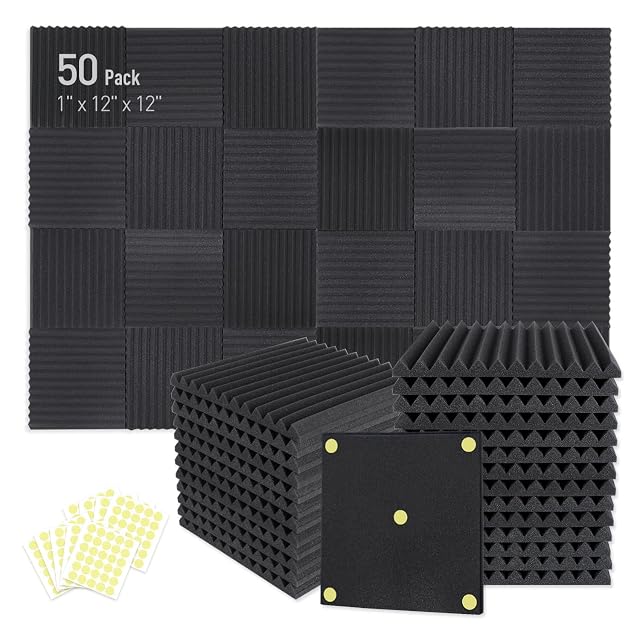
Fifty one-inch foam panels with triangular grooves, 300 double-sided adhesive squares supplied, and the only fire claim on this shelf — which on foam glued to a bedroom wall is the line that matters.
Quantity and size
50 panels at 1 × 12 × 12 in — the largest quantity on this shelf
Profile
Triangular grooves, which Focusound states absorb noise better than a flat face
Adhesive
300 double-sided adhesive squares supplied free — six per panel
Fire
Focusound states strong fire resistance and that the foam stops burning to prevent a hidden fire hazard — the only fire claim on this shelf
Material
High-density foam. Focusound states that if it does not return to shape it can be soaked in water and air-dried
Thickness
1 in — 2.5 cm. One panel on this shelf publishes 5 cm (2 in), and its page notes thickness is what reaches lower
Absorption
Focusound publishes no NRC figure. No panel on this shelf publishes one
Air permeability
Stated as good, alongside the fire resistance
Coverage
50 square feet in total
Manufacturer reference
FS0302C
Amazon reference
B0832DPMYR
EAN
0658848729111
Fifty panels, the most on this shelf, with 300 adhesive squares included — six per panel
The only panel here to publish anything about fire, and it says the foam stops burning
One inch of foam treats echo and not bass, as the page for another panel here states
Best for: Covering a lot of wall at once, where the fire claim and the adhesive count matter as much as the foam.
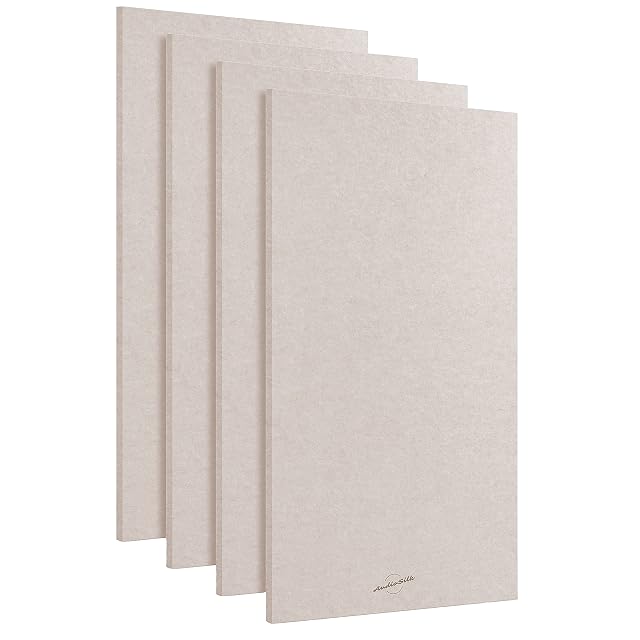
Four large panels rather than a grid of tiles — 46 by 23 inches each — in post-consumer recycled polyester, mounted on removable strips that leave no mark, and the only listing here to compare itself with foam.
Quantity and size
4 panels at 46 × 23 in — 1.17 × 0.58 m (4 × 1.9 ft) each, the only large-format panel on this shelf. Every other panel here is a 12 × 12 in tile
Material
Post-consumer recycled polyester, not foam. AudioSilk states no harsh chemical smell, no shrinkage and no peeling
Versus foam
The second bullet is titled BETTER THAN FOAM and claims much higher performance than equivalent acoustic foam — the only listing on this shelf to compare itself with its neighbors’ material
Mounting
Removable sticky strips, stated to leave no mark on a wall — and sold separately. The maker says so in the same bullet
Absorption
The first bullet reads *High density material with NRC of up to* — and the sentence ends there. No figure is published, and no panel on this shelf publishes one
Thickness
AudioSilk puts nothing in writing on this. Two panels on this shelf publish 0.4 in and 1 in, and one publishes 5 cm (2 in)
Support
Free acoustic treatment advice is offered, including how to measure room performance and where to place panels — the only placement guidance on this shelf
Color
Natural. AudioSilk states a range of colors is available, and two other finishes of this same kit were discarded from this catalog as color variants
Coverage
About 29 square feet in total across the four panels
Fire
AudioSilk puts nothing in writing on this. One panel on this shelf publishes a fire claim
Manufacturer reference
None published
Amazon reference
B0BQRXF5FL
EAN
5065015057055
Four large panels instead of a grid of tiles, so one wall is treated in four decisions rather than eighteen
Recycled polyester rather than foam, with no shrinkage, no peeling and no chemical smell stated
The mounting strips are sold separately, which the listing states and which means the kit does not mount as delivered
Best for: A rented room where the panels have to come down without taking the paint, and one wall has to be dealt with in four pieces.
In rented rooms, the fixing decides what is possible. Panels supplied with adhesive pads or free-standing frames come off without a mark at the end of the lease.
Treating the side first-reflection points and the ceiling above the listening position changes the sound more than any speaker.
Recording voice
A few panels behind and around the mic remove the reverberation that makes takes unusable.
Reducing noise for the neighbors
A very widespread confusion: acoustic treatment does not provide soundproofing. Two physically distinct problems.
What you gain and what you give up, on acoustic treatment
Treatment against soundproofing
Panels absorb reverberation inside a room; they do nothing to stop sound crossing a wall. Confusing the two is the most common mistake.
Absorbing highs against absorbing lows
Thin foam absorbs mainly the highs and lets the lows through, which unbalances the room. Bass calls for far greater thickness.
Coverage against deadening
Too much high-frequency absorption makes a room dull and unpleasant. The aim is balance, not total silence.
Frequent questions on acoustic treatment
Do panels soundproof?
No, not in any way. They absorb reverberation inside the room; soundproofing is a matter of mass and sealing, entirely different.
Where do the first panels go?
At the side first-reflection points, found with a mirror slid along the wall, and on the ceiling above the listening position.
Is thin foam enough?
It absorbs the highs and lets the lows through, which unbalances the room. Bass calls for far greater thickness.
How many panels do I need?
Treatment works by the area covered: a few isolated panels change almost nothing. Better to treat few zones completely than many partially.
Can a room be over-treated?
A room with all its highs absorbed becomes dull and tiring. The aim is balance, not the absence of reverberation.
How are panels fixed?
Mounting adhesive, hooks or frames depending on the wall and the weight. Peeling off strong adhesive takes the paint with it.
Does a bookcase replace panels?
An irregularly filled bookcase diffuses and partly absorbs. Not equivalent, but far from useless.
Are panels fire-rated?
Some foams are not, and that matters in a room where equipment is plugged in all day. The stated fire-reaction rating is information to look for before the look.
What stays with you, on acoustic treatment
Acoustic treatment does not soundproof: it absorbs reverberation inside, it stops nothing crossing a wall. Treat the first-reflection points found with a mirror, and know that thin foam only takes the highs — bass calls for an altogether different thickness.
Summed up: acoustic treatment
Coverage: 18 to 50 square feet in total, on 3 of the 5 models.
Quantity and size: 4 to 50, on 3 of the 5 models.
Thickness: 0.4 to 1, on 3 of the 5 models.
The full table of acoustic treatment
A column is opened only if four devices in five publish the figure. Below that, it would set blanks against blanks.
Specifications: manufacturer sheets for musical instruments and gear and the matching Amazon product pages. Prices and availability: Keepa. Every figure in this table names its source.
Most recent revision in this category: October 7, 2026.