Skip to content

The best studio monitor speakers for 2026

Studio monitors are near-field speakers meant to be listened to from about a meter away, and in a small room the driver size matters less than the connectors and the room controls. A five-inch pair in an untreated bedroom already produces more low end than the room can handle; a switchable low-frequency trim or a rear port that tolerates a wall does more for accuracy than an extra inch of cone. We compare driver size, published frequency response, input connectors — XLR, TRS or RCA, which decides your cables — and whether the price is for one speaker or two, a detail that catches out buyers regularly.

The models we recommend

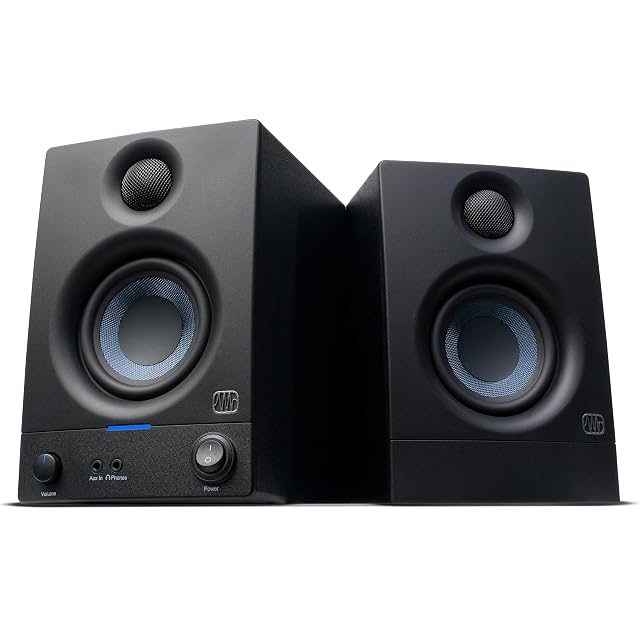
  1. PreSonus Eris 3.5 Gen 2

    Pair · 3.5" woofer · 50 W · front headphone jack

    The desktop pair: 3.5-inch woven composite woofers, 1-inch silk dome tweeters, 50 W total, 80 Hz – 20 kHz, with acoustic tuning controls and a headphone socket on the front panel.

    Best for: A desk where space is the binding constraint and headphones are the main tool anyway.

    7.2/10

    ≈ $260

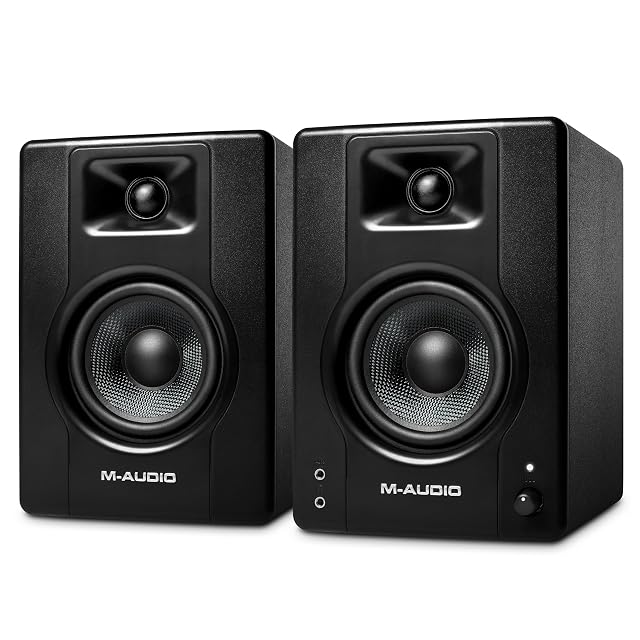
  2. M-Audio BX4

    Pair · 4.5" Kevlar woofer · rear 6.3/3.5/RCA · front aux

    A bi-amplified desktop pair with 4.5-inch black Kevlar woofers and silk dome tweeters, in MDF cabinets, with three rear input types, front-panel aux and rear high/low EQ.

    Best for: A first pair of desktop monitors where nothing else should have to be bought.

    7.8/10

    ≈ $140

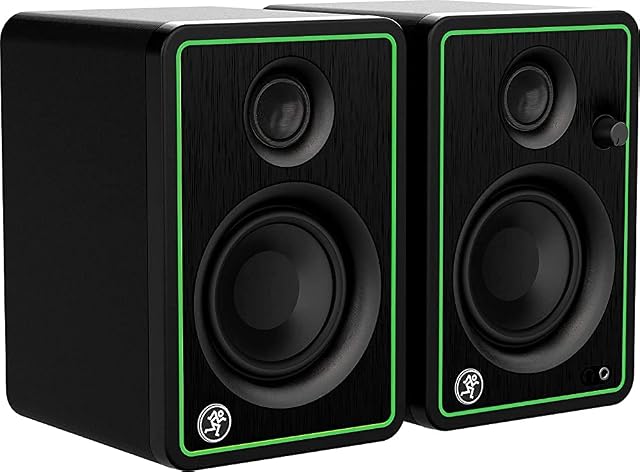
  3. Mackie CR3-X

    3 in drivers · 50 W · headphone jack that mutes the speakers · 1/4 in, 1/8 in and RCA

    The only pair here whose front headphone socket switches the speakers off by itself — on 3-inch drivers, 50 watts, three input types and cables in the box.

    Best for: A desk where the headphones and the speakers share one source and get swapped a dozen times a day.

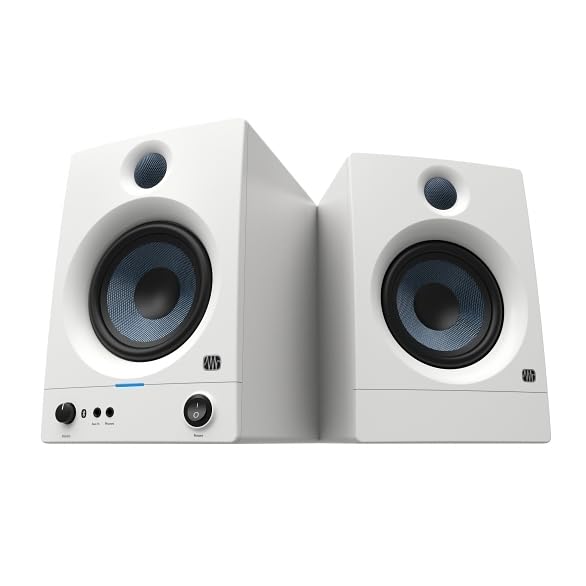
  4. PreSonus Eris 5BT Gen 2

    Pair · 5" woofer · 100 W · Bluetooth · headphone out

    The largest monitors in this group: 5-inch woofers, 1-inch tweeters, 100 W total, with RCA and 6.35 mm (0.25 in) TRS inputs, a headphone output and Bluetooth streaming.

    Best for: A room with a meter or so behind the speakers, doing both music production and listening.

    8.4/10

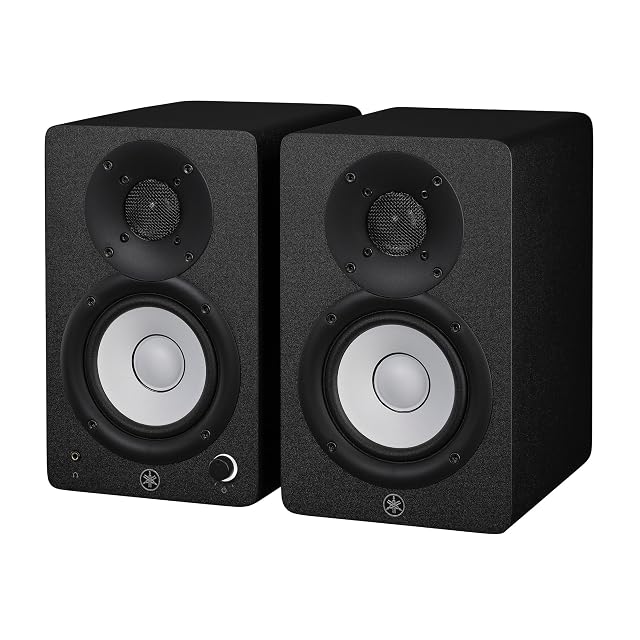
  5. Yamaha HS4

    Pair · 4.5" woofer · 60 Hz – 22 kHz · room control

    Sold as a pair, unlike much of this category: 2-way bass-reflex monitors with a 4.5-inch woofer, a stated 60 Hz – 22 kHz response, 102 dB SPL maximum, and ROOM CONTROL and HIGH TRIM switches on the back.

    Best for: A small room where the speakers have to sit near a wall.

    8.4/10

Need by need, within studio monitors

Hearing the bass in a large room

Driver diameter decides how far down the response goes. A small driver does not reproduce what cannot be corrected afterwards.

PreSonus Eris 5BT Gen 2

Working in a small room

A small speaker excites the resonant modes of a cramped room less. Too much bass in a small volume makes listening unusable.

Mackie CR3-X

Connecting to what you already own

A monitor with balanced inputs only forces you to buy cables and sometimes an interface. The stated inputs decide the real cost of the pair.

PreSonus Eris 5BT Gen 2

Who each family suits, across studio monitors

Home studio
Small speakers well positioned do better than a large model in an untreated room. Placement counts for more than size.
Reference listening
Monitors aim at neutrality and expose flaws. They are not designed to be pleasant.
Untreated room
Reflections from nearby walls dominate the result. A few panels at the reflection points change the sound more than the speaker model does.

What you gain and what you give up, on studio monitors

Bass extension against the room
A speaker that reaches low in a small room excites resonances that mask everything else. Bigger is not better here.
Neutrality against pleasure
An honest monitor puts what is wrong in front of you. Uncomfortable, and exactly its job.
Speakers against headphones
Speakers give a spatial image headphones do not have; headphones are independent of the room. The two complement each other for checking a mix.

Frequent questions on studio monitors

How should monitors be positioned?

In an equilateral triangle with your head, tweeters at ear height, away from the walls. Placement changes the sound more than the model.

Does the room need treating?

It is what brings the biggest gain in a home studio. A few panels at the first reflection points transform the listening.

Do I need decoupling stands?

Putting speakers straight on a desk transmits vibration and muddies the bass. Decoupling foam costs little and is audible.

What size for a small room?

Smaller: a speaker that reaches very low excites resonances that make listening unusable in a reduced volume.

Do I need a subwoofer?

It helps you hear the bottom of the spectrum and complicates setup in an untreated room. Not a first purchase.

Why does my mix change from room to room?

The acoustics of the space overlay the sound of the speakers. That is why you check on several systems.

Do I need powered speakers?

Active models have their amplification built in, matched to the driver. The standard in home studios.

How loud should I listen?

Moderately, to avoid the listening fatigue that skews judgment after an hour. Checking at low volume reveals plenty of balance flaws.

What stays with you, on studio monitors

Placement and the room count for more than the model: equilateral triangle, tweeters at ear height, speakers decoupled from the desk. In a small volume, a speaker that reaches too low excites resonances that mask everything else.

Summed up: studio monitors

  • Frequency response: 60 to 80, on 3 of the 5 models.

The full table of studio monitors

A column is opened only if four devices in five publish the figure. Below that, it would set blanks against blanks.

ModelPriceDriversInputsSold as
M-Audio BX4$1404.5" black Kevlar woofer, silk dome tweeter—One active and one passive speaker with connecting cable
PreSonus Eris 3.5 Gen 2$2603.5" woven composite woofer, 1" silk dome tweeterBalanced TRS, RCA, front-panel auxA stereo pair
Mackie CR3-X—3 in — the smallest on this shelf. The others publish 3.5, 4.5 and 5 in1/4 in, 1/8 in and RCA — the same three types one other pair on this shelf publishes—
PreSonus Eris 5BT Gen 2—5" woofer, 1" tweeterRCA, 6.35 mm (0.25 in) TRS, headphone outputA stereo pair
Yamaha HS4—4.5" woofer, 1" dome tweeterXLR/TRS combo, RCA, stereo miniA stereo pair

Our guides on studio monitors

Sources, and how the order is set

Specifications: manufacturer sheets for musical instruments and gear and the matching Amazon product pages. Prices and availability: Keepa. Every figure in this table names its source.

Most recent revision in this category: October 7, 2026.

The method applied to studio monitors

Prices quoted in these summaries are dated readings. The live price is shown next to each product.