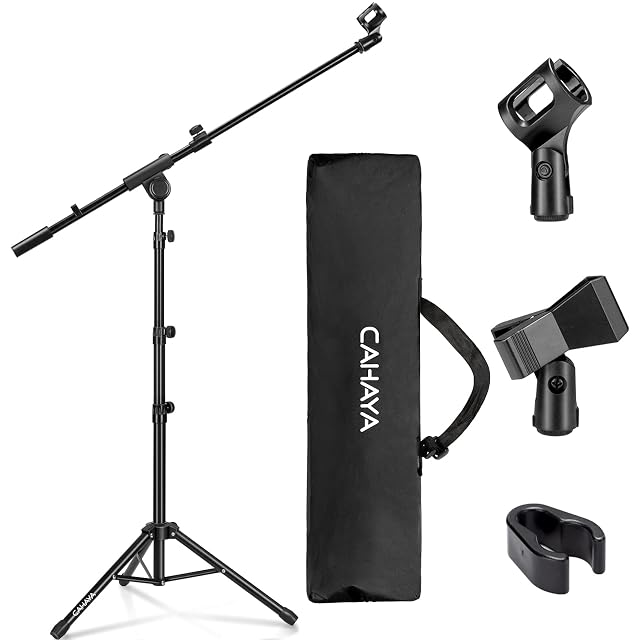
A two-in-one stand: a straight floor stand, or a boom arm when the top section is fitted horizontally. Adjustable between 64 and 158 cm (62.2 in), which covers both a seated desk and a standing vocalist.
CAHAYA 2-in-1 Boom Stand
A two-in-one stand: a straight floor stand, or a boom arm when the top section is fitted horizontally. Adjustable between 64 and 158 cm (62.2 in), which covers both a seated desk and a standing vocalist.
Type
Floor stand, converts to boom
Height range
64 – 158 cm (25.2 to 62.2 in)
Base
Tripod
Amazon reference
B09J2CXPDW (identical on 6 markets)
EAN
5060987649925
A floor stand does not transmit desk knocks into the microphone the way a desk arm does
The 64 cm (25.2 in) minimum is low enough to use seated at a desk
A tripod base takes floor space that a desk clamp does not
Best for: Recording vocals seated or standing, in a room where the floor is free.
A stand is not an exciting purchase and it decides more about a recording than the microphone does, because it decides where the microphone sits and what it picks up from the room.
This one converts between a straight floor stand and a boom, and adjusts between 64 and 158 cm (62.2 in). That bottom figure matters: many floor stands do not go low enough to be used sitting at a desk, which is where most home recording actually happens.
The reason to prefer a floor stand over a desk-mounted arm is mechanical. A desk arm is bolted to the surface you type on, and every keystroke travels up it into the capsule. A tripod on the floor is isolated from that entirely.
Check the thread size against your microphone’s mount before ordering — 3/8 and 5/8 inch are both common, and the adapter costs almost nothing and stops a session dead when it is missing.
The questions players ask
Floor stand or desk arm?
A desk arm saves floor space and transmits every keystroke and knock on the desk straight into the microphone. A floor stand does not. If you type while recording, the floor stand is the answer.
Will my microphone fit the thread?
Microphone mounts use 3/8 inch or 5/8 inch threads, and adapters between the two cost very little. Check which your microphone or shock mount uses before assuming — the missing brass adapter is a classic first-session problem.
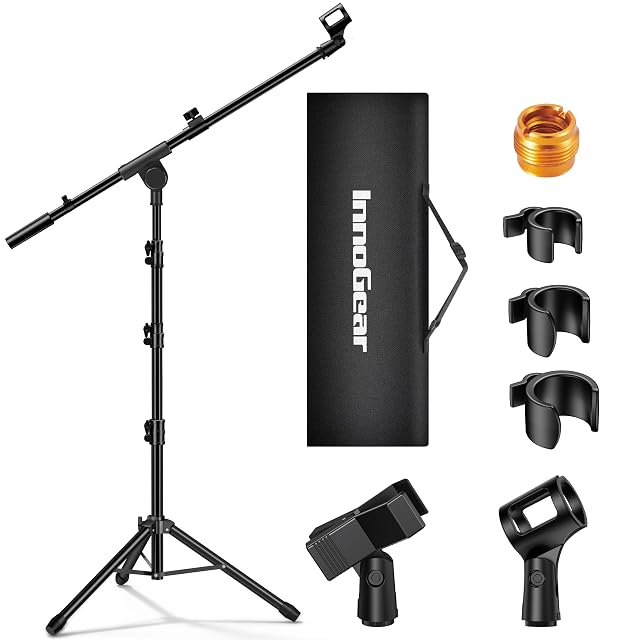
The only stand here whose boom changes length — 16 to 30 inches — on a tripod that reaches 228 cm (89.8 in), rotating 360 degrees on two axes, with two microphone clips and a carrying bag.
Height range
28.1 to 89.8 in — 71 to 228 cm (28 to 89.8 in). The two stands already here reach 158 cm (62.2 in) and about 154 cm (60.6 in)
Boom length
Adjustable from 16 to 30 in — 41 to 76 cm (16.1 to 29.9 in). The only adjustable boom on this shelf; the other two are fixed
Boom movement
Rotates 360° horizontally and vertically, and detaches — the only two-axis rotation published here
Base
Tripod, in thickened steel poles which InnoGear states give more stability than lighter stands
Clips
Two different styles supplied, stated compatible with Shure SM58, SM48 and PG58 among others — the only stand here to name a microphone
Portability
A carrying bag is included, and the stand disassembles into several pieces
Thread size
InnoGear puts nothing in writing on this. No stand on this shelf publishes a thread size, and 3/8 and 5/8 in are both common
Counterweight
InnoGear puts nothing in writing on this. The page for another stand here notes that a long boom needs its counterweight balanced or the stand will tip
Weight
1,896 g (66.9 oz) in the product record. Neither stand already here has a figure
Manufacturer reference
TS186
Amazon reference
B0C61MKJK5
EAN
0810015622698
The only stand on this shelf whose boom length adjusts — 41 to 76 cm (16.1 to 29.9 in), rather than one fixed reach
Reaches 228 cm (89.8 in), where the two stands already here stop at about 155 cm (61 in)
No thread size published, which is the one figure that decides whether a microphone fits a clip
Best for: A room where one stand has to serve a seated desk, a standing vocal and an overhead position.
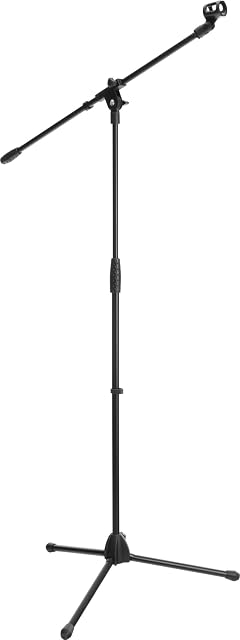
A conventional tripod boom stand with a swivel arm of about 75 cm (29.5 in), height to roughly 154 cm (60.6 in), and — the part that is often missing — a microphone clip and cable clips in the box.
Type
Tripod with boom arm
Height
Adjustable to about 154 cm (60.6 in)
Boom length
About 75 cm (29.5 in)
Included
Microphone clip, cable clips
Manufacturer reference
00034629
Amazon reference
B00LW6TI22 (identical on 5 markets)
EAN
4260368344888
A microphone clip is included, which a surprising number of stands leave out
Cable clips keep the lead off the floor and away from feet
No UK offer at the time of writing
Best for: A first microphone stand where nothing else should have to be bought.
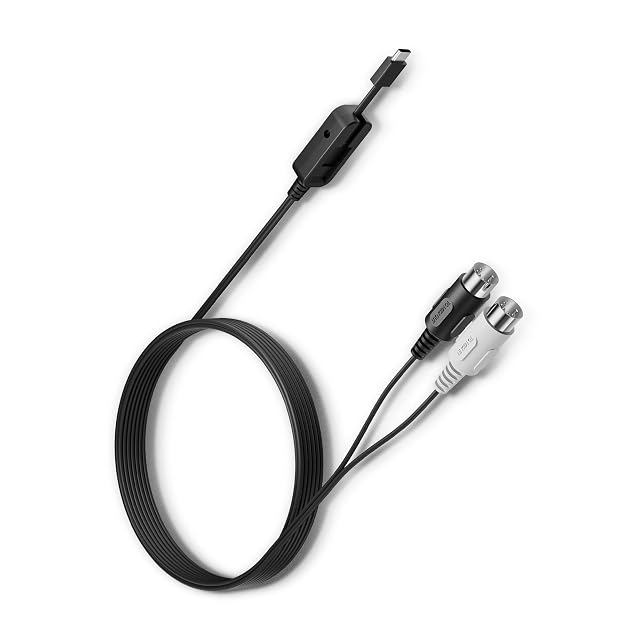
A USB-C MIDI cable with a 32-bit processor inside it. It can filter, remap and route MIDI through free software, and in its second mode it links two instruments directly with no computer in the chain.
Mode 1
USB MIDI interface — computer to MIDI hardware over USB-C (maker’s bullet)
Mode 2
Smart MIDI Cable — links two MIDI devices directly, without a computer, powered from the MIDI Out port. The only cable on this shelf that works with no computer (maker’s bullet)
Processor
32-bit — the only processor published on this shelf (maker’s bullet)
Processing
Routing, filtering and mapping, configured in the free UxMIDI Tools software for macOS, Windows, iOS and Android. The only configuration software on this shelf (maker’s bullet)
Message support
Stated to transmit all MIDI messages including clock, sysex, MTC and MPE — the only listing on this shelf to name a message type (maker’s bullet)
Platforms
macOS, Windows, iOS, Android, Linux and Chrome OS (maker’s bullet)
Plug
Retractable USB-C, with dual-tone MIDI connectors (maker’s bullet)
Channels
CME puts nothing in writing on this. Both other MIDI cables on this shelf publish 16
Length
CME puts nothing in writing on this. One of the three MIDI cables here publishes a length
Manufacturer reference
S-F000C12
Weight
89 g (3.1 oz) in the product record
Amazon reference
B0DQYJJ3L2
EAN
8885011101517
Connects two instruments with no computer in the chain — nothing else on this shelf does that
Filtering, mapping and routing in a cable, configured from a phone as well as a computer
Five times the price of the least expensive item on this shelf, for a cable
Best for: A rig where a controller has to drive a synthesizer without a laptop, or where incoming MIDI has to be filtered before it arrives.
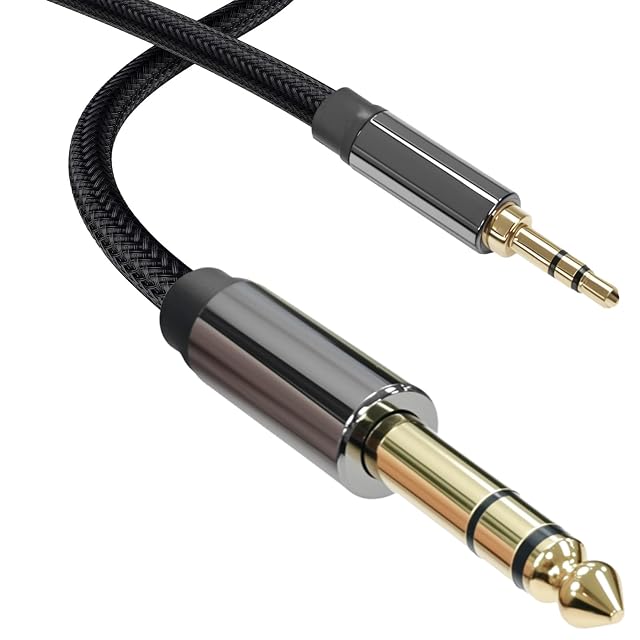
A three-and-a-bit-foot stereo lead in oxygen-free copper under a braided jacket. The shortest cable on this shelf, which on a desk is the point rather than a compromise.
Connection
3.5 mm (0.14 in) TRS to 6.35 mm (0.25 in) TRS, stereo, male to male (from the title)
Length
3.3 ft — the shortest length published on this shelf (from the title)
Conductor
Oxygen-free copper with shielding — the only listing on this shelf to name oxygen-free copper (maker’s bullet)
Signal
Stated to support balanced to unbalanced transmission, with strong anti-interference capability (maker’s bullet)
Jacket
Braided outer cover with gold-plated connectors (maker’s bullet)
Named compatibility
Yamaha, Casio and Roland keyboards, digital pianos, bass amplifiers and home theatre systems (maker’s bullet)
Shielding
Described as shielded. No layer count or coverage is published; one cable on this shelf publishes two layers (maker’s bullet)
Manufacturer reference
190 0027
Weight
30 g (1.1 oz) in the product record
Amazon reference
B0FPQZ3SZQ
EAN
0826341058438
The shortest lead on this shelf, which on a desk means no coil on the floor and less aerial
TRS at both ends and said so, where most listings here describe stereo without naming contacts
3.3 ft will not reach from a desk to an amplifier across a room
Best for: A desk: interface to monitor, or laptop to a 1/4-inch input, with nothing left over.
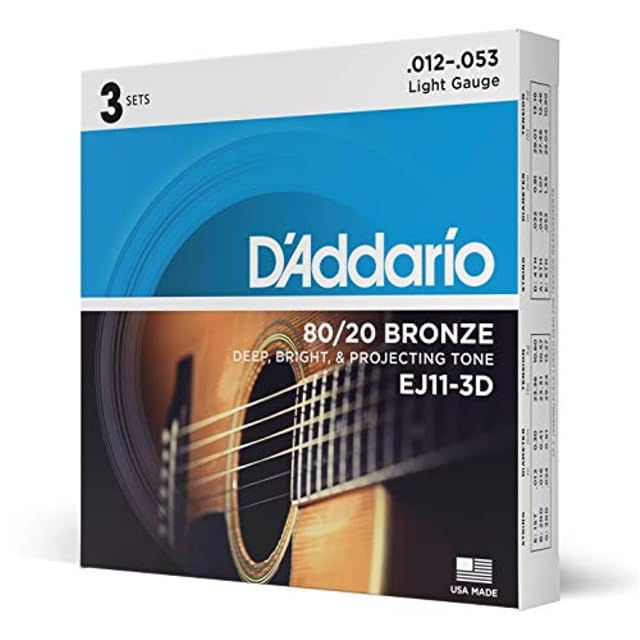
Three sets of light-gauge 80/20 bronze at $6.66 a set — the lowest price per set on this shelf — in the bolder and brighter of the two acoustic alloys, created in the 1930s.
Quantity
Three sets — which works out at $6.66 a set, the lowest price per set on this shelf
Gauge
Light, 12-53 — the same gauge as the two phosphor bronze sets here, so the comparison is purely about alloy
Wrap wire
80/20 bronze, which D’Addario states gives a bold, bright sound with crisp projection — the other acoustic alloy, against phosphor bronze’s warmth
Core
A hexagonal high-carbon steel core, precision wound
Origin
Created in the 1930s by John D’Addario Sr. and the guitar maker John D’Angelico — the earlier of the two dates published on this shelf
Made in
The USA, drawn at D’Addario’s New York facility
Packaging
A recyclable VCI bag with a Players Circle code
Instrument
Acoustic. Not for the electric or classical guitars this shelf also serves
Amazon reference
B0783QYRV5
EAN
0019954255855
The lowest price per set on this shelf — $6.66, against $8.30 and $9.99 for the same gauge
The same 12-53 gauge as the phosphor bronze sets here, so the only variable is the alloy
80/20 bronze is brighter and loses its brightness faster than phosphor bronze
Best for: A played acoustic whose owner has decided they want bright rather than warm, and wants a year of strings.