A large quantity of thin acoustic foam. It absorbs high frequencies and flutter echo effectively and does nothing at all about low frequencies — which is exactly what to expect from foam this thin.
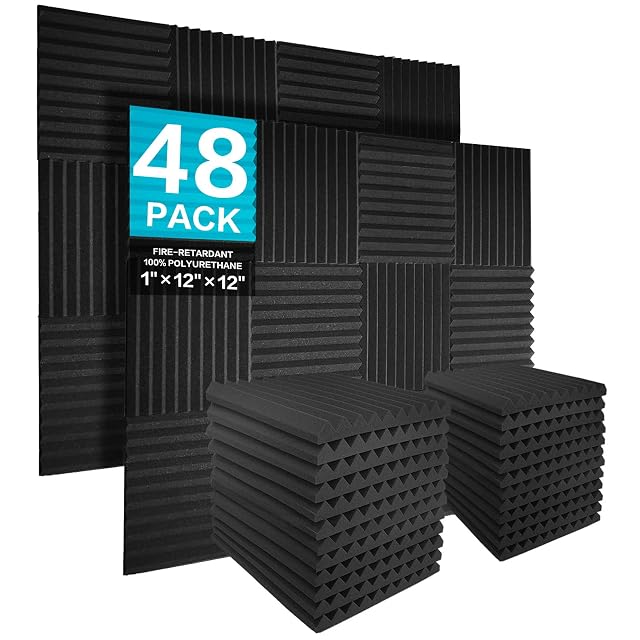
JBER Acoustic Foam (48 pieces)
A large quantity of thin acoustic foam. It absorbs high frequencies and flutter echo effectively and does nothing at all about low frequencies — which is exactly what to expect from foam this thin.
Quantity
48 tiles
Material
Acoustic foam
Absorbs
High frequencies and flutter echo
Amazon reference
B07PB1L2ZK (identical on 6 markets)
EAN
0742939246295
Enough tiles to cover the first reflection points of a small room in one order
Kills the flutter echo between parallel walls, which is what makes a room sound like a bathroom
Thin foam does nothing below a few hundred hertz — bass problems need thickness or traps
Best for: A first treatment pass on a small recording corner.
Acoustic foam has a reputation problem, mostly because it is sold as a solution to problems it cannot touch.
Here is what it does: it absorbs high frequencies. That kills flutter echo — the metallic ring between two parallel bare walls — and takes the harshness out of a small room, which is genuinely audible on a vocal recording.
Here is what it does not do: anything meaningful below a few hundred hertz. Bass energy passes straight through material this thin, and a room with a bass problem still has one after the walls are covered. That requires thickness, corner traps, or both.
Placement matters more than quantity. The wall behind the microphone, the wall behind the speakers, and the side walls at head height are where reflections arrive earliest and do the most damage.
The questions players ask
Will this soundproof my room?
No, and nothing at this price will. Absorption changes how a room sounds inside; soundproofing stops sound leaving, and requires mass and structural work. They are different problems with different products.
Where should the panels go?
The first reflection points: the wall behind the microphone or the speakers, and the side walls level with your head. Covering an entire wall evenly is a common and expensive mistake — a few panels in the right places outperform a full wall in the wrong ones.
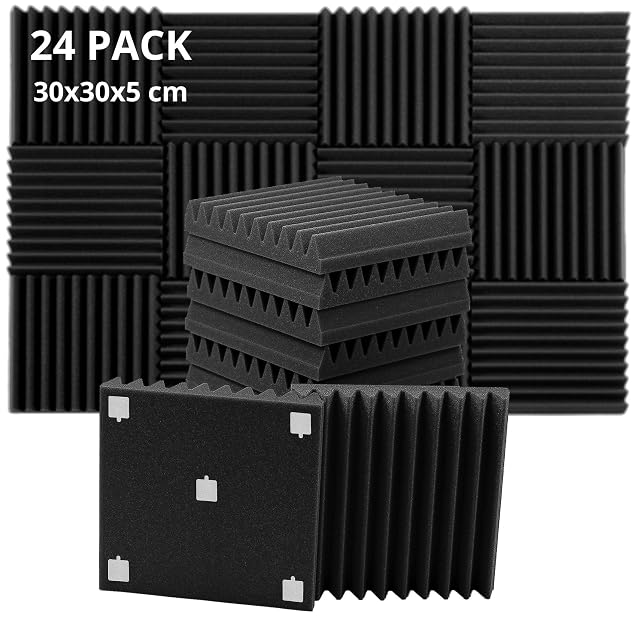
Twenty-four high-density panels, 5 cm (2 in) thick, with adhesive supplied. The thickness is the specification that matters: 5 cm (2 in) reaches noticeably lower than the thin tiles sold in larger quantities.
Quantity
24 panels
Dimensions
30 × 30 × 5 cm (11.8 × 11.8 × 2 in)
Density
High density (ROVSON states)
Included
Adhesive
Amazon reference
B0D2XWQDBG (identical on 6 markets)
EAN
8436614640325
Five centimeters of high-density foam absorbs usefully lower than 2 cm (0.8 in) tiles
Adhesive supplied, so nothing else is needed to mount them
Adhesive mounting takes paint off a rented wall when removed
Best for: A room you own, or one where the panels can be mounted on frames.
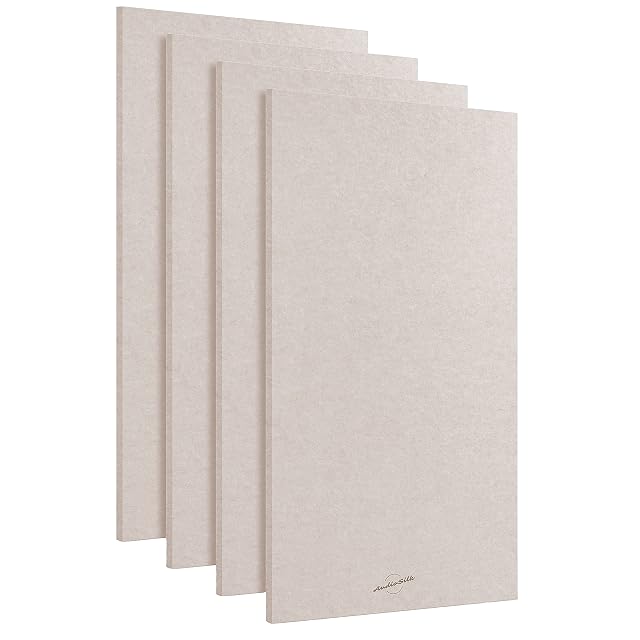
Four large panels rather than a grid of tiles — 46 by 23 inches each — in post-consumer recycled polyester, mounted on removable strips that leave no mark, and the only listing here to compare itself with foam.
Quantity and size
4 panels at 46 × 23 in — 1.17 × 0.58 m (4 × 1.9 ft) each, the only large-format panel on this shelf. Every other panel here is a 12 × 12 in tile
Material
Post-consumer recycled polyester, not foam. AudioSilk states no harsh chemical smell, no shrinkage and no peeling
Versus foam
The second bullet is titled BETTER THAN FOAM and claims much higher performance than equivalent acoustic foam — the only listing on this shelf to compare itself with its neighbors’ material
Mounting
Removable sticky strips, stated to leave no mark on a wall — and sold separately. The maker says so in the same bullet
Absorption
The first bullet reads *High density material with NRC of up to* — and the sentence ends there. No figure is published, and no panel on this shelf publishes one
Thickness
AudioSilk puts nothing in writing on this. Two panels on this shelf publish 0.4 in and 1 in, and one publishes 5 cm (2 in)
Support
Free acoustic treatment advice is offered, including how to measure room performance and where to place panels — the only placement guidance on this shelf
Color
Natural. AudioSilk states a range of colors is available, and two other finishes of this same kit were discarded from this catalog as color variants
Coverage
About 29 square feet in total across the four panels
Fire
AudioSilk puts nothing in writing on this. One panel on this shelf publishes a fire claim
Manufacturer reference
None published
Amazon reference
B0BQRXF5FL
EAN
5065015057055
Four large panels instead of a grid of tiles, so one wall is treated in four decisions rather than eighteen
Recycled polyester rather than foam, with no shrinkage, no peeling and no chemical smell stated
The mounting strips are sold separately, which the listing states and which means the kit does not mount as delivered
Best for: A rented room where the panels have to come down without taking the paint, and one wall has to be dealt with in four pieces.
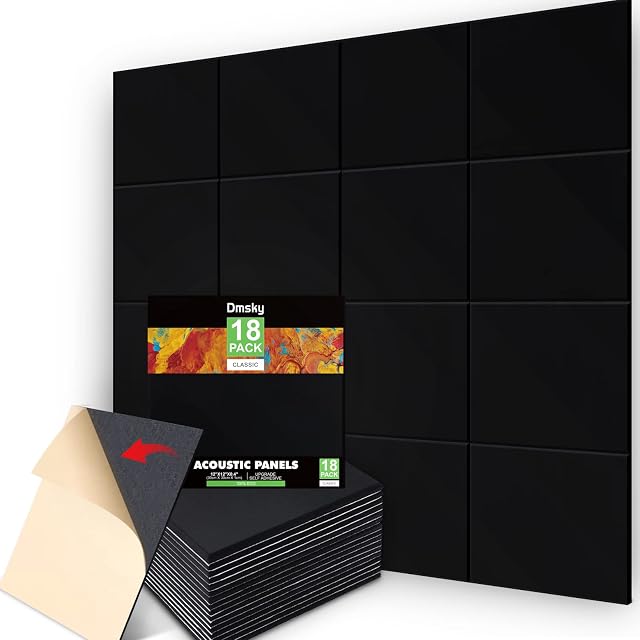
Eighteen polyester-fiber panels rather than foam tiles, with edges chamfered at 45 degrees so they butt together without a gap, and adhesive already on the back.
Quantity and size
18 panels at 12 × 12 × 0.4 in — 1 cm thick, the thinnest on this shelf
Material
High-density polyester fiber, not foam. DMSKY states it has better ductility and wear resistance and does not deform easily
Edges
A 45° chamfer, which DMSKY states leaves no gap between panels — the only edge treatment published on this shelf
Mounting
Adhesive already applied; the backing is peeled off
Absorption
DMSKY states the effect is better than ordinary material and publishes no NRC figure. No panel on this shelf publishes one
Thickness
0.4 in. One panel on this shelf publishes 5 cm (2 in), and its page notes that thickness is what reaches lower frequencies
Fire
DMSKY puts nothing in writing on this. One panel on this shelf publishes a fire claim
Color
Black
Coverage
18 square feet in total
Manufacturer reference
None published
Amazon reference
B08PVTC9G4
EAN
0798797224944
Polyester fiber rather than foam, which DMSKY states resists wear and deformation
The only panel on this shelf with a published edge treatment — a 45° chamfer so panels butt without a gap
At 0.4 in it is the thinnest panel on this shelf, and thin material does nothing to bass
Best for: Killing flutter echo on a small wall where the panels have to meet each other cleanly.
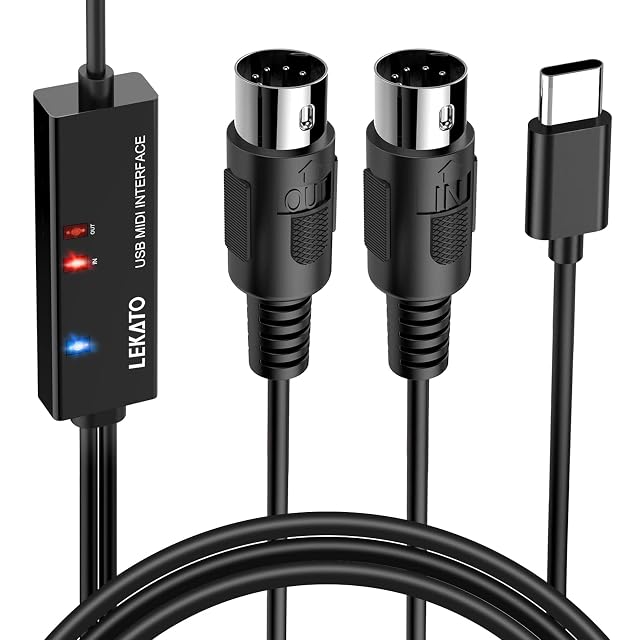
MIDI in and out on one end, USB-C on the other, over six and a half feet — the only MIDI cable here that publishes its length, with lights that say which color means what.
Connection
5-pin MIDI in and out to USB-C, with a built-in driver for direct connection (maker’s bullet)
Length
6.5 ft — the only MIDI cable on this shelf that publishes a length (from the title)
Channels
Up to 16 input and 16 output channels (maker’s bullet)
Indicators
Red for power, blue for signal transfer and connection — the only listing on this shelf that says which color means what (maker’s bullet)
Conductor
Soft bare copper, with stated resistance to electromagnetic interference (maker’s bullet)
Driver
None required — stated plug and play on Windows 7, 8, 10 and macOS (maker’s bullet)
Published caution
In the maker’s own words: some older or vintage synthesizers may require specific driver settings or proprietary interfaces, and may not be recognized. The only MIDI listing on this shelf to publish a limit of its own (maker’s bullet)
Stated devices
Electronic keyboards, digital pianos, synthesizers and drum pads, to Mac, Windows PC or iPad (maker’s bullet)
Manufacturer reference
LUM-03
Weight
100 g (3.5 oz) in the product record
Amazon reference
B09KZ3X59K
EAN
0793811894240
USB-C at the computer end, which is the only socket on a good many current laptops
The only MIDI cable here with a published length, and 6.5 ft reaches a stand across a desk
Twice the price of the USB-A MIDI cable on this shelf for the same 16 channels
Best for: A current laptop with USB-C sockets and a keyboard whose only MIDI connection is 5-pin DIN.
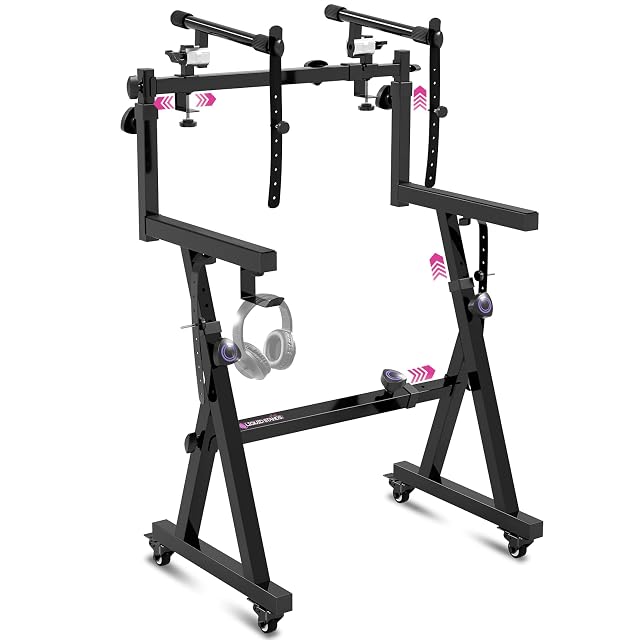
The MS1078 with wheels and a second tier: 250 lb on the base and a separately published 60 lb on the top, with the tier adjusting from 19.5 to 35.5 inches wide and stated to fit 1.25-inch square tubing.
Contents
MS1078 Z-frame, MS1118 second tier and wheels — published as one reference, KIT-MS1078-MS1118
Base rating
250 lb stated (maker’s bullet)
Tier rating
60 lb stated, separately. The only second-tier capacity published on this shelf, and the only listing here that rates two surfaces (maker’s bullet)
Tier adjustment
Width 19.5 to 35.5 in in 2 in increments, height 22.5 to 35.5 in in 1.5 in increments, with adjustable angle (maker’s bullet)
Tube section
Stated to fit any keyboard stand with 1.25 in square tubing, including this maker’s MS1078, MS1080, MS1084 and MS1085. The only tube section published on this shelf, and the figure that decides whether a tier will mount (maker’s bullet)
Wheels
Yes. Three of the twelve stands on this shelf have wheels (from the title)
Retention
Anchoring straps, adjustable feet, anti-skid foam pads and a headphone hook (maker’s bullet)
Stated additions
The tier is stated to take a keyboard, a synth or a laptop, or attachments for a microphone, monitors or a tablet (maker’s bullet)
Manufacturer reference
KIT-MS1078-MS1118
Weight
13,812 g (487.2 oz) in the product record — the heaviest figure on this shelf, for a stand, a tier and a set of wheels together
Amazon reference
B0DBZM6N9X
EAN
0850053407383
Two surfaces with two published ratings, where no other stand here rates more than one
Publishes the 1.25 in tube section, which is the figure that decides what a tier will fit
The tier is rated 60 lb, so a second weighted 88-key piano does not belong on it
Best for: Two keyboards, or a keyboard and a laptop, on one footprint that rolls.
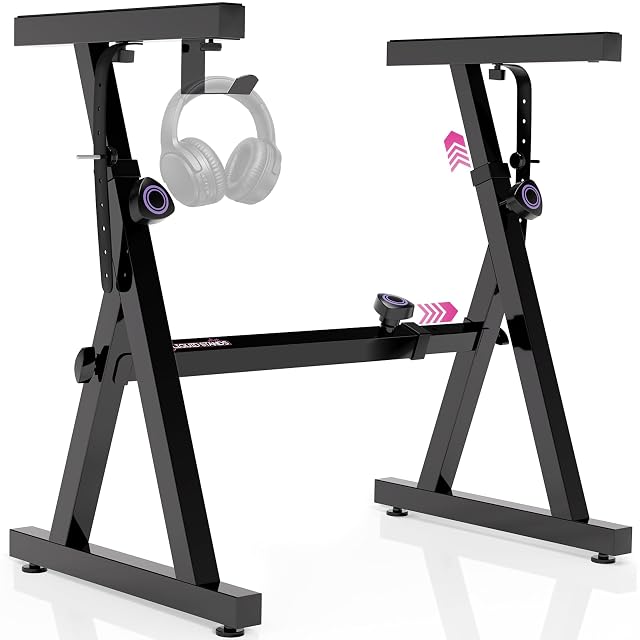
A heavy-duty Z-frame rated at 250 lb that publishes how it adjusts rather than just that it does: height in 1.25-inch steps, width in 2-inch steps, with two anchoring straps and a headphone hook in the box.
Load rating
250 lb stated, for the heaviest instruments. Four of the twelve stands on this shelf publish this figure; one publishes 100 lb; seven publish none (maker’s bullet)
Height
22.5 to 33.5 in, in 1.25 in increments — the finest published step on this shelf (maker’s bullet)
Width
22.5 to 33.5 in, in 2 in increments (maker’s bullet)
Retention
Two anchoring straps that attach the keyboard to the stand, plus four adjustable feet and anti-skid foam pads (maker’s bullet)
Included
A headphone hook. Four of the twelve items on this shelf have one, and all four are from this maker (maker’s bullet)
Stated fit
54 to 88 keys, and stated for DJ mixers, turntables, synths and MIDI keyboards as well (from the title and maker’s bullet)
Frame
Z-style, stated less likely to tip than an X-style stand — which is the argument another page on this shelf makes in its own words (maker’s bullet)
Setup
Stated under a minute to set up or break down, packing flat for transport (maker’s bullet)
Wheels
None. The same maker sells this stand with wheels as MS1080, two dollars dearer — and that listing publishes a 1.5 in height step rather than 1.25 in
Manufacturer reference
MS1078
Weight
7,000 g (246.9 oz) in the product record, which is 7.0 kg (15.4 lb) exactly — a shipping figure. Nothing here is ranked on it
Amazon reference
B07574VQPQ
EAN
0703610714892
A published 250 lb rating, which answers the question the X-frame page on this shelf has to leave open
The finest published height step here at 1.25 in, so the right setting is reachable
Two dollars buys the same stand with wheels from the same maker
Best for: A heavy weighted 88-key piano that needs a stand with a number on it.