Skip to content

DMSKY 18-pack 12 × 12 in

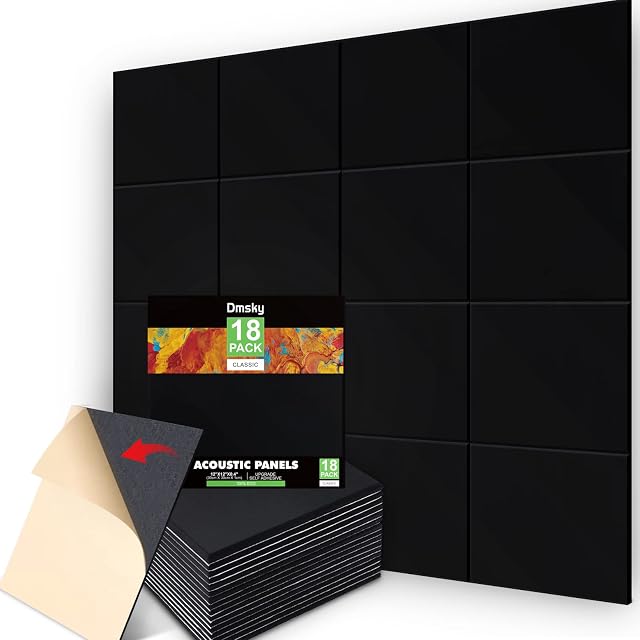
Eighteen polyester-fiber panels rather than foam tiles, with edges chamfered at 45 degrees so they butt together without a gap, and adhesive already on the back.

DMSKY black acoustic panels, 18-pack of 12 by 12 inch tiles

DMSKY 18-pack 12 × 12 in

Eighteen polyester-fiber panels rather than foam tiles, with edges chamfered at 45 degrees so they butt together without a gap, and adhesive already on the back.

Quantity and size
18 panels at 12 × 12 × 0.4 in — 1 cm thick, the thinnest on this shelf
Material
High-density polyester fiber, not foam. DMSKY states it has better ductility and wear resistance and does not deform easily
Edges
A 45° chamfer, which DMSKY states leaves no gap between panels — the only edge treatment published on this shelf
Mounting
Adhesive already applied; the backing is peeled off
Absorption
DMSKY states the effect is better than ordinary material and publishes no NRC figure. No panel on this shelf publishes one
Thickness
0.4 in. One panel on this shelf publishes 5 cm (2 in), and its page notes that thickness is what reaches lower frequencies
Fire
DMSKY puts nothing in writing on this. One panel on this shelf publishes a fire claim
Color
Black
Coverage
18 square feet in total
Manufacturer reference
None published
Amazon reference
B08PVTC9G4
EAN
0798797224944
  • Polyester fiber rather than foam, which DMSKY states resists wear and deformation
  • The only panel on this shelf with a published edge treatment — a 45° chamfer so panels butt without a gap
  • At 0.4 in it is the thinnest panel on this shelf, and thin material does nothing to bass

Best for: Killing flutter echo on a small wall where the panels have to meet each other cleanly.
Check price on Amazon

Specifications

Quantity and size
18 panels at 12 × 12 × 0.4 in — 1 cm thick, the thinnest on this shelf
Material
High-density polyester fiber, not foam. DMSKY states it has better ductility and wear resistance and does not deform easily
Edges
A 45° chamfer, which DMSKY states leaves no gap between panels — the only edge treatment published on this shelf
Mounting
Adhesive already applied; the backing is peeled off
Absorption
DMSKY states the effect is better than ordinary material and publishes no NRC figure. No panel on this shelf publishes one
Thickness
0.4 in. One panel on this shelf publishes 5 cm (2 in), and its page notes that thickness is what reaches lower frequencies
Fire
DMSKY puts nothing in writing on this. One panel on this shelf publishes a fire claim
Color
Black
Coverage
18 square feet in total
Manufacturer reference
None published
Amazon reference
B08PVTC9G4
EAN
0798797224944

Eighteen panels at 12 × 12 × 0.4 inches, in high-density polyester fiber rather than foam, with a 45° chamfer on the edges and adhesive already applied.

The material is the first thing to note. Two of the five panels on this shelf are not foam, and this is one of them: polyester fiber, which DMSKY states resists deformation and wear better than the alternative. Foam yellows, crumbles at the edges and sheds; a fiber panel does not. That is a durability argument rather than an acoustic one, and it is the honest version of it.

The chamfer is the detail nothing else here publishes. Two square tiles butted together leave a line of bare wall between them, and a line of bare wall in the middle of an absorber is a reflecting surface. A 45° edge lets them meet cleanly, which matters when eighteen are going up in a grid rather than four being scattered.

The adhesive is on the back already. One panel on this shelf supplies 300 separate adhesive squares for 50 panels; another is mounted with removable strips sold separately. This is the simplest of the three and the least reversible — the page for another panel on this shelf notes that adhesive mounting takes paint off a rented wall when removed.

What it cannot do is bass. 0.4 inches is a centimeter, the thinnest on this shelf, and the page for the thickest panel here — 5 cm (2 in) — explains why that matters: thin material does nothing below a few hundred hertz. What a centimeter of fiber does well is kill the flutter echo between parallel walls, which is the thing that makes a small room sound like a bathroom.

And no NRC. The noise reduction coefficient is the one number an acoustic panel has, and no panel on this shelf publishes one — one gets as far as writing NRC of up to and the sentence is cut where the figure should be.

Availability

Read on the day this page was built: $30 at the American Amazon shop.

Read from Keepa on the day this page was last revised; stock and price both move without notice.

Prices quoted in this text were read on 2026-10-07. The live price is at the top of the page.

The questions players ask

Does 0.4 inches of anything absorb sound?

At speech frequencies and above, yes; below that, no. The page for another panel on this shelf puts it plainly: thin foam does nothing below a few hundred hertz — bass problems need thickness or traps, and a centimeter of polyester fiber is thin by that standard. What material this thin does well is kill the flutter echo between parallel walls, which is what makes a small room sound like a bathroom. That is a real and worthwhile job, and it is not bass treatment.

Why is a chamfered edge worth mentioning?

Because a gap between two panels is a hard surface in the middle of an absorber. A 45° chamfer lets two tiles meet edge to edge with no line of wall showing, which matters when eighteen of them are going up in a grid. It is the only edge treatment published on this shelf — every other panel here is a square tile with a square edge, and the gaps between them are left to the person with the adhesive.

Instruments it is stated to fit

All acoustic treatment