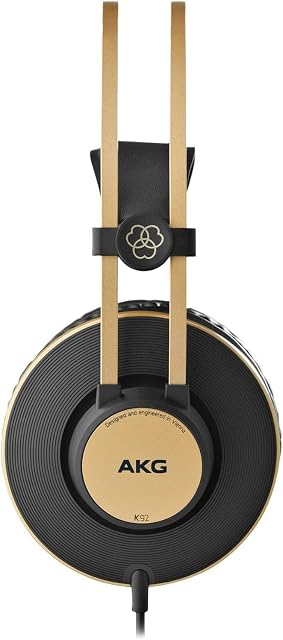
AKG’s closed-back reference: 50 mm (1.97 in) drivers, 32 ohms and a stated 114 dB SPL/V sensitivity, tuned towards the AKG Reference Response curve. Low impedance, so it also works from a laptop.
What it amounts to The most measurable pair here: AKG publishes the numbers that decide whether headphones suit your setup, and they are friendly ones.
The K371 is AKG’s closed-back answer to a specific problem: studio headphones that are actually usable outside a studio, driven by whatever is to hand.
The numbers are published, which is rarer than it should be. Thirty-two ohms and 114 dB SPL/V at 1 kHz mean a laptop headphone socket can drive them to a sensible level; a 250-ohm pair on the same socket sounds thin and quiet, and buyers routinely conclude the headphones are faulty when they are simply under-driven.
AKG describes the tuning as following their Reference Response curve. That is a claim about neutrality rather than about excitement, and it is the right claim for headphones you intend to make decisions on.
The eight-position folding hinges are a genuine convenience and a genuine extra failure point. Closed oval earcups and isolating pads are the rest of the argument: they keep the room out and the click track in.
In its favor, and its limits
Strengths
32 ohms is low enough to be driven properly by a laptop or an interface headphone output
Folds at eight hinge positions, which is unusual on a closed studio pair
AKG publishes both impedance and sensitivity, so the numbers can be compared rather than guessed
Isolating earpads, which is what closed-back headphones are bought for
Compromises
Foldable hinges are one more mechanical part than a fixed headband has
A neutral tuning is less immediately impressive than a bass-forward one
Specifications
Design
Closed back, oval over-ear, foldable with 8-position hinges
Drivers
50 mm (1.97 in), OFC voice coils
Impedance
32 ohms
Sensitivity
114 dB SPL/V at 1 kHz (AKG states)
Frequency response
5 Hz – 40 kHz (AKG states)
Tuning
AKG Reference Response curve
Amazon reference
B07T78PX8X (identical on 6 markets)
EAN
9002761040715
The two closest instruments on price
Same section, nearest price — what the same money else sounds like.
AKG states 32 ohms and 114 dB SPL/V, which is the combination that makes a pair playable from a weak output. High-impedance studio headphones — 250 ohms and above — are the ones that sound quiet and lifeless from a phone.
What is a reference response curve?
A target frequency response the manufacturer tunes towards, intended to be neutral rather than flattering. AKG names theirs on this model; the point is comparability between rooms, not excitement.
Our score
8.4/ 10
The most measurable pair here: AKG publishes the numbers that decide whether headphones suit your setup, and they are friendly ones.
This one’s price among music instruments and gear
A reference exists on these Amazon stores: France, Germany, Italy, Spain, United Kingdom, United States. Listed is not the same as in stock — availability changes daily.
Details checked on August 18, 2026.
Who should pick this one, among music instruments and gear
One pair for recording and for checking a mix, driven from an interface or a laptop.
Our music instruments and gear guides that pick it
Specifications: the manufacturer sheet for musical instruments and gear and the matching Amazon product page. Prices and availability: Keepa. Every figure on this page names its source.
Closed back · 40 mm (1.57 in) PEEK drivers · DAW plug-in included
Berlin-designed closed backs with 40 mm (1.57 in) PEEK drivers, a stated 2 Hz – 23.5 kHz response and 112.5 dB SPL, plus a Headphone Utility plug-in with crossfeed for the DAW.
Best for: Mixing on headphones, where crossfeed makes a stereo image less exhausting.
Closed back · 40 mm (1.57 in) drivers · low impedance
The cheapest way into closed-back monitoring here. AKG states 40 mm (1.57 in) drivers, a low impedance chosen so phones and interfaces can drive it, and replaceable earpads at a price where that is unusual.
Best for: A second pair, a practice pair, or a first pair on a strict budget.
The only American listing here to name what its voice coils are made of — copper-clad aluminum wire over rare-earth magnets — in a collapsible closed-back with a single-side cable exit.
Best for: Tracking and everyday monitoring where isolation matters and the pair will be folded into a bag.