The arranger that survives the first year · review
Casio Casiotone CT-S1-76 review
The 76-key version of the same idea, with a bigger speaker system: 2 × 6.5 W instead of 2 × 2.5 W. Still no accompaniment styles, still 61 sounds, and 80 cm (31.5 in) longer in the room.
What it amounts to The 76-key middle path, with speakers that actually fill a room.
This is the CT-S1 with fifteen more keys and a speaker system with more than twice the power, and those are the only differences that matter.
Seventy-six keys is a deliberate middle ground. It covers the great majority of piano repertoire that runs off the end of a 61-key board, without committing to the length, weight and price of an 88-key weighted instrument. At 5.3 kg (11.7 lb) it is still portable in a way a hammer-action piano never is.
The rest is unchanged: 61 sounds from the AiX engine, no accompaniment styles, USB-to-Host, headphone socket, audio input and a pedal socket with no pedal supplied. The music rest and power adapter are included.
The practical warning is length. At 1.14 m (4 ft) it needs a stand or a desk that can take it, and that is worth measuring before it arrives rather than after.
In its favor, and its limits
Strengths
76 keys covers most piano repertoire that 61 keys cuts short
Speakers more than twice the power of the 61-key model, which is audible in a large room
Still only 5.3 kg (11.7 lb) — lighter than most 88-key instruments by a wide margin
Same short, deliberate sound list as its smaller sibling
Compromises
1.14 m (4 ft) long: measure the desk or the stand before ordering
The UK price stood far above the German one at the time of writing
Specifications
Keys
76, touch-sensitive
Sounds
61 from the AiX sound source
Accompaniment
None — Casio states there is no auto-accompaniment
Speakers
2 × 6.5 W
Connections
USB-to-Host, headphone, audio in, pedal socket
In the box
Music rest and power adapter — pedal not included
Dimensions and weight
1,140 × 258 × 83 mm (44.9 × 10.2 × 3.27 in) · 5.3 kg
Amazon reference
B0D78LP87Y (identical on 6 markets)
EAN
4971850315247
The questions players ask
61, 76 or 88 keys?
Sixty-one covers most pop and beginner material; 76 covers nearly all of it; 88 is the full piano range. The other difference is weight and length — this 76-key model is 1.14 m (4 ft) and 5.3 kg (11.7 lb), where an 88-key weighted piano is heavier still.
Does the bigger speaker matter?
At 2 × 6.5 W it is more than double the 61-key model. In headphones it changes nothing; in a room, it is the difference between a keyboard you hear and one you lean towards.
Our score
8.4/ 10
The 76-key middle path, with speakers that actually fill a room.
Accessories confirmed for this instrument
Shown because the accessory names this instrument itself.
A reference exists on these Amazon stores: France, Germany, Italy, Spain, United Kingdom, United States. Listed is not the same as in stock — availability changes daily.
Details checked on August 18, 2026.
Who should pick this one, among music instruments and gear
A player who has run out of keys on a 61 but does not want an 88-key weighted piano.
Sources
Specifications: the manufacturer sheet for musical instruments and gear and the matching Amazon product page. Prices and availability: Keepa. Every figure on this page names its source.
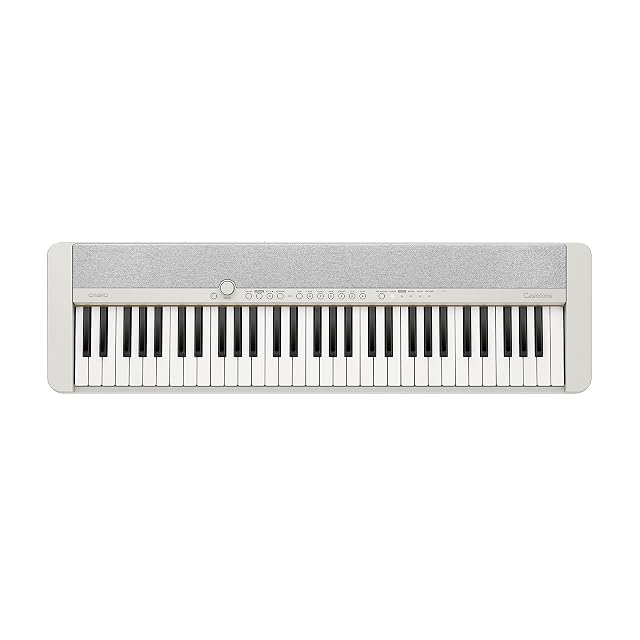
61 touch-sensitive keys · 61 sounds · no auto-accompaniment
A keyboard built like a piano rather than like an arranger: 61 touch-sensitive keys, 61 sounds, and deliberately no accompaniment styles. Music rest and power adapter are included; the pedal is not.
Best for: Someone who wants piano sounds and 61 keys without an arranger’s menus.
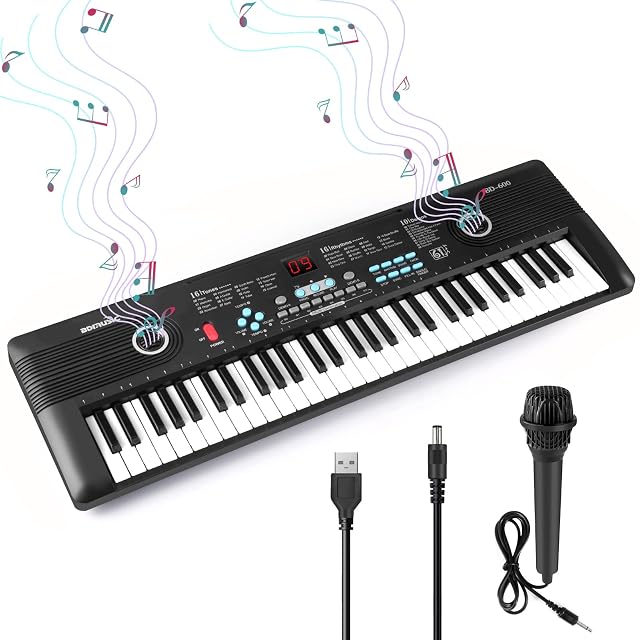
61 keys · microphone output and a built-in microphone · 100 tones · 4 AA batteries
The least expensive keyboard on this shelf by a wide margin, and the only one that records a voice — a microphone output and a built-in microphone — with 100 tones, eight percussion panels and battery operation.
Best for: A child learning at a desk, where a microphone and a set of batteries matter more than a published key size.