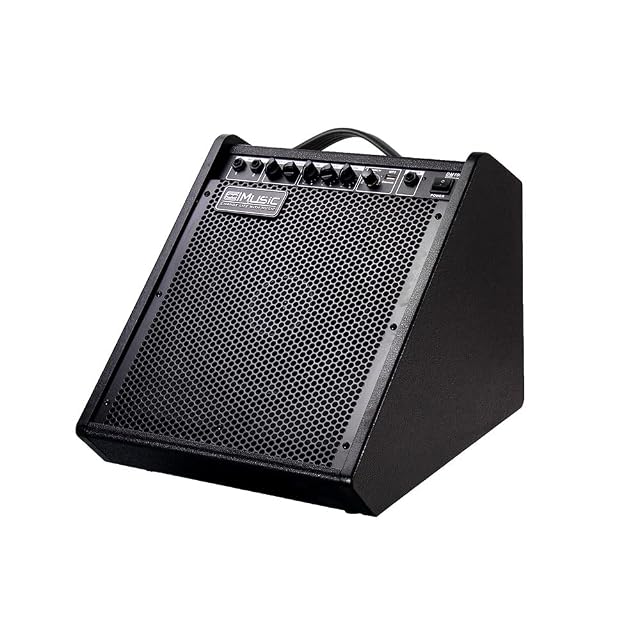
A twenty-watt personal monitor for an electronic kit or a keyboard, with two published driver sizes, separate bass and treble controls, a slanted cabinet aimed at a seated player, and its own dimensions and weight in writing.
What it amounts to The only amplifier here that publishes its drivers, its dimensions and its weight, in a cabinet shaped for someone sitting down. Twenty watts is a bedroom, and it has no headphone socket.
Twenty watts. A 6.5-inch woofer and a 2.5-inch tweeter. Independent LOW and HIGH tone knobs with a master volume. A slanted cabinet facing a seated player, on rubber feet. A 1/4-inch instrument input, Bluetooth and USB playback with buttons on the box. 286 × 246 × 236 mm and 4.2 kg.
Three of those figures are published by nobody else on this shelf.
Both driver sizes. Three amplifiers here publish two drivers; this is the smallest of the three and the only one in a cabinet this size.
Its own dimensions, in millimeters. Seven amplifiers on this shelf and this is the only one that says how big it is — which on a box that has to sit beside an electronic kit in a bedroom is the figure that decides it.
Its own weight, 4.2 kg. The product record holds 4,500 g, and the two agree within 300 g. That is worth noting because across this site the record figure and the maker’s figure rarely match at all.
The slanted cabinet is the detail that explains what this is for. A drummer and a keyboard player both sit, and a box on the floor firing straight ahead sends the sound past their knees. Angling it up is a one-line design decision and it is the only cabinet shape published for a use anywhere on this shelf.
The tone controls are what put it in the amplifier aisle rather than the monitor aisle. A studio monitor is built to add nothing — the monitor pages on this site publish acoustic tuning for the room and never a bass knob. This has LOW and HIGH to taste, which is an instrument amplifier’s job.
What is missing is a headphone output. Three amplifiers on this shelf publish one, and one of their pages calls it what makes practice possible at any hour — which on a drum amplifier in a flat is the whole argument. And a single instrument input, where one amplifier here publishes four line channels, an aux input and an XLR microphone socket.
Twenty watts is a bedroom. The two 100 W amplifiers on this shelf are for a room with other people in it.
Availability
Read on the day this page was built: $85 at the American Amazon shop.
Read from Keepa on the day this page was last revised; stock and price both move without notice.
Prices quoted in this text were read on 2026-10-07. The live price is at the top of the page.
In its favor, and its limits
Strengths
Publishes both driver sizes, its own dimensions and its own weight — no other amplifier here does all three
A slanted cabinet aimed at a seated player, which is what a drummer or keyboard player actually needs
Bluetooth and USB playback with buttons on the box, so a backing track needs no second device
Compromises
No headphone output published, which is the feature three amplifiers on this shelf lead with
Twenty watts is a practice level — the two 100 W amplifiers on this shelf are for a room with other people in it
A single instrument input, where one amplifier here publishes four line channels and a mic input
Specifications
Power
20 W
Drivers
A 6.5 in woofer and a 2.5 in tweeter — one of three amplifiers on this shelf to publish two driver sizes
Tone controls
Independent LOW and HIGH knobs plus a master volume. This is what makes it an amplifier rather than a studio monitor, which is built to add nothing
Cabinet
A slanted enclosure facing the sound at a seated player, with a hard-edge frame and rubber feet — the only cabinet shape published for a use on this shelf
Inputs
A standard 1/4 in instrument input, with Bluetooth and USB playback and onboard track and volume buttons
Dimensions
286 × 246 × 236 mm (11.3 × 9.69 × 9.29 in), published by the maker — the only amplifier on this shelf to publish a size
Weight
4.2 kg (9.3 lb), published by the maker. The product record holds 4,500 g (158.7 oz), which agrees within 300 g
Stated use
Electronic drums and keyboards, in home studios, music classes and small gigs
Headphone output
Coolmusic puts nothing in writing on this. Three amplifiers on this shelf publish one
Manufacturer reference
DM20
Amazon reference
B08L34HBWD
EAN
0788417347306
The questions players ask
Why is this an amplifier and not a studio monitor?
Because of the tone controls. A studio monitor is built to add nothing: no EQ, flat response, so what you hear is what was recorded — the studio monitor pages on this site publish acoustic tuning controls for the room and never a bass and treble knob. This has independent LOW and HIGH knobs to shape the sound to taste, a slanted cabinet for a player rather than a listener, and a 1/4 in instrument input. Those three put it on this shelf.
Is 20 W enough for an electronic kit?
For a bedroom, yes; next to an acoustic drummer, no. Twenty watts through a 6.5-inch woofer reproduces a kick drum at a practice level and runs out of headroom when a band starts. Two amplifiers on this shelf publish 100 W — one with a 10-inch woofer and one with a 12-inch — and the guitar amplifiers published here run from 10 to 25 W. The page for the 25 W guitar amp calls that the point where an amp stops being a practice amp.
This one’s price among music instruments and gear
Details checked on October 7, 2026.
Who should pick this one, among music instruments and gear
A seated player — an electronic kit or a keyboard — who needs to hear themselves in a bedroom and play along to a phone.
What buyers actually choose
Amazon reports what buyers took in the month before this page was last checked: at least 100.
The figure is a floor, rounded by Amazon, and read through Keepa — it says what buyers picked, not what a maker claims.
Sources
Specifications: the manufacturer sheet for musical instruments and gear and the matching Amazon product page. Prices and availability: Keepa. Every figure on this page names its source.
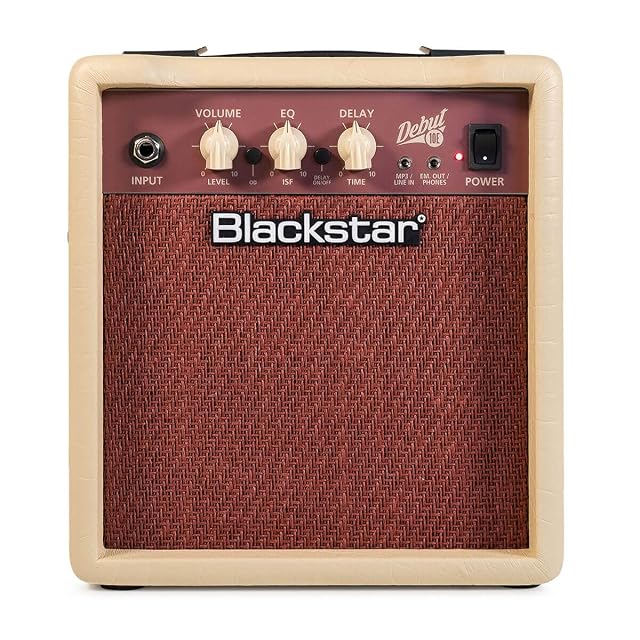
10 W · ISF tone control · tape delay · headphone and line in
The same 10 W class as the Fender, with two things it does not have: Blackstar’s ISF control, which sweeps between British and American voicings, and a built-in tape-style delay.
Best for: A first amp for someone who already knows they want effects.
100 W · 10 in woofer and 3 in tweeter, coaxial · DI out · 3-band EQ · two channels
One hundred watts through a coaxial 10-inch woofer and 3-inch tweeter, with two instrument channels, a three-band EQ and the only DI output on this shelf — which is what takes an electronic kit from a bedroom to a stage.
Best for: An electronic kit that has to be heard in a rehearsal room and sent to a desk at the same time.