One hundred watts through a coaxial 10-inch woofer and 3-inch tweeter, with two instrument channels, a three-band EQ and the only DI output on this shelf — which is what takes an electronic kit from a bedroom to a stage.
What it amounts to One hundred watts, a coaxial pair with both sizes published, two channels and the only DI output on this shelf. It publishes no headphone socket, no dimensions and no weight — all three of which its own smaller stablemate here manages.
One hundred watts. A coaxial driver: a 10-inch woofer with a 3-inch tweeter in its center. Two channels for a kit, a keyboard or another instrument. A three-band EQ. Bluetooth. And a DI output.
The DI is the reason this page is not just a louder version of the smaller Coolmusic on this shelf. A DI sends a clean balanced signal to a mixing console while the amplifier carries on doing its job for the player — which is the difference between an amplifier that fills a rehearsal room and one that can be used on a stage. Without it, an electronic kit in front of an audience has to be miked, which defeats the point of it being electronic. No other amplifier on this shelf publishes a DI.
The coaxial arrangement is the other published decision, and Coolmusic explains it in its own words: the 10-inch woofer carries the kick, the 3-inch tweeter carries the snare crack. Putting the tweeter in the middle of the woofer means both arrive from one point, so the balance does not shift as the player moves. It is the only coaxial design on this shelf.
Two channels matter on a drum amplifier more than they look: a kit and a keyboard, or a kit and a click source, without a mixer in front.
What it does not publish is the practical half, and its own smaller stablemate on this shelf publishes all of it. No headphone output — three amplifiers here have one, and on a drum amplifier silent practice is half the reason it exists. No dimensions.No weight, and the product record holds nothing either, where the smaller Coolmusic publishes 286 × 246 × 236 mm (11.3 × 9.69 × 9.29 in) and 4.2 kg (9.3 lb).
The listing is five short bullets, and the first one is about playing background music for a workout.
Availability
Read on the day this page was built: $171 at the American Amazon shop.
Read from Keepa on the day this page was last revised; stock and price both move without notice.
Prices quoted in this text were read on 2026-10-07. The live price is at the top of the page.
In its favor, and its limits
Strengths
The only DI output on this shelf, which is what lets the amplifier feed a PA as well as the player
A coaxial driver arrangement with both sizes published — 10 in and 3 in
100 W and two channels, so a kit and a keyboard can share one box
Compromises
No headphone output published, on a drum amplifier where silent practice is half the use
No dimensions and no weight, where its own smaller stablemate on this shelf publishes both
Five short bullets, one of which is about using it for a workout
Specifications
Power
100 W — one of two amplifiers on this shelf at this power
Drivers
A coaxial arrangement: a 10 in woofer with a 3 in tweeter, which Coolmusic states handles the bass and the snare crack separately
Channels
Two, for an electronic kit, a keyboard or another instrument
DI out
A DI output to another speaker or a mixing console — the only DI on this shelf
EQ
Three-band
Wireless
Bluetooth, for a backing track from a phone or tablet
Headphone output
Coolmusic puts nothing in writing on this. Three amplifiers on this shelf publish one
Dimensions
Coolmusic puts nothing in writing on this, where its own smaller amplifier on this shelf publishes 286 × 246 × 236 mm (11.3 × 9.69 × 9.29 in)
Weight
Coolmusic puts nothing in writing on this, and the product record holds no figure either
Manufacturer reference
SB-122
Amazon reference
B0BCPXY882
EAN
0768488070013
The questions players ask
What does a DI output do that a line output does not?
It gives the sound engineer a clean, balanced signal to put through the PA, while the amplifier keeps doing its job for the player. Without one, an electronic kit on a stage is either miked — which defeats the point — or unplugged from the front of house entirely. This is the only DI output on this shelf, and it is the line that separates a rehearsal amplifier from one that can play a room.
Why coaxial?
The tweeter sits in the center of the woofer rather than beside it, so both arrive from one point and the sound does not change as a player moves their head. Coolmusic states the reason plainly: the 10-inch woofer carries the kick and the 3-inch tweeter carries the snare crack. It is the only coaxial arrangement published on this shelf, and on a drum amplifier the two jobs really are that separate.
This one’s price among music instruments and gear
Details checked on October 7, 2026.
Who should pick this one, among music instruments and gear
An electronic kit that has to be heard in a rehearsal room and sent to a desk at the same time.
Sources
Specifications: the manufacturer sheet for musical instruments and gear and the matching Amazon product page. Prices and availability: Keepa. Every figure on this page names its source.
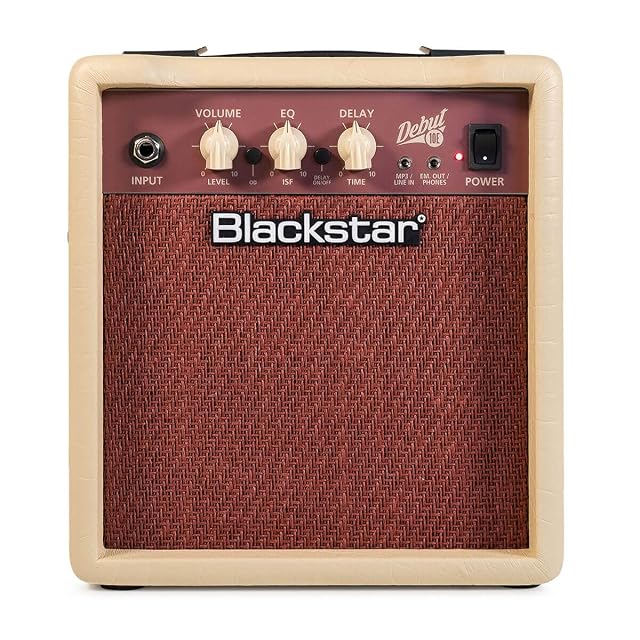
10 W · ISF tone control · tape delay · headphone and line in
The same 10 W class as the Fender, with two things it does not have: Blackstar’s ISF control, which sweeps between British and American voicings, and a built-in tape-style delay.
Best for: A first amp for someone who already knows they want effects.
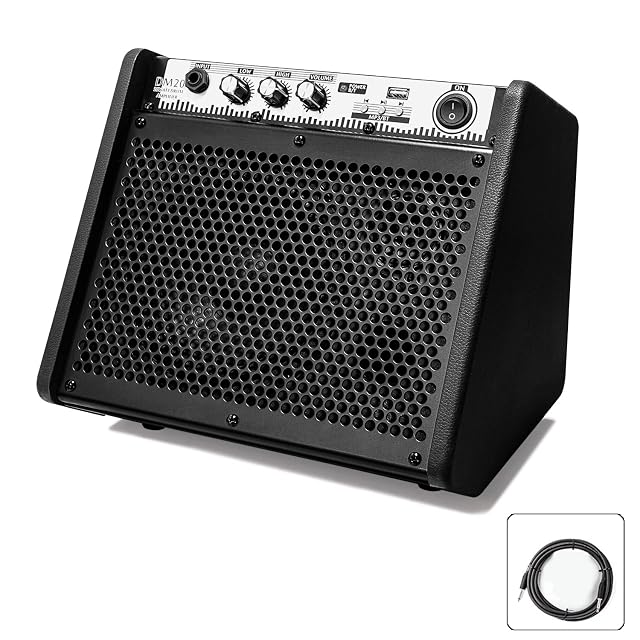
20 W · 6.5 in woofer and 2.5 in tweeter · LOW and HIGH tone controls · 286 × 246 × 236 mm (11.3 × 9.69 × 9.29 in)
A twenty-watt personal monitor for an electronic kit or a keyboard, with two published driver sizes, separate bass and treble controls, a slanted cabinet aimed at a seated player, and its own dimensions and weight in writing.
Best for: A seated player — an electronic kit or a keyboard — who needs to hear themselves in a bedroom and play along to a phone.