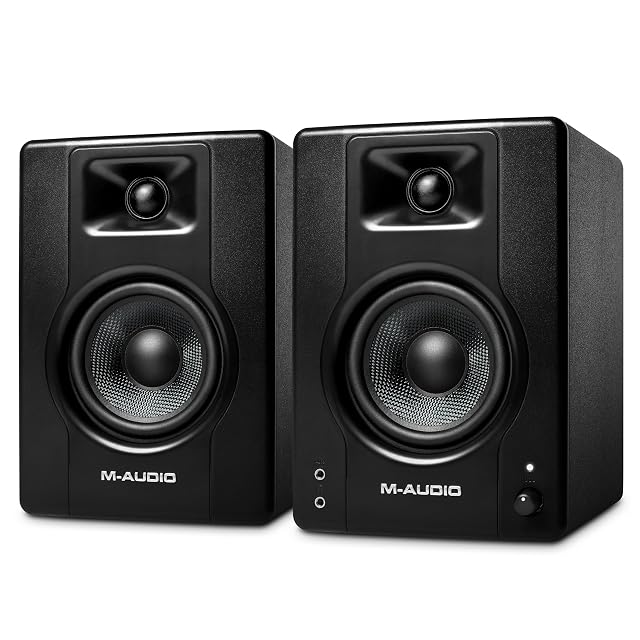
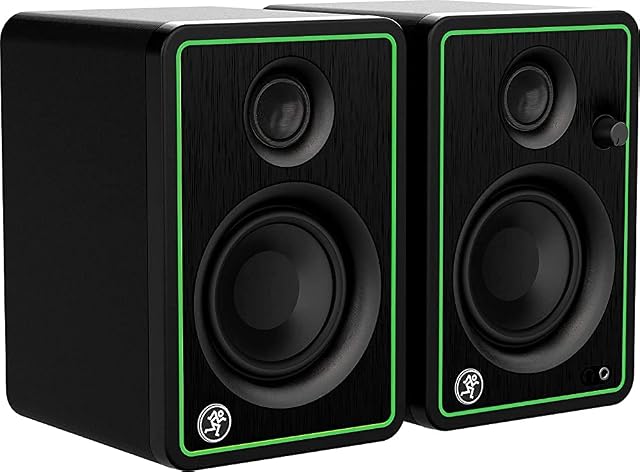
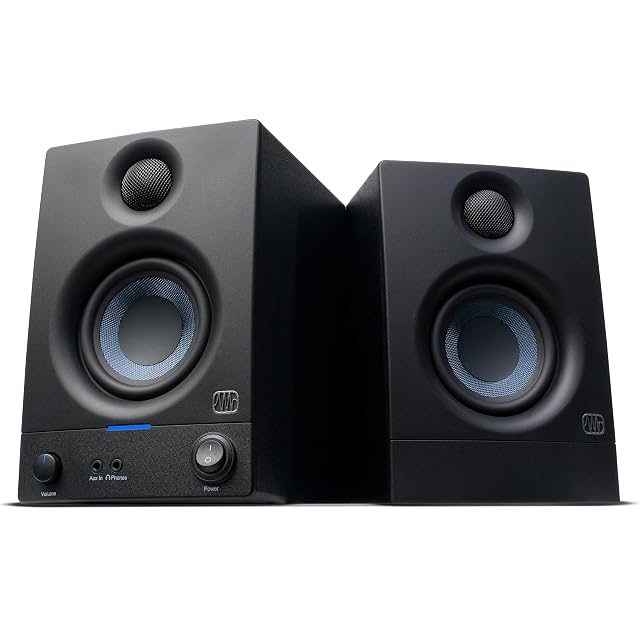
The largest monitors in this group: 5-inch woofers, 1-inch tweeters, 100 W total, with RCA and 6.35 mm (0.25 in) TRS inputs, a headphone output and Bluetooth streaming.
What it amounts to The most capable pair here, and the one most dependent on having a decent room to put it in.
The Eris 5BT is where this family stops being desktop speakers. Five-inch woofers, 1-inch tweeters and 100 W total is genuine monitoring power, and it will reveal things the 3.5-inch pair cannot.
That capability comes with a condition, and it is the room. A 5-inch driver puts real energy into the low frequencies, and in a small untreated bedroom those frequencies build up against the walls and mislead you. With a little space behind the speakers, or a few acoustic panels, the same pair is far more accurate than anything smaller.
The connections are complete: 6.35 mm (0.25 in) TRS and RCA for wired sources, a headphone output on the speakers, and Bluetooth for streaming. The last is a listening feature rather than a working one, and having it means the pair does not need a second set of speakers for the evening.
At the time of writing there were no US or UK offers for this reference.
In its favor, and its limits
Strengths
A 5-inch woofer reaches lower than everything else here, which is the whole point of the size
One hundred watts total: headroom rather than volume
Bluetooth for listening, wired inputs for working — both, without compromise
Headphone output on the speakers themselves
Compromises
A 5-inch woofer in an untreated small room produces low end the room cannot control
No US or UK offer at the time of writing
Specifications
Sold as
A stereo pair
Power
100 W total
Drivers
5" woofer, 1" tweeter
Inputs
RCA, 6.35 mm (0.25 in) TRS, headphone output
Wireless
Bluetooth streaming
Amazon reference
B0GQVFBGGP (identical on 4 markets)
EAN
0673454014536
The questions players ask
Bigger woofer, better monitor?
Not automatically. A 5-inch driver produces more low end, and in a small untreated room that extra energy is exactly what the walls will exaggerate. Bigger is better with space and treatment, and worse without.
Does Bluetooth compromise the sound?
It is a convenience path for listening, not the one to mix through — a wired connection is what the TRS and RCA inputs are for. Having both means the speakers serve as a hi-fi when work is over.
Our score
8.4/ 10
The most capable pair here, and the one most dependent on having a decent room to put it in.
Accessories confirmed for this instrument
Shown because the accessory names this instrument itself.
A reference exists on these Amazon stores: France, Germany, Italy, Spain. Listed is not the same as in stock — availability changes daily.
Details checked on August 18, 2026.
Who should pick this one, among music instruments and gear
A room with a meter or so behind the speakers, doing both music production and listening.
Sources
Specifications: the manufacturer sheet for musical instruments and gear and the matching Amazon product page. Prices and availability: Keepa. Every figure on this page names its source.
Pair · 4.5" Kevlar woofer · rear 6.3/3.5/RCA · front aux
A bi-amplified desktop pair with 4.5-inch black Kevlar woofers and silk dome tweeters, in MDF cabinets, with three rear input types, front-panel aux and rear high/low EQ.
Best for: A first pair of desktop monitors where nothing else should have to be bought.
3 in drivers · 50 W · headphone jack that mutes the speakers · 1/4 in, 1/8 in and RCA
The only pair here whose front headphone socket switches the speakers off by itself — on 3-inch drivers, 50 watts, three input types and cables in the box.
Best for: A desk where the headphones and the speakers share one source and get swapped a dozen times a day.
The desktop pair: 3.5-inch woven composite woofers, 1-inch silk dome tweeters, 50 W total, 80 Hz – 20 kHz, with acoustic tuning controls and a headphone socket on the front panel.
Best for: A desk where space is the binding constraint and headphones are the main tool anyway.