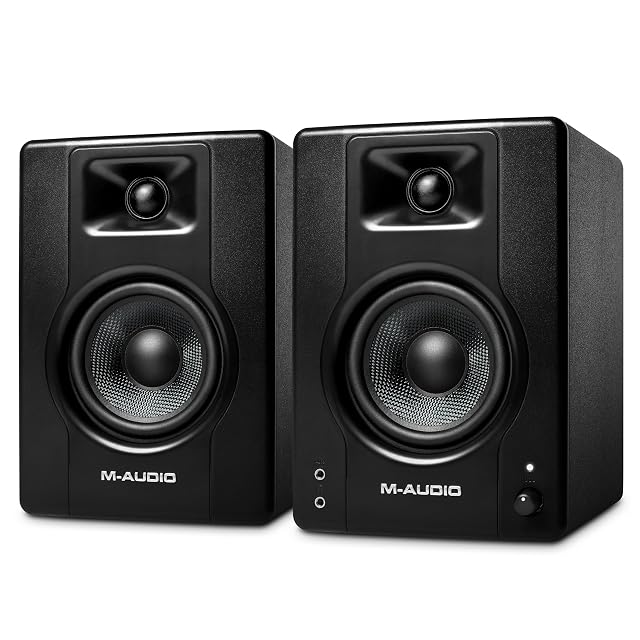
The only pair here whose front headphone socket switches the speakers off by itself — on 3-inch drivers, 50 watts, three input types and cables in the box.
What it amounts to One real idea, and it is a good one: a front headphone socket that turns the speakers off by itself, which nothing else on this shelf publishes. Everything measurable is absent — no response, no room controls, no cabinet, no feet — and the drivers are the smallest here.
Three-inch drivers.Fifty watts. A front-facing headphone jack that auto-defeats the speaker output. 1/4-inch, 1/8-inch and RCA inputs. Hookup cables included.
The headphone socket is the reason this page exists. On most desktop monitors the socket is simply another output: plugging in does not silence the cabinets, so either the volume comes down first or the socket is round the back where a hand cannot reach it at eleven at night. Mackie’s auto-defeats — headphones in, speakers off, from the front.
Four pairs on this shelf publish a headphone socket. One puts it on the front panel; two more publish one without saying where. None of the other three says it mutes the speakers. It is a one-line design decision and it is used a dozen times a day.
The three input types are the second practical thing, and they are matched exactly by one other pair here: a quarter-inch jack for an interface, a 3.5 mm (0.14 in) for a laptop, RCA for anything older. All three as delivered means no adapter is part of the purchase.
Cables included, though Mackie does not say which — one pair on this shelf itemizes three cables and a set of foam feet to decouple the speakers from the desk.
What is absent is everything a monitor is normally compared on.
No frequency response. Three pairs on this shelf publish one, and the page for a 3.5-inch pair treats its own 80 Hz figure as a limit worth stating plainly: bass decisions need checking elsewhere. This publishes professional studio-quality sound, which is not a figure.
No room controls. Two pairs here publish acoustic tuning for a room that will never be treated, which in a bedroom is the control that matters most.
No cabinet material — one pair publishes MDF with a bass reflex port — and no isolation feet.
And the drivers are 3 inches, the smallest on this shelf against 3.5, 4.5 and 5. A cone that size moves very little air below 100 Hz, so what these are good for is balance, level and arrangement rather than low end. The page for the 5-inch pair here says the opposite thing about itself: a 5-inch woofer in an untreated room produces low end the room cannot control. Both are honest limits, and only one of them is published on its own listing.
Availability
Catalogued and unsold: the American Amazon shop lists the reference with nobody behind it.
Read from Keepa on the day this page was last revised; stock and price both move without notice.
In its favor, and its limits
Strengths
The only headphone socket on this shelf published as switching the speakers off — no reaching behind a cabinet at night
Three input types as delivered: an interface, a laptop and a mixer all connect without an adapter
Cables included, and 50 watts from a pair small enough to sit either side of a laptop
Compromises
No frequency response published, where three pairs on this shelf publish one
3-inch drivers, the smallest here — bass decisions cannot be made on them
No room controls, no cabinet material and no isolation feet published
Specifications
Drivers
3 in — the smallest on this shelf. The others publish 3.5, 4.5 and 5 in
Power
50 watts, which Mackie describes as clean, articulate stereo. One pair on this shelf publishes 50 W total and another 100 W; neither this listing nor that one says whether the figure is per speaker or for the pair
Headphone socket
Front-facing, and it auto-defeats the speaker output — the only headphone socket on this shelf published as muting the speakers
Inputs
1/4 in, 1/8 in and RCA — the same three types one other pair on this shelf publishes
In the box
Hookup cables included. Mackie does not say which, where one pair on this shelf itemizes three cables and a set of foam feet
Frequency response
Mackie puts nothing in writing on this. Three pairs on this shelf publish one, and the page for one of them calls its 80 Hz starting point a limit worth knowing
Room controls
Mackie puts nothing in writing on this. Two pairs on this shelf publish acoustic tuning controls
Cabinet
Mackie puts nothing in writing on this. One pair here publishes MDF with a bass reflex port
Isolation
Mackie puts nothing in writing on this. One pair here supplies foam feet to decouple the speakers from a desk
Manufacturer reference
CR3-X
Amazon reference
B08J835J47
EAN
0649661176794
The questions players ask
Why is an auto-defeating headphone socket worth a bullet?
Because the alternative is reaching behind a speaker. On most desktop monitors the headphone socket is an extra output — plugging in does not silence the cabinets, so the volume knob has to come down first, or the socket is on the back where it cannot be reached. This one switches the speakers off by itself, from the front. Four pairs on this shelf publish a headphone socket and none of the other three says it mutes the speakers, which is the whole point of having one.
Can mixing be done on 3-inch drivers?
Up to a point, and that point is the bass. A 3-inch cone moves very little air below about 100 Hz, so a kick drum and a bass line are being judged on their harmonics rather than on their fundamentals. The page for a 3.5-inch pair on this shelf makes the same admission in its own words — 80 Hz is a high starting point and bass decisions need checking elsewhere — and this listing publishes no frequency response at all, so the limit cannot even be read. What small monitors are genuinely good for is balance, level and arrangement.
Accessories confirmed for this instrument
Shown because the accessory names this instrument itself.
Who should pick this one, among music instruments and gear
A desk where the headphones and the speakers share one source and get swapped a dozen times a day.
Sources
Specifications: the manufacturer sheet for musical instruments and gear and the matching Amazon product page. Prices and availability: Keepa. Every figure on this page names its source.
Pair · 4.5" Kevlar woofer · rear 6.3/3.5/RCA · front aux
A bi-amplified desktop pair with 4.5-inch black Kevlar woofers and silk dome tweeters, in MDF cabinets, with three rear input types, front-panel aux and rear high/low EQ.
Best for: A first pair of desktop monitors where nothing else should have to be bought.
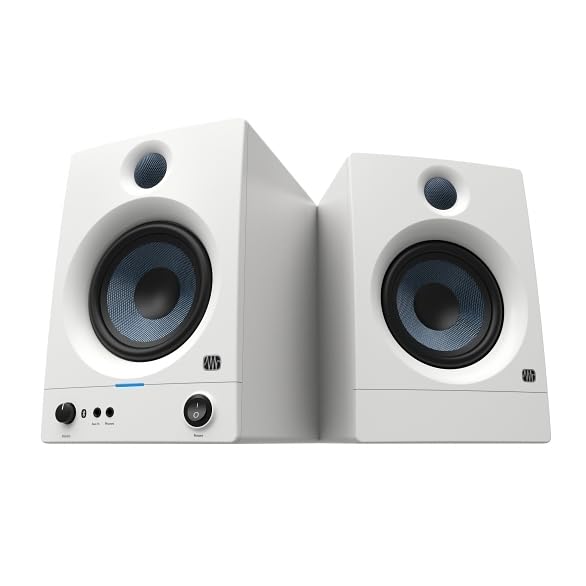
Pair · 5" woofer · 100 W · Bluetooth · headphone out
The largest monitors in this group: 5-inch woofers, 1-inch tweeters, 100 W total, with RCA and 6.35 mm (0.25 in) TRS inputs, a headphone output and Bluetooth streaming.
Best for: A room with a meter or so behind the speakers, doing both music production and listening.
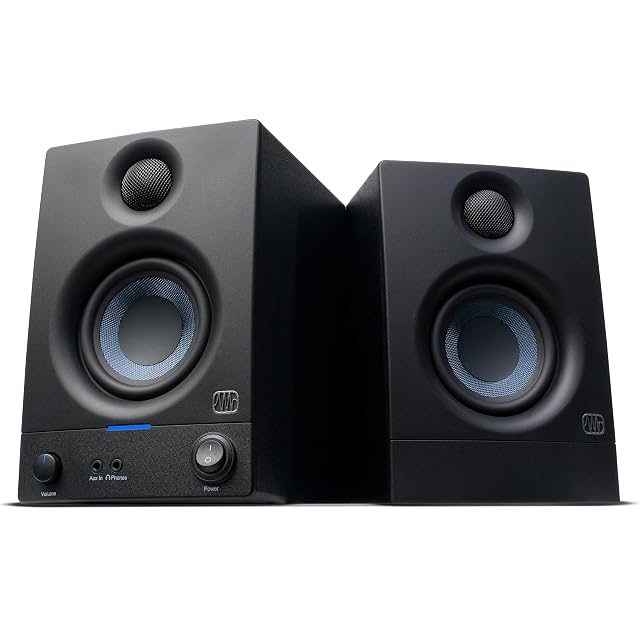
The desktop pair: 3.5-inch woven composite woofers, 1-inch silk dome tweeters, 50 W total, 80 Hz – 20 kHz, with acoustic tuning controls and a headphone socket on the front panel.
Best for: A desk where space is the binding constraint and headphones are the main tool anyway.