Skip to content

Akai Professional MPK Mini IV review

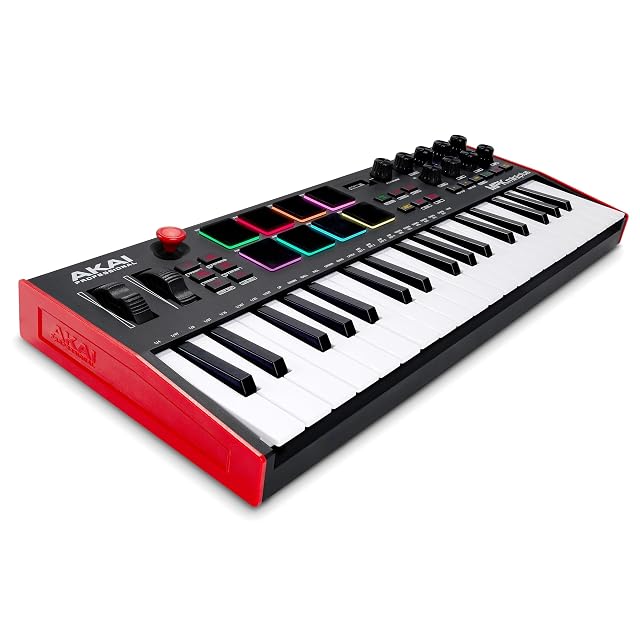
The fourth generation of the MPK Mini, and the only controller here whose pads sense pressure as well as velocity — with a full-color screen, a push/turn encoder, USB-C and a full-size MIDI output.

What it amounts to The generation that adds the two things the MPK Mini was missing: pads that sense pressure and a screen to see what is mapped. It is still 25 mini keys, and the lessons are a trial rather than a library.

25 mini velocity-sensitive keys. Eight MPC pads, velocity- and pressure-sensitive, with RGB feedback. A full-color screen and a push/turn encoder. Eight assignable 360° knobs. USB-C over USB 3.0, and a full-size MIDI Out. An arpeggiator with Pattern, Freeze and Mutate, plus Chord and Scale modes. A software suite with 1,000-plus sounds from AIR and Akai Pro, pre-mapped to Ableton Live Lite 12, Logic Pro and FL Studio. NKS integration and a 30-day Melodics trial.

Two things here exist nowhere else on this shelf.

Pads that read pressure. Velocity says how hard the pad was hit; pressure says how hard it is held afterwards, and that can be mapped to a filter, a vibrato, a pitch. It turns a trigger into something closer to a key. The MPK Mini MK3, published on this shelf, states velocity only — so this is a real generational change rather than a color.

A color screen with an encoder. Every other controller on this shelf is configured by key combinations, by a utility on a computer, or not at all. A screen means the knob assignments can be read rather than remembered, and the push/turn encoder means they can be changed without opening a laptop.

The full-size MIDI Out is the third addition, and it matters for the same reason it does on the 61-key keyboard further down this shelf: it lets the controller talk to hardware rather than only to software. Two of the eleven controllers here publish a MIDI socket.

The arpeggiator gets named functions rather than a label — Pattern, Freeze, Mutate — and Chord and Scale modes keep a part in key. The cheapest controller on this shelf publishes an arpeggiator too, and its page notes that is unusual at $59; this one publishes what the arpeggiator can do.

What has not changed is the keys: 25, mini. Both earlier pages on this shelf make the point and it still holds — mini keys teach a spacing a piano does not have.

And the lessons are a trial. Thirty days of Melodics, where one controller on this shelf publishes 100 lessons kept for good and another publishes that there is no subscription at all.

The product record gives 1,000 g (35.3 oz) — a round figure, and therefore a shipping one.

Availability

Read on the day this page was built: $99 at the American Amazon shop.

Read from Keepa on the day this page was last revised; stock and price both move without notice.

Prices quoted in this text were read on 2026-10-07. The live price is at the top of the page.
In its favor, and its limits

Strengths

  • The only pads on this shelf that sense pressure as well as velocity
  • The only color screen here, with a push/turn encoder rather than a key combination
  • A full-size MIDI Out, which only one other controller on this shelf has

Compromises

  • 25 mini keys, the same spacing caveat the earlier generations carry
  • The Melodics lessons are a 30-day trial, where one controller here keeps 100 lessons for good
  • No faders and no sequencer, both of which other controllers on this shelf publish

Specifications

Keys25 mini, velocity-sensitive
Pads8 MPC pads, velocity- and pressure-sensitive, with RGB feedback — the only pressure-sensitive pads on this shelf
ScreenA full-color screen with a push/turn encoder for settings, presets and DAW access — the only screen on this shelf
Controls8 assignable 360° knobs
ConnectionUSB-C over a USB 3.0 port, plus a full-size MIDI Out — one of two controllers here with a MIDI socket
Performance toolsArpeggiator with Pattern, Freeze and Mutate functions, plus Chord and Scale modes
SoftwareA VST/AU and standalone suite with 1,000+ drums, keys, synths, bass and effects from AIR and Akai Pro, with Ableton Live Lite 12, Logic Pro and FL Studio pre-mapped
IntegrationNative Kontrol Standard (NKS), shared with the MK3 published on this shelf
LessonsA 30-day Melodics trial for keyboard and pad lessons
Versus the MK3The MPK Mini MK3 is published separately on this shelf. This generation adds the color screen, the pressure-sensitive pads, USB-C and the full-size MIDI Out, and replaces the thumbstick
Manufacturer referenceMPKMINI4B
Amazon referenceB0FT3N7TK1
EAN0694318026809

The questions players ask

What does pressure sensitivity on a pad actually do?

It gives a second dimension after the hit. Velocity reads how hard the pad was struck; pressure reads how hard it is held afterwards, which can be mapped to a filter, a vibrato or a sample’s pitch. On a finger-drumming controller that turns a pad from a trigger into something closer to an expressive key. It is the only pressure-sensitive pad set on this shelf, including on the MK3 generation published here, which states velocity only.

Is it worth replacing an MK3?

The published differences are four: a full-color screen with a push/turn encoder, pressure-sensitive pads, USB-C rather than USB-B, and a full-size MIDI Out. The thumbstick is gone. The MK3’s page on this shelf criticizes that thumbstick for not being a pitch wheel, and this generation does not publish what replaced it. Everything else — eight pads, eight endless knobs, NKS, the software bundle — is on both.

This one’s price among music instruments and gear

Details checked on October 7, 2026.

Who should pick this one, among music instruments and gear

Finger-drumming and beat work on a desk, where the pads matter more than the keys.

What buyers actually choose

Amazon reports what buyers took in the month before this page was last checked: at least 1,000.

The figure is a floor, rounded by Amazon, and read through Keepa — it says what buyers picked, not what a maker claims.

Sources

Specifications: the manufacturer sheet for musical instruments and gear and the matching Amazon product page. Prices and availability: Keepa. Every figure on this page names its source.

The method applied to these music instruments and gear