The smallest way to get keys next to a laptop: 25 responsive mini keys, octave buttons, a sustain button, a built-in arpeggiator with clock, and eight programmable preset slots.
What it amounts to The pocket controller: keys, an arpeggiator and presets, and nothing else in the way.
The LPK25 answers one question: how do you get playable keys next to a laptop on a desk that has no room for them?
Twenty-five velocity-responsive mini keys, octave up and down buttons to reach the rest of the range, a sustain button, and — unusually at this price — a built-in arpeggiator with its own clock. Eight programmable preset slots hold mappings for different programs, edited from a computer.
It is bus powered and class compliant, so one USB cable does everything and nothing is installed. Akai lists compatibility with every major program, which for a plain MIDI controller is more or less automatic.
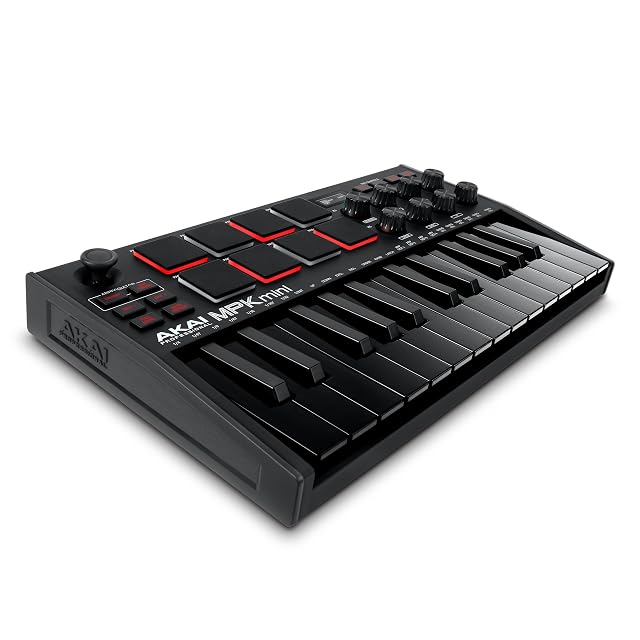
What it does not have is pads and knobs. If beat programming is the plan, the MPK Mini MK3 further down this family adds eight pads and eight knobs for roughly twice the price. If the plan is chords and melodies into software, this is the smaller and cheaper answer.
In its favor, and its limits
Strengths
Fits in a laptop bag, which is the entire argument for a 25-key controller
An arpeggiator on a controller at this price is unusual
Eight preset slots, so mappings for different programs are recalled rather than rebuilt
One USB cable and nothing to install
Compromises
Mini keys teach a spacing that a full-size keyboard does not have
No pads and no knobs — this is keys and nothing else
Specifications
Keys
25 mini, velocity responsive
Range
Dedicated octave up/down buttons, sustain button
Arpeggiator
Built in, with clock
Presets
8 programmable slots, editable from a computer
Power
USB bus powered, plug and play on Mac and PC
Compatibility
GarageBand, Logic, Studio One, Cubase, Ableton Live, Pro Tools, FL Studio and others
Amazon reference
B0BF9PCGM8 (identical on 6 markets)
EAN
0694318025574
The questions players ask
Will it make a sound on its own?
No. A MIDI controller sends notes to software; the sound comes from the computer. If you want an instrument that makes sound with nothing attached, you are looking for a keyboard, not a controller.
Are mini keys a problem?
For entering parts and chords, no. For practicing piano technique, yes — the spacing is smaller than standard, and the habits do not transfer cleanly to a full-size keyboard.
Our score
7.2/ 10
The pocket controller: keys, an arpeggiator and presets, and nothing else in the way.
Accessories confirmed for this instrument
Shown because the accessory names this instrument itself.
A reference exists on these Amazon stores: France, Germany, Italy, Spain, United Kingdom, United States. Listed is not the same as in stock — availability changes daily.
Details checked on August 18, 2026.
Who should pick this one, among music instruments and gear
Writing parts on a laptop, on a desk with no room for anything larger.
Our music instruments and gear guides that pick it
Amazon reports what buyers took in the month before this page was last checked: at least 200.
The figure is a floor, rounded by Amazon, and read through Keepa — it says what buyers picked, not what a maker claims.
Sources
Specifications: the manufacturer sheet for musical instruments and gear and the matching Amazon product page. Prices and availability: Keepa. Every figure on this page names its source.
25 mini keys · pressure-sensitive MPC pads · full-color screen · USB-C · MIDI Out
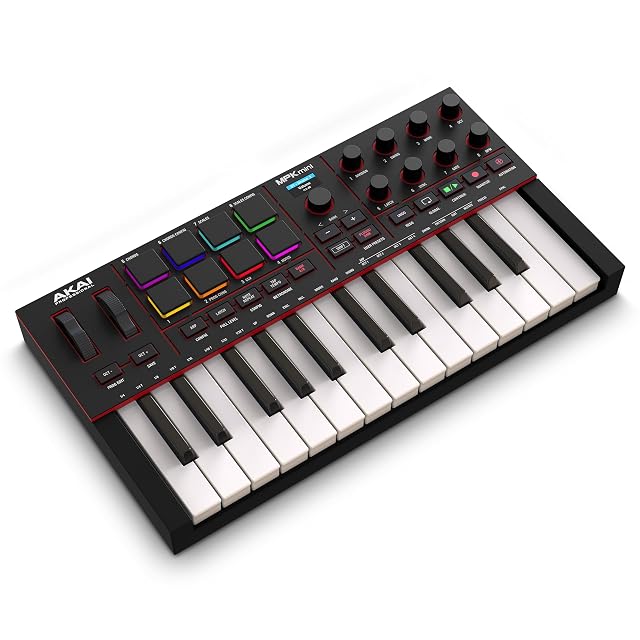
The fourth generation of the MPK Mini, and the only controller here whose pads sense pressure as well as velocity — with a full-color screen, a push/turn encoder, USB-C and a full-size MIDI output.
Best for: Finger-drumming and beat work on a desk, where the pads matter more than the keys.
The default small controller: 25 velocity-sensitive mini keys, eight backlit MPC pads, eight 360-degree knobs, a four-way thumbstick, an arpeggiator and NKS integration.
Best for: Beat making and production on a laptop, where pads matter as much as keys.
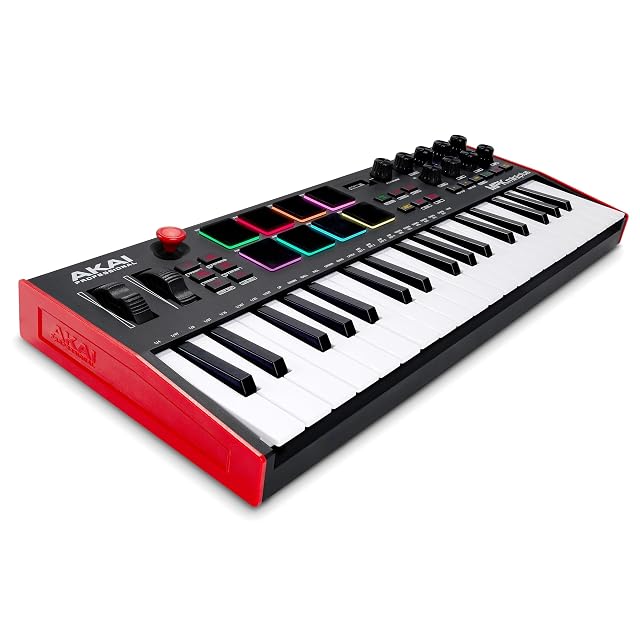
The only controller on this shelf with CV/Gate and the only one with a sequencer: 37 keys, MIDI in and out, a 64-step sequencer with separate drum and melody tracks, and eight RGB MPC pads.
Best for: A desk with hardware on it: a synth, a module or a modular rack that needs a keyboard and a sequencer.