The only controller on this shelf with CV/Gate and the only one with a sequencer: 37 keys, MIDI in and out, a 64-step sequencer with separate drum and melody tracks, and eight RGB MPC pads.
What it amounts to The controller on this shelf for a desk with hardware on it: CV/Gate, MIDI both ways, a 64-step sequencer and three octaves of keys. It has no screen and no faders, and both exist elsewhere on this shelf.
Thirty-seven keys — three full octaves. CV/Gate and MIDI in and out. A built-in 64-step sequencer with one drum track and one melodic track. Eight premium RGB MPC pads with Chord and Scale modes. Eight endless knobs and a transport section. NKS with a choice of one of three Komplete 15 Select bundles, MPC Beats, and two months of Splice.
Two of those exist nowhere else on this shelf, and both point the same way: this is a controller for a desk with hardware on it.
CV/Gate. A control voltage sets the pitch and a gate signal says when the note starts and stops — the way analog synthesisers worked before MIDI, and the way modular racks still do. A keyboard with CV/Gate plays a modular directly, with no converter in between. No other controller on this shelf has it, and for a desk running only software it is worth nothing.
A 64-step sequencer. It works with the computer off: a part is built on the keyboard, stored, and played back into a synth or a module. One drum track and one melodic track is a loop rather than an arrangement, and that is the honest size of it. No other controller here publishes a sequencer at all.
The 37 keys sit in a gap this shelf otherwise leaves open. Below are three 25-key minis, whose pages all note that mini keys teach a spacing a piano does not have; above are 49-, 61- and 88-key boards that occupy a desk. Three octaves is two hands on a keyboard that still fits beside a laptop.
The MIDI in and out matter alongside the CV: a keyboard that receives MIDI can be clocked by something else, which is what makes a sequencer in a rack of hardware useful rather than isolated.
What it does without is a screen — the 25-key generation above it on this shelf publishes a full-color one — and faders, which one controller here publishes nine of. No pitch or modulation wheel is published either.
And the extras are time-limited: two months of Splice, and one of three Komplete bundles rather than all three.
The product record gives 1,300 g (45.9 oz).
Availability
Read on the day this page was built: $139 at the American Amazon shop.
Read from Keepa on the day this page was last revised; stock and price both move without notice.
Prices quoted in this text were read on 2026-10-07. The live price is at the top of the page.
In its favor, and its limits
Strengths
The only controller on this shelf with CV/Gate, which is what connects a MIDI keyboard to modular hardware
The only built-in sequencer here — 64 steps, with drums and melody on separate tracks, and no computer needed
37 keys and MIDI in and out, so it drives hardware as well as software
Compromises
No screen, where the 25-key generation above it on this shelf publishes a full-color one
No faders, and no pitch or modulation wheel published
The Splice access is two months, and the Komplete bundle is one of three rather than all three
Specifications
Keys
37, giving three full octaves — between the 25-key minis and the 49-key boards on this shelf
Hardware connections
CV/Gate and MIDI in and out, for modular gear, sound modules and synthesisers — the only CV/Gate on this shelf
Sequencer
A built-in 64-step sequencer with one drum track and one melodic track, usable with no computer attached — the only sequencer on this shelf
Pads
8 premium RGB MPC pads, with Chord and Scale modes
Controls
8 assignable endless rotary knobs, and a transport section to arm, start, stop, rewind and fast-forward a DAW
Integration
Native Kontrol Standard (NKS), with a choice of one of three curated Komplete 15 Select bundles
Software
MPC Beats, with thousands of drum samples and plugin instrument presets, plus two months of Splice
Screen
Akai puts nothing in writing on this. One controller on this shelf publishes a full-color screen
Faders
Akai puts nothing in writing on this. One controller here publishes nine
Manufacturer reference
MPKMINIPLUS
Amazon reference
B0BFBDT2D2
EAN
0694318025802
The questions players ask
What is CV/Gate for?
Analog hardware that predates MIDI, and modular synthesisers that still use it. CV is a control voltage that sets the pitch; Gate is the signal that says a note has started and stopped. A keyboard with CV/Gate can play a modular rack directly, with no MIDI-to-CV converter in between — and no other controller on this shelf has it. For a desk with only software on it, it is worth nothing at all.
A 64-step sequencer — why does that change anything?
Because it works with the computer switched off. A part can be built, stored and played back from the keyboard into a synthesiser or a module, which is a different way of working from recording into a DAW. One drum track and one melodic track is enough for a loop and not enough for an arrangement, and that is the honest scope of it. No other controller on this shelf publishes a sequencer.
Accessories confirmed for this instrument
Shown because the accessory names this instrument itself.
Who should pick this one, among music instruments and gear
A desk with hardware on it: a synth, a module or a modular rack that needs a keyboard and a sequencer.
What buyers actually choose
Amazon reports what buyers took in the month before this page was last checked: at least 600.
The figure is a floor, rounded by Amazon, and read through Keepa — it says what buyers picked, not what a maker claims.
Sources
Specifications: the manufacturer sheet for musical instruments and gear and the matching Amazon product page. Prices and availability: Keepa. Every figure on this page names its source.
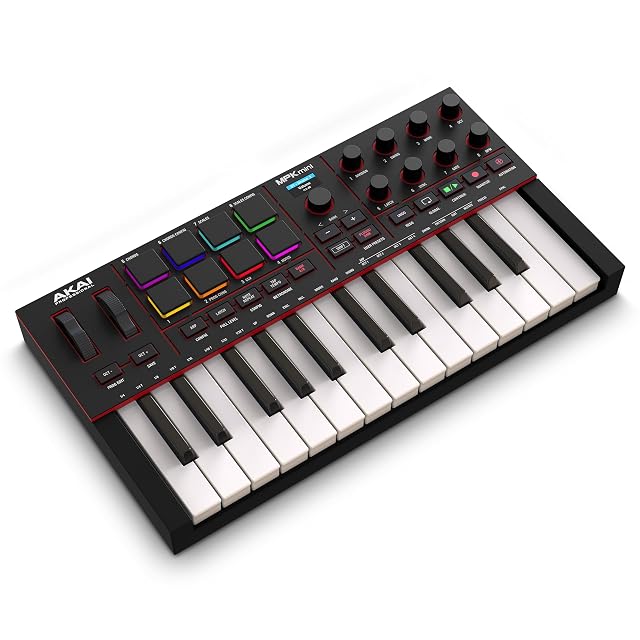
25 mini keys · pressure-sensitive MPC pads · full-color screen · USB-C · MIDI Out
The fourth generation of the MPK Mini, and the only controller here whose pads sense pressure as well as velocity — with a full-color screen, a push/turn encoder, USB-C and a full-size MIDI output.
Best for: Finger-drumming and beat work on a desk, where the pads matter more than the keys.
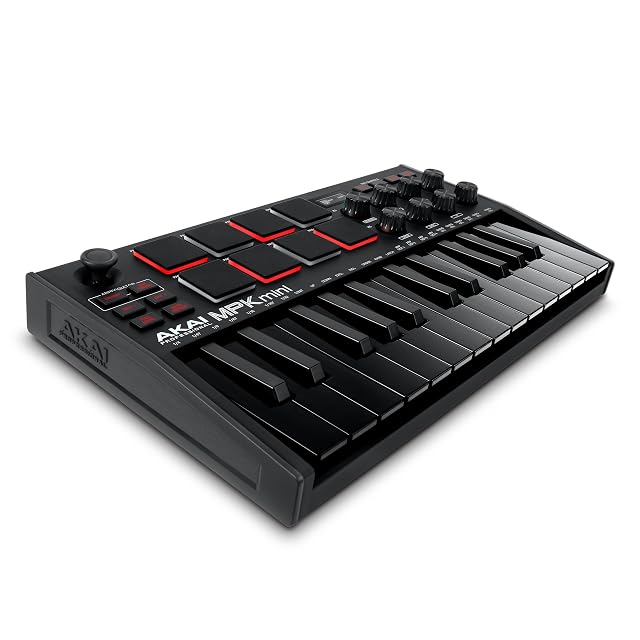
The default small controller: 25 velocity-sensitive mini keys, eight backlit MPC pads, eight 360-degree knobs, a four-way thumbstick, an arpeggiator and NKS integration.
Best for: Beat making and production on a laptop, where pads matter as much as keys.
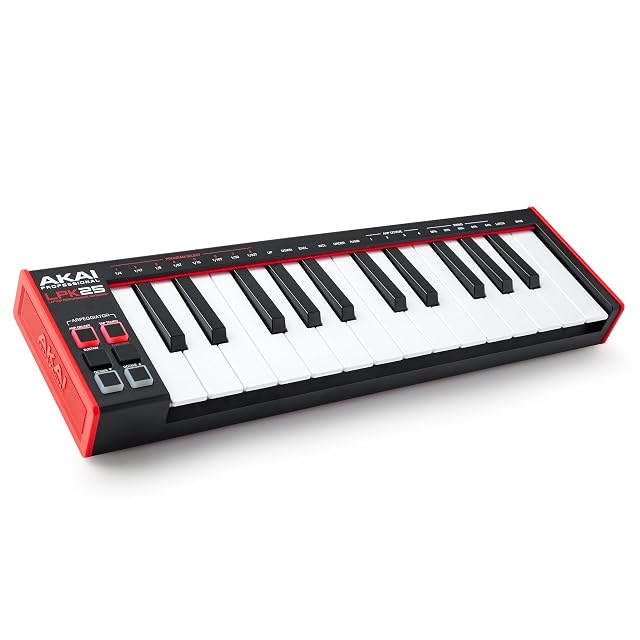
25 mini keys · arpeggiator · 8 preset slots · USB powered
The smallest way to get keys next to a laptop: 25 responsive mini keys, octave buttons, a sustain button, a built-in arpeggiator with clock, and eight programmable preset slots.
Best for: Writing parts on a laptop, on a desk with no room for anything larger.