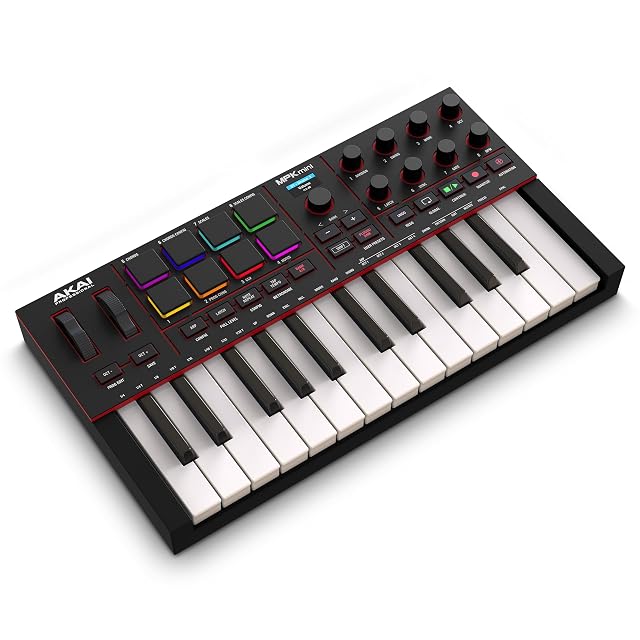
The default small controller: 25 velocity-sensitive mini keys, eight backlit MPC pads, eight 360-degree knobs, a four-way thumbstick, an arpeggiator and NKS integration.
What it amounts to The one to buy if beats are involved: pads, encoders and a software bundle that does most of the work.
The MPK Mini has been the default small controller for years, and the MK3 keeps the reason: eight backlit MPC pads with Note Repeat and Full Level, which is the interface drum programming actually wants.
Around them sit 25 velocity-sensitive mini keys, eight endless 360-degree encoders, a four-way thumbstick handling pitch and modulation, and an arpeggiator with control over resolution, range and mode.
The encoders deserve a note. Because they are endless rather than fixed, loading a new preset does not leave the physical knob position lying about the value, and the first turn adjusts rather than jumps — the single most irritating behavior of cheap controllers.
The bundle is a large part of the value: MPC Beats, three virtual instruments, 2 GB of content and over 1,500 sounds, a Komplete 15 Select bundle from Native Instruments, and two months of Splice. For someone starting out, that is more software than most people buy in a year.
In its favor, and its limits
Strengths
Eight MPC pads are the reason this controller has dominated its category for a decade
Endless encoders, so a knob does not jump when a plug-in loads
NKS integration browses Native Instruments libraries from the hardware
The bundled software and sound content are worth a substantial fraction of the price
Compromises
A thumbstick is not a pitch wheel, and players coming from keyboards notice
Twenty-five mini keys: the same spacing caveat as the LPK25
Specifications
Keys
25 velocity-sensitive mini keys
Pads
8 backlit MPC pads with Note Repeat and Full Level
Knobs
8 endless 360-degree encoders
Control
4-way thumbstick for pitch and modulation, arpeggiator with resolution, range and modes
A Komplete 15 Select bundle and two months of Splice
Amazon reference
B0886KWVYR (identical on 6 markets)
EAN
0694318024935
The questions players ask
Why endless knobs rather than normal ones?
A conventional knob has a fixed position that no longer matches the software when a different preset loads, so the first movement jumps the value. Endless encoders send relative changes instead, and nothing jumps.
What is NKS?
Akai and Native Instruments’ shared standard, which lets the controller browse and control NI presets and libraries directly from the hardware rather than through the screen.
Our score
7.8/ 10
The one to buy if beats are involved: pads, encoders and a software bundle that does most of the work.
Accessories confirmed for this instrument
Shown because the accessory names this instrument itself.
A reference exists on these Amazon stores: France, Germany, Italy, Spain, United Kingdom, United States. Listed is not the same as in stock — availability changes daily.
Details checked on August 18, 2026.
Who should pick this one, among music instruments and gear
Beat making and production on a laptop, where pads matter as much as keys.
Our music instruments and gear guides that pick it
Specifications: the manufacturer sheet for musical instruments and gear and the matching Amazon product page. Prices and availability: Keepa. Every figure on this page names its source.
25 mini keys · pressure-sensitive MPC pads · full-color screen · USB-C · MIDI Out
The fourth generation of the MPK Mini, and the only controller here whose pads sense pressure as well as velocity — with a full-color screen, a push/turn encoder, USB-C and a full-size MIDI output.
Best for: Finger-drumming and beat work on a desk, where the pads matter more than the keys.
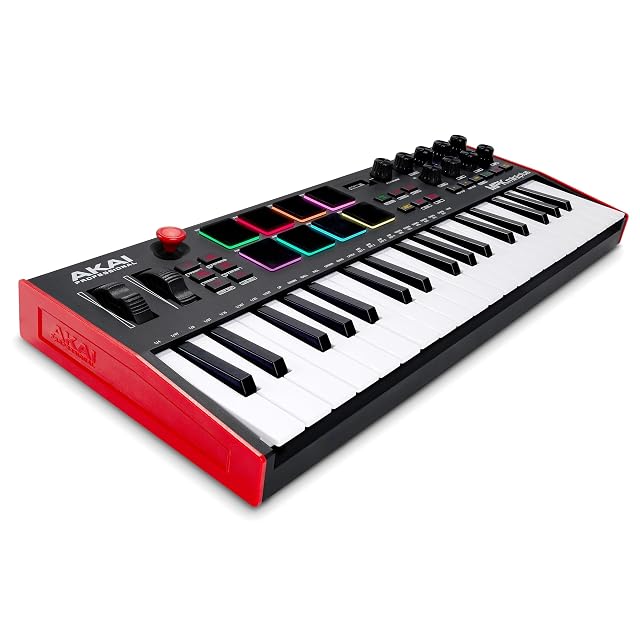
The only controller on this shelf with CV/Gate and the only one with a sequencer: 37 keys, MIDI in and out, a 64-step sequencer with separate drum and melody tracks, and eight RGB MPC pads.
Best for: A desk with hardware on it: a synth, a module or a modular rack that needs a keyboard and a sequencer.
25 mini keys · arpeggiator · 8 preset slots · USB powered
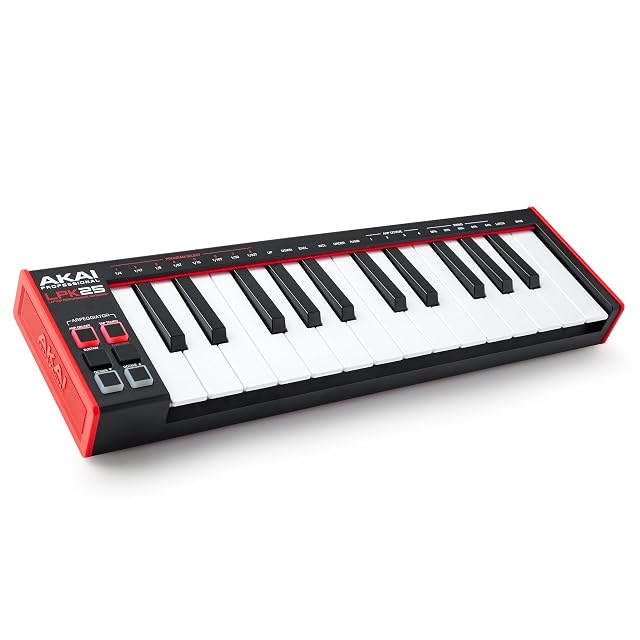
The smallest way to get keys next to a laptop: 25 responsive mini keys, octave buttons, a sustain button, a built-in arpeggiator with clock, and eight programmable preset slots.
Best for: Writing parts on a laptop, on a desk with no room for anything larger.