The one listing on this shelf that passes no audio: an 8-in, 8-out MIDI interface with three standalone routing modes, per-port activity indicators and front-mounted sockets.
What it amounts to Eight MIDI ports each way, three routing modes that work without a computer, and a light on every socket. It is on a shelf called audio interfaces and it carries no audio — which is the single most important thing to know about it, and why this page says it first.
It passes no audio. That is the first line of this page because the shelf it sits on is called audio interfaces, and a reader comparing it against the boxes beside it needs to know that nothing they want to record will go through it.
What it does carry is MIDI: note, timing and controller data. Which key, how hard, for how long. Eight ports in and eight out, which is a different scale from anything else here — the only other MIDI on this shelf is a single In and Out on a PreSonus audio interface.
The three standalone routing modes are the feature that justifies the price. They route MIDI between instruments with no computer attached: a keyboard driving a synth module, a sequencer clocking a drum machine, a controller split across two sound sources. None of that involves a DAW, and a box that stores three such arrangements and recalls them is a studio fixture rather than a peripheral.
LED activity indicators on every port sound trivial until sixteen cables are connected. A port that shows no activity is a cable, a socket or a setting — and finding out which, without a light, means unplugging things in turn.
The listing is three bullets long. No dimensions, no power requirement, no rack-unit height, no software. The product record gives 3,901 g (137.6 oz), which is a rack box rather than a desktop one.
At $349 it is the second most expensive item on this shelf and it records nothing. For a studio with two MIDI instruments it is the wrong purchase; for one with eight, it is the only listing here that addresses the problem at all.
Availability
Read on the day this page was built: $349 at the American Amazon shop.
Read from Keepa on the day this page was last revised; stock and price both move without notice.
Prices quoted in this text were read on 2026-10-07. The live price is at the top of the page.
In its favor, and its limits
Strengths
Eight MIDI ports in and eight out, where the only other MIDI on this shelf is a single In and Out on an audio interface
Three standalone routing modes, so it routes between instruments with the computer switched off
Activity indicators on every port, which is how a dead cable is found in a rack of sixteen
Compromises
It passes no audio, which the shelf name does not warn a reader about
At $349 it is the second most expensive item on this shelf and records nothing
Three bullets in total, with no dimensions, no power requirement and no software published
Specifications
What it carries
MIDI only. No audio. This is an interface in the sense that it connects instruments to a computer, and no sound passes through it
Channels
8 MIDI inputs and 8 MIDI outputs
Routing
Three standalone routing modes — it routes MIDI between instruments with no computer attached
Metering
LED activity indicators on every port
Connections
Front-mounted I/O
Microphone preamp
None. Every other interface on this shelf has at least one
Phantom power
None, and none is needed — nothing here takes a microphone
Resolution
Not applicable. MIDI carries note and controller data, not audio, so there is no sample rate or bit depth
Software
Black Lion Audio puts nothing in writing on this.
Manufacturer reference
MIDI Eight
Amazon reference
B0GKJBDGRB
EAN
0753459634752
The questions players ask
Will this record my microphone?
No. It passes no audio of any kind. MIDI carries note, timing and controller data — which key was pressed, how hard, for how long — and no sound. A MIDI interface and an audio interface solve different problems, and this page opens on that because the shelf name does not. Every other listing on this shelf has at least one microphone preamp; this has none, and needs none.
What are standalone routing modes for?
Connecting instruments to each other with no computer in the room. A keyboard driving a synth module, a sequencer clocking a drum machine — those are MIDI paths that have nothing to do with a DAW, and three stored modes mean the box does them on its own. One other listing on this shelf has MIDI at all, and it is a single In and Out on an audio interface, which cannot route anything.
This one’s price among music instruments and gear
Details checked on October 7, 2026.
Who should pick this one, among music instruments and gear
A studio with more than two MIDI instruments, where the problem is routing rather than recording.
Sources
Specifications: the manufacturer sheet for musical instruments and gear and the matching Amazon product page. Prices and availability: Keepa. Every figure on this page names its source.
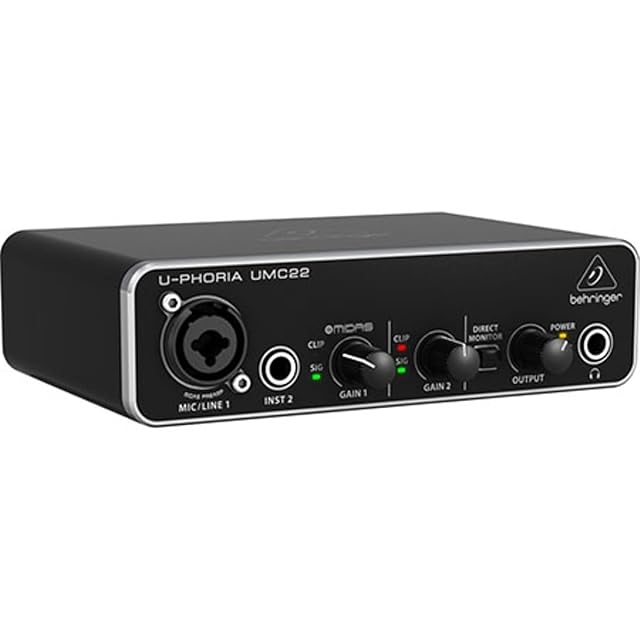
The cheapest honest way into recording: one XLR/TRS combo input with a Midas-designed preamp, a separate instrument input, direct monitoring and USB power. Forty-eight kilohertz, and no pretense beyond it.
Best for: A first interface for one voice or one instrument at a time.
2 channels · 48 V phantom power · gain meter −36 to 10 dB · 3.5 mm (0.14 in) mic input
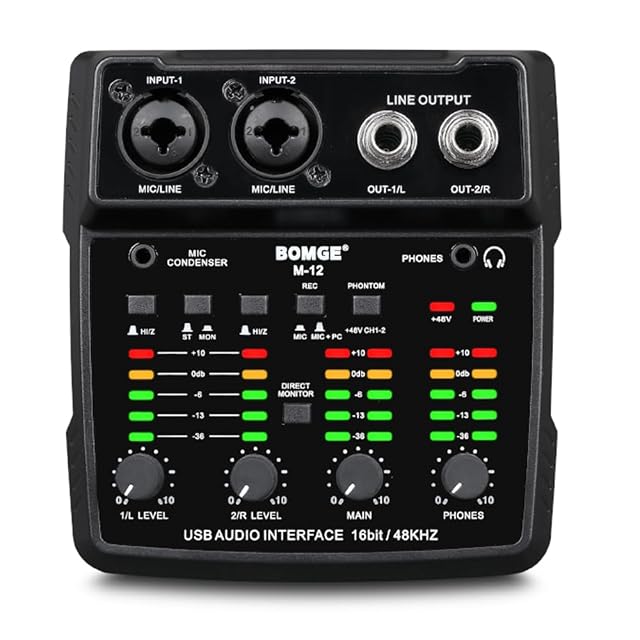
The least expensive interface on this shelf by a wide margin, with two XLR inputs, 48 V phantom power, a published gain-meter range of −36 to 10 dB, and an extra 3.5 mm (0.14 in) microphone jack.
Best for: A first interface for someone who already has recording software and wants two XLR inputs for the least money.
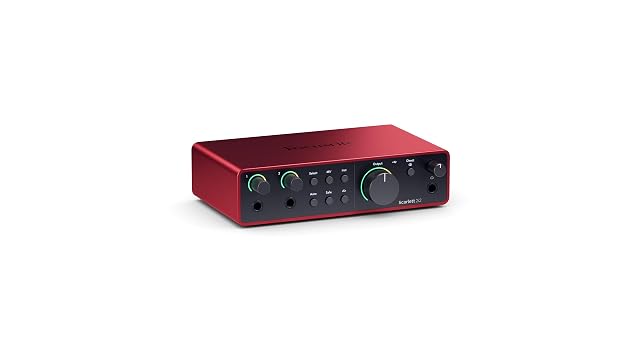
Two microphone preamps rather than one, plus Auto Gain to set levels and Clip Safe to stop a take being destroyed by a loud moment. The interface most home studios settle on and stop replacing.
Best for: Anyone who will ever record two things at the same time.