The only controller on this shelf that plays without a cable: Bluetooth on a 2,000 mAh battery, with 25 velocity-sensitive keys, eight RGB pads, eight encoders and two capacitive touch strips in place of wheels.
What it amounts to The one controller here that plays without a cable, on a published battery, and the cheapest controller here that has pads and encoders at all. Its pitch control is a touch strip rather than a wheel, and it has no MIDI socket to talk to hardware.
25 velocity-sensitive mini keys.Bluetooth on a 2,000 mAh battery. Eight RGB backlit velocity-sensitive pads.Eight assignable rotary encoders.Two capacitive touch strips for pitch bend. Smart chord and smart sound functions. Windows, macOS, Android and iOS.
Two of those are unique on this shelf.
The battery. Eleven controllers here and this is the only one that works without a cable — and the only one that publishes a capacity. Two thousand milliamp-hours is a figure a reader can hold against a claim, which matters because wireless on a controller is sold on freedom and delivered on charge.
The system list. Windows and macOS are assumed everywhere; Android and iOS are not, and this is the only listing on this shelf that names them. Combined with the battery, that makes it a tablet instrument rather than a desk one.
The touch strips are the compromise, and they are the reason it is as thin as it is. A pitch wheel springs back to center and can be held at an exact bend; a capacitive strip has no spring and no detent, so the note has to be released rather than let go. The page for another controller on this shelf makes the same criticism of a thumbstick, and it applies more here.
Eight pads and eight encoders at $74.75 is the rest of the argument. The cheapest controller on this shelf has neither — it is keys, an arpeggiator and presets — and the next step up with pads costs $99.
What is absent is the hardware side. No MIDI output socket, so this talks to a computer or a phone and not to a synthesiser; two controllers on this shelf publish one. No sequencer, which one controller here has and which is what lets a part be built with no computer in the room.
The product record gives 1,070 g (37.7 oz).
Availability
Read on the day this page was built: $75 at the American Amazon shop.
Read from Keepa on the day this page was last revised; stock and price both move without notice.
Prices quoted in this text were read on 2026-10-07. The live price is at the top of the page.
In its favor, and its limits
Strengths
The only controller on this shelf that works wirelessly, on a published 2,000 mAh battery
Android and iOS named alongside Windows and macOS, which only this listing does
Eight velocity-sensitive RGB pads and eight assignable encoders at the bottom of the price range
Compromises
Touch strips instead of a pitch wheel, which players coming from a keyboard notice
No MIDI output socket published, so it talks to a computer and not to hardware
25 mini keys, which teaches a spacing a full-size keyboard does not have
Specifications
Keys
25 mini, velocity-sensitive, described as semi-weighted
Wireless
Bluetooth, on a built-in 2,000 mAh battery — the only battery and the only wireless connection on this shelf
Pads
8 RGB backlit, velocity-sensitive
Controls
8 assignable rotary encoders, and 2 capacitive touch strips for pitch bend — in place of the wheels or thumbstick every other controller here uses
Creative tools
Smart chord and smart sound functions, selectable from the keys
Systems
Windows, macOS, Android and iOS, with Ableton Live, FL Studio, Cubase and Logic Pro named
Power
USB powered, or the internal battery over Bluetooth
MIDI out
M-VAVE puts nothing in writing on this. Two controllers on this shelf publish a MIDI output socket
Sequencer
M-VAVE puts nothing in writing on this. One controller here publishes a 64-step sequencer
Manufacturer reference
K5
Amazon reference
B0B66SX286
EAN
0798044128339
The questions players ask
Does Bluetooth MIDI add latency?
Some, and it matters less than it would for audio. MIDI is a few bytes per note rather than a continuous stream, so the delay is small — but it is not zero, and a player recording a tight part will feel it where someone sketching a chord progression will not. This is the only controller on this shelf with the option at all, and the USB cable is still in the box for when it matters.
Touch strips instead of a pitch wheel — is that a loss?
For most players, yes. A wheel springs back to center and can be held at a precise bend; a capacitive strip has no detent and no spring, so a pitch bend has to be released rather than let go. The page for another controller on this shelf makes the same criticism of a thumbstick. What a strip buys is thickness: it is why this keyboard fits where a wheel housing would not.
Accessories confirmed for this instrument
Shown because the accessory names this instrument itself.
Who should pick this one, among music instruments and gear
Writing on a sofa or a train, where the cable is the thing in the way.
What buyers actually choose
Amazon reports what buyers took in the month before this page was last checked: at least 100.
The figure is a floor, rounded by Amazon, and read through Keepa — it says what buyers picked, not what a maker claims.
Sources
Specifications: the manufacturer sheet for musical instruments and gear and the matching Amazon product page. Prices and availability: Keepa. Every figure on this page names its source.
25 mini keys · pressure-sensitive MPC pads · full-color screen · USB-C · MIDI Out
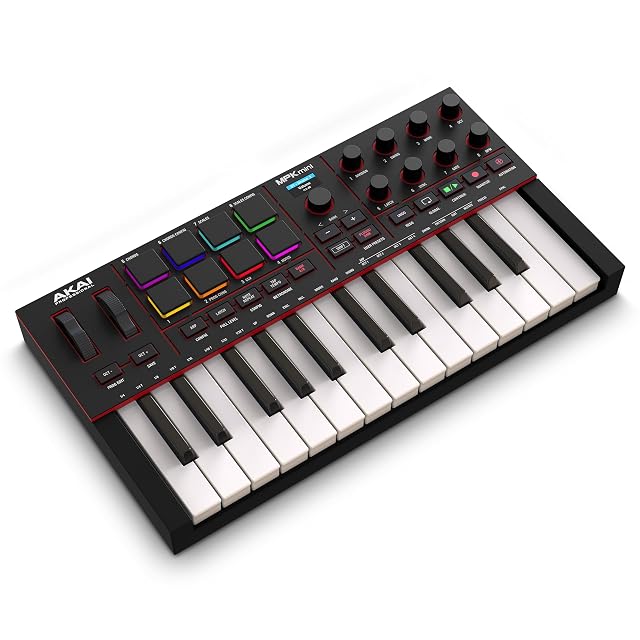
The fourth generation of the MPK Mini, and the only controller here whose pads sense pressure as well as velocity — with a full-color screen, a push/turn encoder, USB-C and a full-size MIDI output.
Best for: Finger-drumming and beat work on a desk, where the pads matter more than the keys.
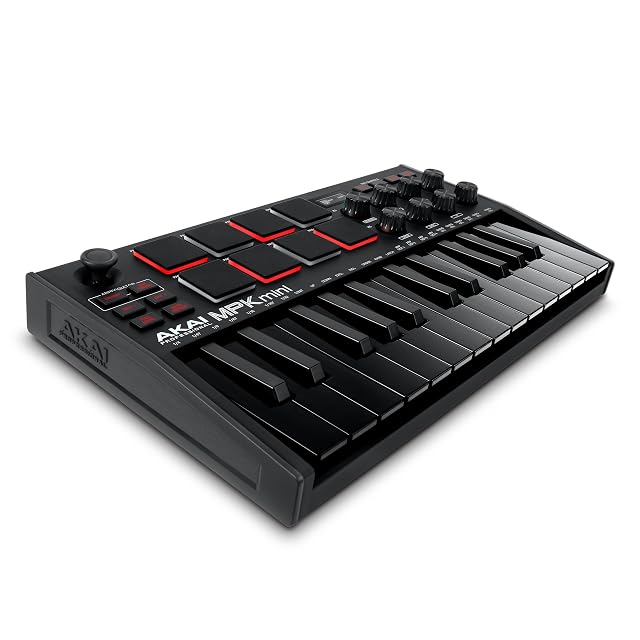
The default small controller: 25 velocity-sensitive mini keys, eight backlit MPC pads, eight 360-degree knobs, a four-way thumbstick, an arpeggiator and NKS integration.
Best for: Beat making and production on a laptop, where pads matter as much as keys.
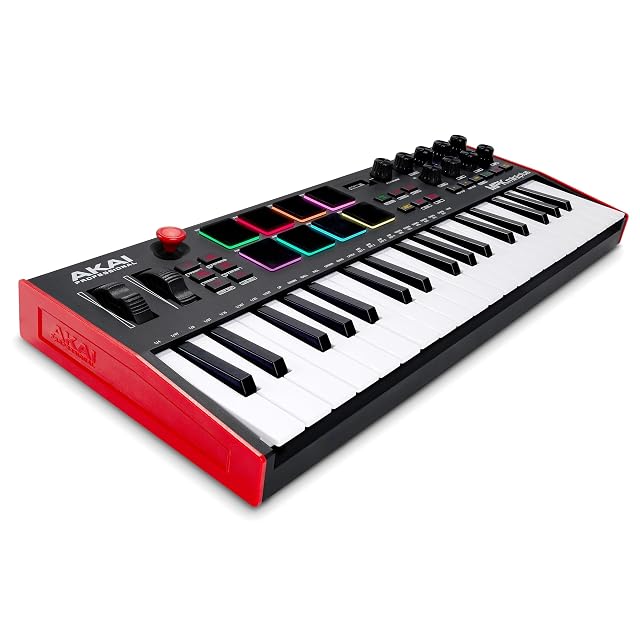
The only controller on this shelf with CV/Gate and the only one with a sequencer: 37 keys, MIDI in and out, a 64-step sequencer with separate drum and melody tracks, and eight RGB MPC pads.
Best for: A desk with hardware on it: a synth, a module or a modular rack that needs a keyboard and a sequencer.