Skip to content

CME C2MIDI Pro

A USB-C MIDI cable with a 32-bit processor inside it. It can filter, remap and route MIDI through free software, and in its second mode it links two instruments directly with no computer in the chain.

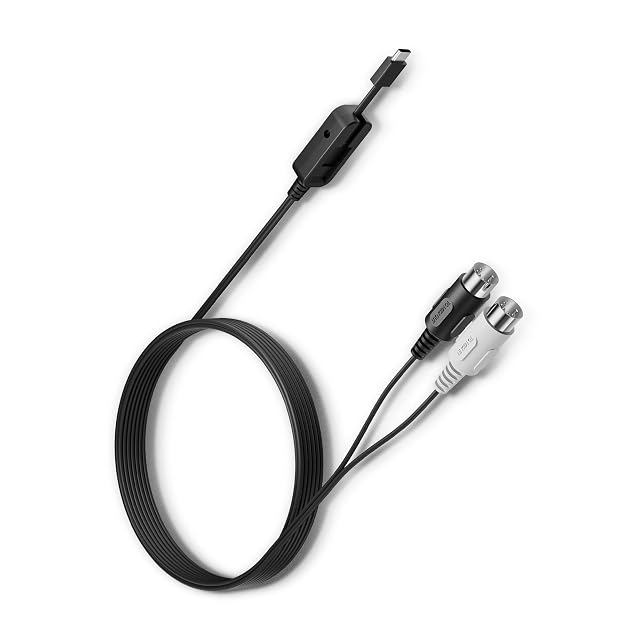
CME C2MIDI Pro USB-C MIDI cable with dual-tone connectors

CME C2MIDI Pro

A USB-C MIDI cable with a 32-bit processor inside it. It can filter, remap and route MIDI through free software, and in its second mode it links two instruments directly with no computer in the chain.

Mode 1
USB MIDI interface — computer to MIDI hardware over USB-C (maker’s bullet)
Mode 2
Smart MIDI Cable — links two MIDI devices directly, without a computer, powered from the MIDI Out port. The only cable on this shelf that works with no computer (maker’s bullet)
Processor
32-bit — the only processor published on this shelf (maker’s bullet)
Processing
Routing, filtering and mapping, configured in the free UxMIDI Tools software for macOS, Windows, iOS and Android. The only configuration software on this shelf (maker’s bullet)
Message support
Stated to transmit all MIDI messages including clock, sysex, MTC and MPE — the only listing on this shelf to name a message type (maker’s bullet)
Platforms
macOS, Windows, iOS, Android, Linux and Chrome OS (maker’s bullet)
Plug
Retractable USB-C, with dual-tone MIDI connectors (maker’s bullet)
Channels
CME puts nothing in writing on this. Both other MIDI cables on this shelf publish 16
Length
CME puts nothing in writing on this. One of the three MIDI cables here publishes a length
Manufacturer reference
S-F000C12
Weight
89 g (3.1 oz) in the product record
Amazon reference
B0DQYJJ3L2
EAN
8885011101517
  • Connects two instruments with no computer in the chain — nothing else on this shelf does that
  • Filtering, mapping and routing in a cable, configured from a phone as well as a computer
  • Five times the price of the least expensive item on this shelf, for a cable

Best for: A rig where a controller has to drive a synthesizer without a laptop, or where incoming MIDI has to be filtered before it arrives.
Check price on Amazon

Specifications

Mode 1
USB MIDI interface — computer to MIDI hardware over USB-C (maker’s bullet)
Mode 2
Smart MIDI Cable — links two MIDI devices directly, without a computer, powered from the MIDI Out port. The only cable on this shelf that works with no computer (maker’s bullet)
Processor
32-bit — the only processor published on this shelf (maker’s bullet)
Processing
Routing, filtering and mapping, configured in the free UxMIDI Tools software for macOS, Windows, iOS and Android. The only configuration software on this shelf (maker’s bullet)
Message support
Stated to transmit all MIDI messages including clock, sysex, MTC and MPE — the only listing on this shelf to name a message type (maker’s bullet)
Platforms
macOS, Windows, iOS, Android, Linux and Chrome OS (maker’s bullet)
Plug
Retractable USB-C, with dual-tone MIDI connectors (maker’s bullet)
Channels
CME puts nothing in writing on this. Both other MIDI cables on this shelf publish 16
Length
CME puts nothing in writing on this. One of the three MIDI cables here publishes a length
Manufacturer reference
S-F000C12
Weight
89 g (3.1 oz) in the product record
Amazon reference
B0DQYJJ3L2
EAN
8885011101517

A USB-C MIDI cable with a 32-bit processor inside it, free software to configure it, and a second mode in which it needs no computer at all. Clock, sysex, MTC and MPE named. Retractable USB-C plug. $29.99.

The second mode is the thing. Every other cable on this shelf is a wire between a computer and an instrument. This one can also sit between two instruments, taking its power from the MIDI Out port, passing and processing messages with nothing else in the room. No other cable on this shelf does that, and for a rig where a controller has to drive a synthesizer without a laptop it is the whole reason to buy it.

The processor is what makes it possible. Filtering drops the messages that confuse an instrument — a clock flood, unwanted aftertouch. Mapping turns a controller’s knob into the parameter you actually want. Routing decides which port a message leaves by. Those are jobs normally done by software on a running computer; here they are configured once, in UxMIDI Tools, and then held in the cable. The software runs on macOS, Windows, iOS and Android, which means a phone can reconfigure a rig on a stage.

Naming clock, sysex, MTC and MPE is not decoration. Clock is whether two machines stay in time; sysex is whether a patch dump arrives intact; MPE is whether per-note expression survives. No other listing on this shelf names a single message type.

Then the costs, and they are real. At $29.99 it is five times the least expensive item on this shelf. It publishes no channel count, where both other MIDI cables here publish 16. And it publishes no length — which, for a cable, is the first figure a buyer needs.

For getting a keyboard into a recording program, the $8.99 cable on this shelf is the honest answer. This one is for the jobs that cable cannot do.

The product record gives 89 g (3.1 oz).

Availability

Read on the day this page was built: $30 at the American Amazon shop.

Read from Keepa on the day this page was last revised; stock and price both move without notice.

Prices quoted in this text were read on 2026-10-07. The live price is at the top of the page.

The questions players ask

What does a processor in a cable actually do?

Three things, and each of them normally needs software running on a computer. Filtering drops messages you do not want — a flood of clock or aftertouch that confuses an instrument. Mapping turns one message into another, so a controller’s knob reaches the parameter you want instead of the one the maker assigned. Routing decides which port a message leaves by. The settings live in the cable, which is why the second mode works at all: once configured, it keeps doing the job with no computer attached. The configuration itself happens in free software that runs on a phone as well as a desktop.

Is this worth five times the least expensive item here?

Only for what the others cannot do. If the job is getting a keyboard into a DAW, the $8.99 cable on this shelf does it with 16 channels and no driver, and that is the honest answer. This one earns its price in two situations: a rig where a controller has to drive a synthesizer with no laptop present, and a setup where MIDI needs filtering or remapping before it arrives. Clock, sysex, MTC and MPE named in writing matter in the first case — they are what decides whether two machines stay in time. For a reader whose instrument has 5-pin sockets and whose computer runs the show, this is more cable than the job needs.

Instruments it is stated to fit

All cables & adapters