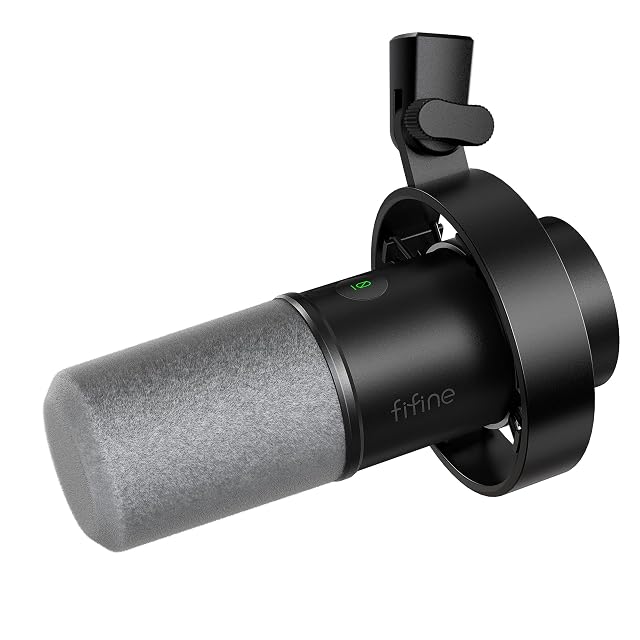
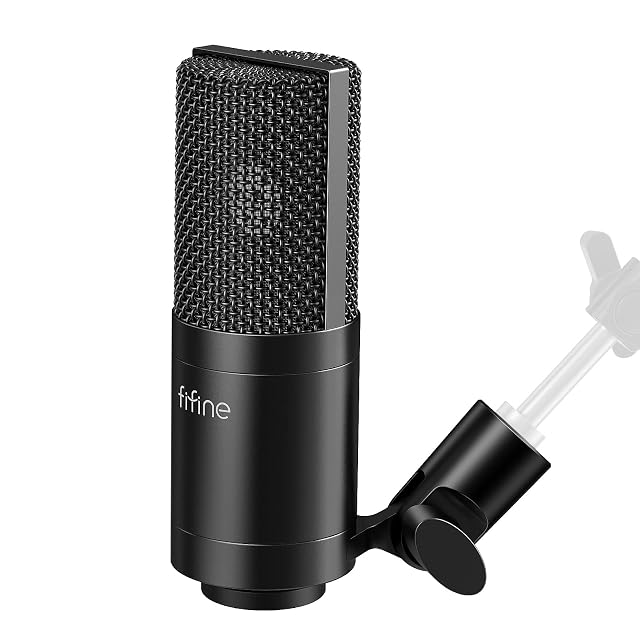
A metal-bodied USB condenser with a tripod stand and its own volume control, sold at a price where the alternative is usually a headset. Cardioid, and stated as PC, Mac, PS4 and PS5 compatible.
What it amounts to The sensible floor of the USB microphone market — metal, cardioid, with a stand, and honest about what it does not support.
At fifty-five dollars the competition is a gaming headset, and this is a considerably better answer for anything that will be listened to afterwards.
It is a cardioid condenser in a metal body, supplied with a tripod stand and a 1.8 m (6 ft) USB cable, with a volume knob on the microphone itself. Cardioid means it listens forward and rejects a good deal of what comes from behind — the pattern you want when a room is untreated and a computer fan is somewhere in it.
Two omissions are worth knowing. There is no headphone socket, so you monitor through the computer and accept whatever delay it introduces. And FIFINE states clearly in the listing that Xbox and telephones are not supported: a limitation stated up front is worth more than one discovered on delivery.
For calls, streaming and demos, it does the job. For singing that will be kept, the RØDE units above have preamps that hold up better when the source is quiet.
In its favor, and its limits
Strengths
A metal body and a real stand at a price where plastic is the norm
Cardioid pattern, which rejects a good deal of what happens beside and behind it
A volume control on the microphone itself, not buried in an operating system menu
Plug and play: one USB cable and nothing to install
Compromises
FIFINE states it will not work with Xbox or with phones
No headphone socket, so monitoring goes through the computer with the delay that implies
Specifications
Type
USB condenser, cardioid
Body
Metal, with tripod stand supplied
Control
Volume knob on the microphone
Cable
1.8 m (6 ft) USB
Compatibility
PC, Mac, PS4, PS5 — FIFINE states it is not compatible with Xbox or phones
Manufacturer reference
800669
Amazon reference
B09BHJRZZB (identical on 6 markets)
EAN
4260707736299
The two closest instruments on price
Same section, nearest price — what the same money else sounds like.
FIFINE states plainly that it will not. The listing names PC, Mac, PS4 and PS5, and excludes Xbox and telephones — one of the few listings in this category that says so rather than leaving it to be discovered.
Does it need phantom power?
No. USB microphones carry their own power over the USB cable. Phantom power is an XLR concern, supplied by an interface.
Our score
7.2/ 10
The sensible floor of the USB microphone market — metal, cardioid, with a stand, and honest about what it does not support.
Accessories confirmed for this instrument
Shown because the accessory names this instrument itself.
A reference exists on these Amazon stores: France, Germany, Italy, Spain, United Kingdom, United States. Listed is not the same as in stock — availability changes daily.
Details checked on August 18, 2026.
Who should pick this one, among music instruments and gear
A first microphone for calls, streaming and rough demos on a computer.
Our music instruments and gear guides that pick it
Specifications: the manufacturer sheet for musical instruments and gear and the matching Amazon product page. Prices and availability: Keepa. Every figure on this page names its source.
The thinnest listing on this shelf by a distance: a condenser microphone whose single bullet is its own title, with no pattern, no diaphragm, no sensitivity, no SPL and no power requirement published anywhere.
Best for: A buyer who already knows this microphone, because the listing answers nothing about it.
Dynamic · XLR and USB · S/N above 80 dB · 130 dB SPL · tap-to-mute · headphone monitoring
A dynamic microphone with both XLR and USB outputs, a signal-to-noise ratio above 80 dB, a 130 dB maximum SPL, tap-to-mute and gain on the body, and a 3.5 mm (0.14 in) headphone socket with its own volume control.
Best for: A podcast or a stream that starts on USB and moves to an interface later, where the mute button needs to be a button.
XLR condenser · 16 mm (0.63 in) diaphragm · −43 dB · 130 dB max SPL · tripod included
The least expensive XLR microphone here, and one of only two that publish a sensitivity figure: 16 mm (0.63 in) diaphragm, −43 dB, 130 dB maximum SPL, an all-metal body and a metal tripod in the box.
Best for: A first XLR microphone for someone who already owns an interface and a cable, and wants figures rather than adjectives.