The thinnest listing in this family: eighty-eight keys, and a second bullet reading “Blk”. Nothing is published about the action, the controls, the pads, the software or the connections.
What it amounts to Two bullets. The first says 88-Key MIDI Controller; the second says Blk. Nothing on this site publishes less — and on an 88-key keyboard, the one figure that matters is the action, which is not among them.
The listing carries two bullets. In full:
88-Key MIDI Controller
Blk
That is the entire published specification. The second bullet is the color, abbreviated to three letters.
This site reports what a manufacturer puts in writing and says when there is nothing. Two listings on this site are thinner still — a pair of drumsticks with no bullets at all, and a microphone whose single bullet repeats its own title. Among the eleven controllers in this family, nothing comes close.
What makes it worse than thin is which figure is missing. On an 88-key keyboard the action is the purchase. A hammer action feels like a piano and costs accordingly; a semi-weighted action is a compromise that suits a synthesiser player; a synth action is light, fast, and teaches nothing transferable. The digital piano pages on this site put it in four words — the action is the instrument — and this listing does not mention it.
Nor does it mention controls, pads, wheels, software or even the connection. USB is implied by the words MIDI Controller and never stated.
What can be said comes from elsewhere. The KeyLab Essential 49 mk3 is published on this shelf with nine rotary knobs, nine faders, eight pads, pitch and modulation wheels, a hybrid key feel, Chord Play and scale mode and a named bundle. The 61-key version is published here too, with 2,000 presets and nine encoders — and no faders mentioned. Whether this 88 shares any of it, the listing does not say.
Eighty-eight keys is a fact, and for a player who wants a full keyboard it may be the only fact that matters. It is also the only one on offer.
The product record gives 8,000 g (282.2 oz) — a round figure, and therefore a shipping one.
Availability
Read on the day this page was built: $399 at the American Amazon shop.
Read from Keepa on the day this page was last revised; stock and price both move without notice.
Prices quoted in this text were read on 2026-10-07. The live price is at the top of the page.
In its favor, and its limits
Strengths
The only 88-key controller on this shelf, which is a full piano keyboard
Part of the KeyLab Essential range, whose 49-key model is published here in full
Eighty-eight keys is a fact, and it is the fact that decides this purchase
Compromises
Two bullets, and the second is the color abbreviated to three letters — nothing in this family comes close
No key action published, which on an 88-key keyboard is the whole question
Nothing published about controls, pads, wheels, software or connection
Specifications
Keys
88 — the only 88-key controller on this shelf
Listing text
Two bullets. The first reads *88-Key MIDI Controller*. The second reads, in full: Blk
Key action
Arturia puts nothing in writing on this. On an 88-key keyboard it is the figure that decides everything about how it plays
Controls
Arturia puts nothing in writing on this. The 49-key model of this range publishes nine knobs and nine faders
Pads
Arturia puts nothing in writing on this. The 49- and 61-key models of this range publish eight
Wheels
Arturia puts nothing in writing on this.
Software
Arturia puts nothing in writing on this. The 49-key model publishes a named bundle
Connection
Arturia puts nothing in writing on this. USB is implied by MIDI Controller and never stated
Creative tools
Arturia puts nothing in writing on this. The 49-key model publishes Chord Play and scale mode
Manufacturer reference
231542
Amazon reference
B0CT92L2N3
EAN
3760033532042
The questions players ask
Is the action weighted?
The listing does not say. On an 88-key keyboard that is not a detail — it is the purchase. A hammer action feels like a piano and costs the most; a semi-weighted action is a compromise; a synth action is light and fast and teaches nothing about a piano. The pages on this site for digital pianos make the point repeatedly: *the action is the instrument*. This listing publishes 88-Key MIDI Controller and Blk.
Why is there a page for a listing that says nothing?
Because the listing exists and someone will read it. This site reports the figures a manufacturer puts in writing and says when there are none — and saying so is the only honest service a comparison page can do here. What can be said: it is 88 keys, it is black, it is from a range whose 49-key model is published on this shelf with nine knobs, nine faders, eight pads, a hybrid action and a named software bundle. Whether any of that is in this one, the listing does not state.
Accessories confirmed for this instrument
Shown because the accessory names this instrument itself.
Who should pick this one, among music instruments and gear
A player who has decided they want 88 keys from this range and will find the specification somewhere other than the listing.
Sources
Specifications: the manufacturer sheet for musical instruments and gear and the matching Amazon product page. Prices and availability: Keepa. Every figure on this page names its source.
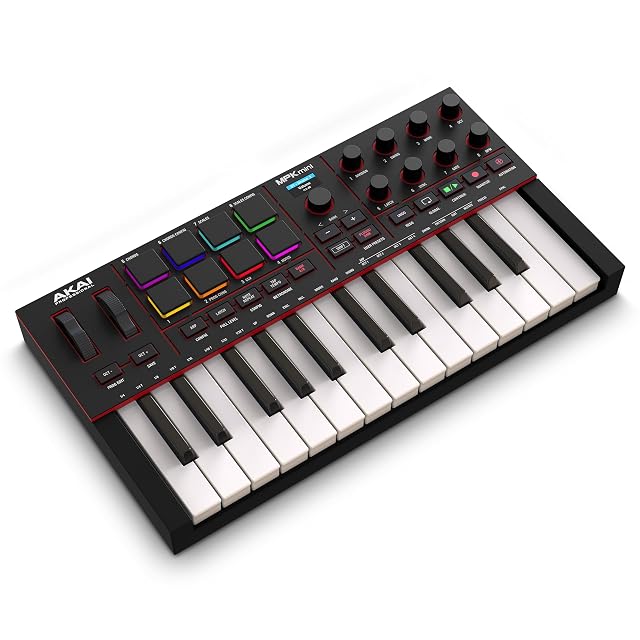
25 mini keys · pressure-sensitive MPC pads · full-color screen · USB-C · MIDI Out
The fourth generation of the MPK Mini, and the only controller here whose pads sense pressure as well as velocity — with a full-color screen, a push/turn encoder, USB-C and a full-size MIDI output.
Best for: Finger-drumming and beat work on a desk, where the pads matter more than the keys.
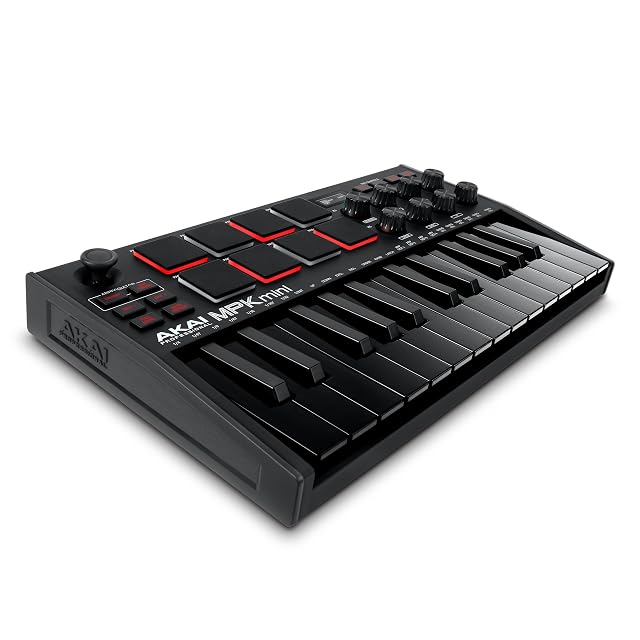
The default small controller: 25 velocity-sensitive mini keys, eight backlit MPC pads, eight 360-degree knobs, a four-way thumbstick, an arpeggiator and NKS integration.
Best for: Beat making and production on a laptop, where pads matter as much as keys.
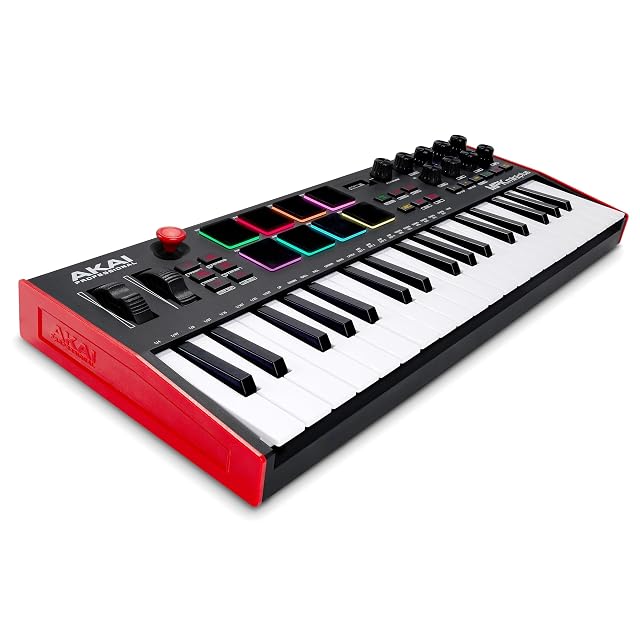
The only controller on this shelf with CV/Gate and the only one with a sequencer: 37 keys, MIDI in and out, a 64-step sequencer with separate drum and melody tracks, and eight RGB MPC pads.
Best for: A desk with hardware on it: a synth, a module or a modular rack that needs a keyboard and a sequencer.