The arranger that survives the first year · review
Yamaha PSR-F52 review
The simplest instrument in this group: 61 full-size keys, 144 sounds and 158 accompaniment styles, at a price where the alternative is usually a toy with 32 small keys.
What it amounts to The honest floor: full-size keys from a maker that supports them, with a specification sheet that stays short.
At this price the market is full of 32-key instruments with speakers the size of a coin. The PSR-F52 is a full-size 61-key keyboard from Yamaha, and that alone puts it in a different category.
The specification is deliberately short: 144 sounds, 158 accompaniment styles, 61 keys. That is what a first year needs, and the absence of a screenful of features is not a flaw at this level.
One thing the listing does not state is touch sensitivity, and this page does not assume it. If dynamics matter — if you want the sound to get louder when you play harder — the PSR-E383 states that capability explicitly and costs appreciably more.
Note the price spread before ordering: at the time of writing, the UK store was at roughly double the German price for the same reference.
In its favor, and its limits
Strengths
61 full-size keys at a price where 32 mini keys are the norm
Yamaha build and Yamaha support at the entry level of the range
158 styles is more accompaniment than a first year needs
Sold on all six Amazon stores under one reference
Compromises
The listing does not state touch sensitivity, so this page does not claim it
The UK price stood at roughly double the German one at the time of writing
Specifications
Keys
61, full size
Sounds
144
Styles
158
Touch sensitivity
Not stated in this listing
Amazon reference
B09CG11ZW1 (identical on 5 markets)
EAN
4957812669719
The questions players ask
Are the keys touch-sensitive?
Yamaha does not state it in this listing, and we do not fill the gap in. If expressive dynamics matter to you, the PSR-E383 states touch sensitivity explicitly and is the safer choice.
Full-size keys — does it matter at this level?
Yes, more than the sound count. Full-size keys teach the hand the distances it will need on any other keyboard or piano; mini keys teach distances that have to be unlearned.
Our score
7.2/ 10
The honest floor: full-size keys from a maker that supports them, with a specification sheet that stays short.
Accessories confirmed for this instrument
Shown because the accessory names this instrument itself.
A reference exists on these Amazon stores: France, Germany, Italy, Spain, United Kingdom. Listed is not the same as in stock — availability changes daily.
Details checked on August 18, 2026.
Who should pick this one, among music instruments and gear
A first keyboard for a child, or a second one to leave at a grandparent’s house.
Our music instruments and gear guides that pick it
Specifications: the manufacturer sheet for musical instruments and gear and the matching Amazon product page. Prices and availability: Keepa. Every figure on this page names its source.
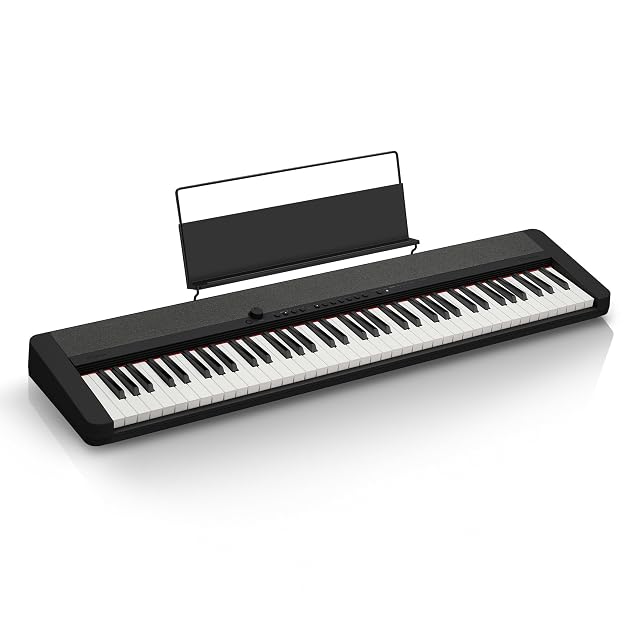
The 76-key version of the same idea, with a bigger speaker system: 2 × 6.5 W instead of 2 × 2.5 W. Still no accompaniment styles, still 61 sounds, and 80 cm (31.5 in) longer in the room.
Best for: A player who has run out of keys on a 61 but does not want an 88-key weighted piano.
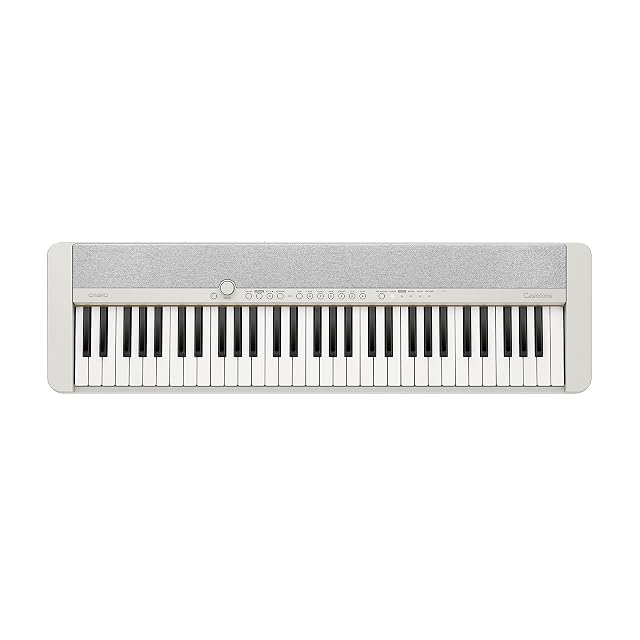
61 touch-sensitive keys · 61 sounds · no auto-accompaniment
A keyboard built like a piano rather than like an arranger: 61 touch-sensitive keys, 61 sounds, and deliberately no accompaniment styles. Music rest and power adapter are included; the pedal is not.
Best for: Someone who wants piano sounds and 61 keys without an arranger’s menus.
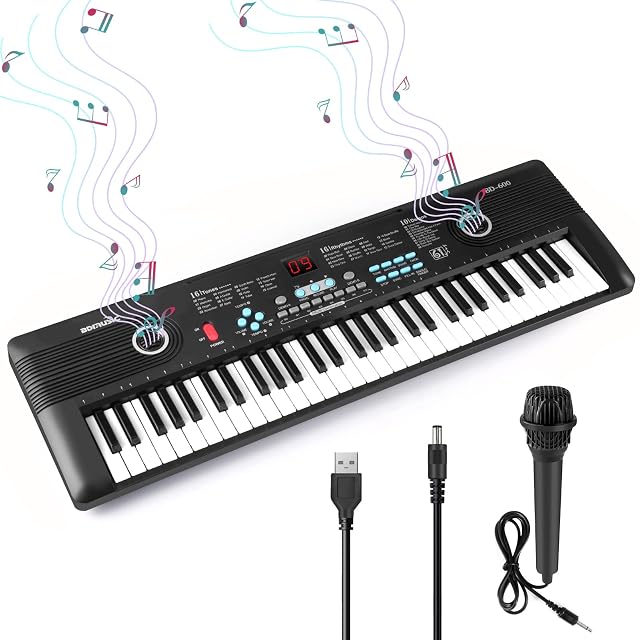
61 keys · microphone output and a built-in microphone · 100 tones · 4 AA batteries
The least expensive keyboard on this shelf by a wide margin, and the only one that records a voice — a microphone output and a built-in microphone — with 100 tones, eight percussion panels and battery operation.
Best for: A child learning at a desk, where a microphone and a set of batteries matter more than a published key size.