The most expensive controller on this shelf, and the one that publishes least for the money: five bullets of which three are category labels and two are statements about the seller rather than the product.
What it amounts to The most expensive controller on this shelf and the one that publishes least: three category words and two sentences about the seller. The higher line of a range whose cheaper models are documented here in full — and nothing on this page comes from this listing except the key count.
Five bullets. Here they are:
MIDI Keyboard 61
master keyboards
keyboard instruments
We value a balanced combination of careful workmanship and selected materials.
Our goal - Your satisfaction is our top priority and is our focus.
The first three are the category the product is sold in. The last two are about the seller. Not one of the five says anything about the keyboard.
At $599 this is the most expensive controller on this shelf, and it is the least described. Another listing here, at $399, publishes 88-Key MIDI Controller and Blk — two bullets — and between them those two are the thinnest in this family.
What the name carries is real and it comes from outside this listing. In Arturia’s range the KeyLab is the line above the KeyLab Essential, and both Essential models are published on this shelf: the 49 with nine rotary knobs, nine faders, eight pads, a hybrid key feel, Chord Play and scale mode and a named software bundle, and the 61 with 2,000 presets, nine encoders and eight pads. A step up in that range normally buys a better keybed, a heavier build and more control surface.
This listing publishes none of it. Not the action — which on a 61-note keyboard decides how it plays. Not the control count. Not the pads, the screen, the software or the dimensions.
So this page reports what there is: 61 keys, USB, white, and a maker whose cheaper models are documented. Everything else about this keyboard will be found in a manual, and a reader deciding between this and the Essential 61 at half the price has nothing on either listing to decide with except the key count, which is identical.
The product record gives 8,482 g (299.2 oz), the heaviest figure on this shelf.
Availability
Read on the day this page was built: $599 at the American Amazon shop.
Read from Keepa on the day this page was last revised; stock and price both move without notice.
Prices quoted in this text were read on 2026-10-07. The live price is at the top of the page.
In its favor, and its limits
Strengths
It is the KeyLab rather than the KeyLab Essential, which is the higher line in this maker’s range
61 keys, which is two hands and most of what a part needs
A maker whose Essential models are published on this shelf with their specifications intact
Compromises
The most expensive controller on this shelf at $599, and five bullets contain no specification at all
Three bullets are category words and two are about the seller rather than the keyboard
Nothing published about the action, the controls, the pads, the screen or the software
Specifications
Keys
61 (from the title and the first bullet)
Listing text
Five bullets. Three are category words — *MIDI Keyboard 61*, *master keyboards*, *keyboard instruments*. Two are about the seller: *We value a balanced combination of careful workmanship and selected materials* and *Our goal - Your satisfaction is our top priority*
Range position
The KeyLab rather than the KeyLab Essential, which is the step above the two Essential models published on this shelf
Key action
Arturia puts nothing in writing on this
Controls
Arturia puts nothing in writing on this. The Essential 49 on this shelf publishes nine knobs and nine faders
Pads
Arturia puts nothing in writing on this. Both Essential models here publish eight
Software
Arturia puts nothing in writing on this
Connection
USB, from the title. Nothing more is published
Screen
Arturia puts nothing in writing on this. One controller on this shelf publishes a full-color screen
Manufacturer reference
231631
Amazon reference
B0D9DMT3LV
EAN
3760033532110
The questions players ask
What is actually published here?
That it is a 61-key USB MIDI keyboard controller from Arturia, in white. The five bullets are: *MIDI Keyboard 61*, *master keyboards*, *keyboard instruments*, *We value a balanced combination of careful workmanship and selected materials*, and *Our goal - Your satisfaction is our top priority and is our focus.* Three are the category the product sits in; two are about the seller. No key action, no control count, no pads, no screen, no software, no dimensions. At $599 this is the most expensive controller on this shelf and the least described.
How does the KeyLab differ from the KeyLab Essential?
In Arturia’s range the KeyLab is the line above the KeyLab Essential, and both Essential models are published on this shelf — the 49 with nine knobs, nine faders, eight pads, a hybrid action, Chord Play and scale mode, and the 61 with 2,000 presets and nine encoders. What the step up buys is normally the keybed, the build and the control surface. This listing publishes none of those, so the difference cannot be read from it, and this page will not invent it.
Accessories confirmed for this instrument
Shown because the accessory names this instrument itself.
Who should pick this one, among music instruments and gear
A player who already knows the KeyLab mk3 and is buying on the name, because the listing describes nothing.
Sources
Specifications: the manufacturer sheet for musical instruments and gear and the matching Amazon product page. Prices and availability: Keepa. Every figure on this page names its source.
25 mini keys · pressure-sensitive MPC pads · full-color screen · USB-C · MIDI Out
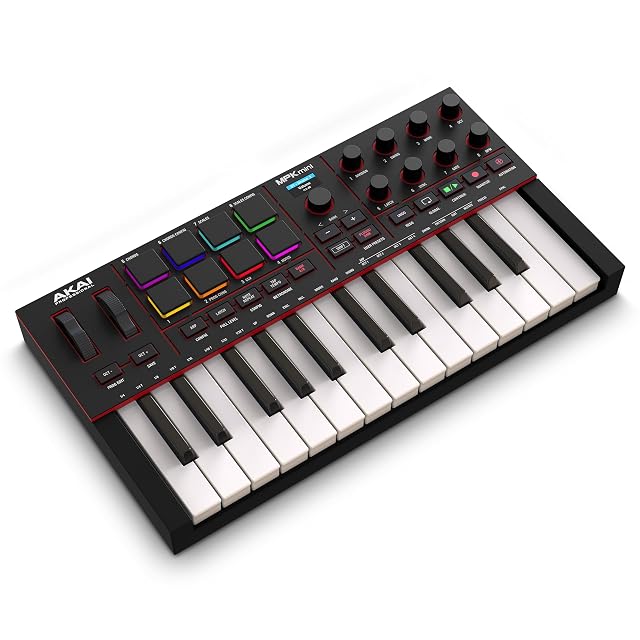
The fourth generation of the MPK Mini, and the only controller here whose pads sense pressure as well as velocity — with a full-color screen, a push/turn encoder, USB-C and a full-size MIDI output.
Best for: Finger-drumming and beat work on a desk, where the pads matter more than the keys.
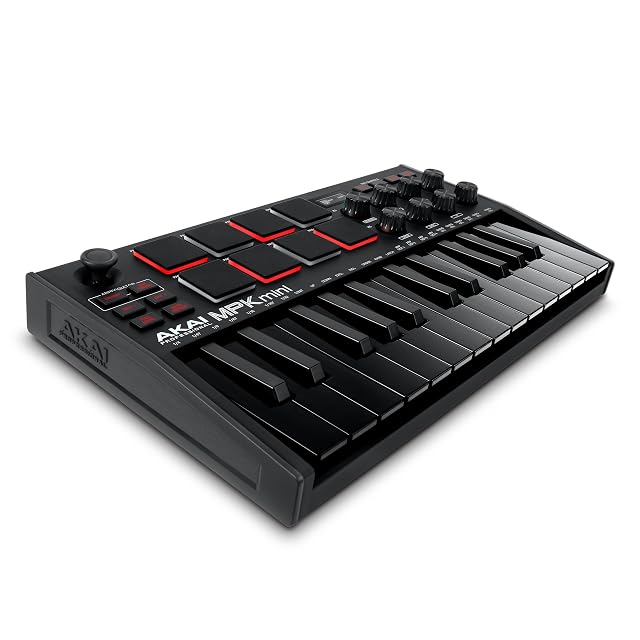
The default small controller: 25 velocity-sensitive mini keys, eight backlit MPC pads, eight 360-degree knobs, a four-way thumbstick, an arpeggiator and NKS integration.
Best for: Beat making and production on a laptop, where pads matter as much as keys.
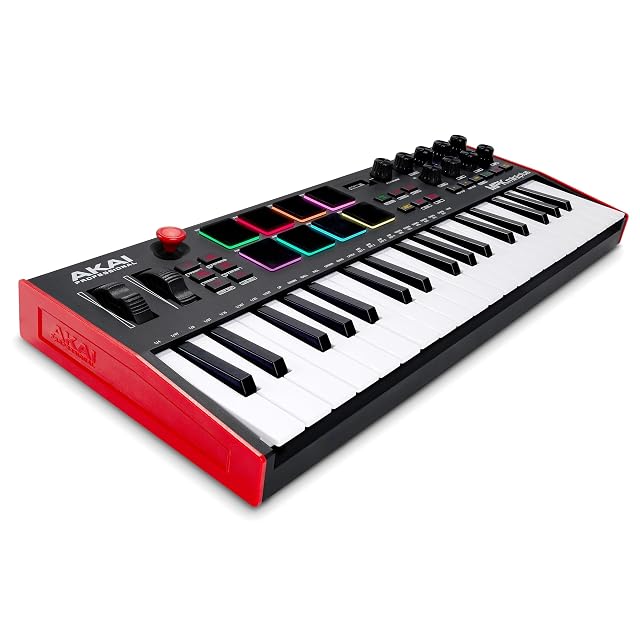
The only controller on this shelf with CV/Gate and the only one with a sequencer: 37 keys, MIDI in and out, a 64-step sequencer with separate drum and melody tracks, and eight RGB MPC pads.
Best for: A desk with hardware on it: a synth, a module or a modular rack that needs a keyboard and a sequencer.