Skip to content

UGREEN 10628

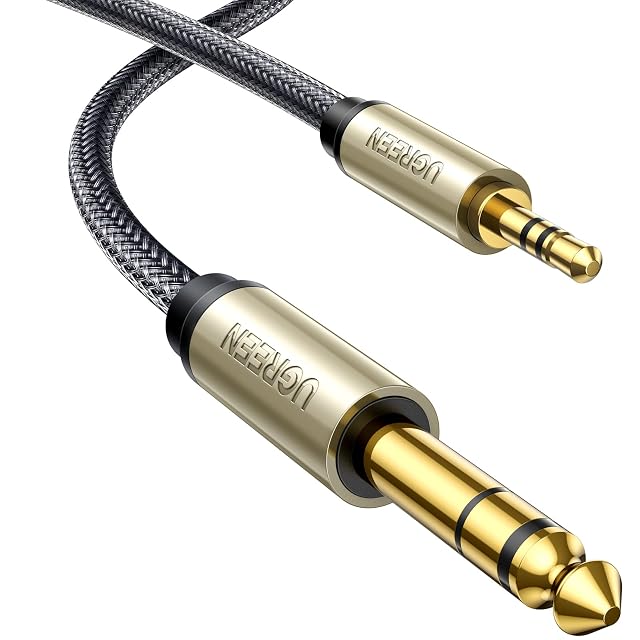
A 3.5 mm (0.14 in) to 1/4-inch male-to-male lead with double shielding under a nylon braid — and the only listing on this shelf whose own bullets warn that an electric guitar outputs mono and cannot be made stereo by a cable.

UGREEN nylon-braided 3.5 mm to 6.35 mm audio cable

UGREEN 10628

A 3.5 mm (0.14 in) to 1/4-inch male-to-male lead with double shielding under a nylon braid — and the only listing on this shelf whose own bullets warn that an electric guitar outputs mono and cannot be made stereo by a cable.

Connection
3.5 mm (0.14 in) TRS male to 6.35 mm (0.25 in) male, 6.6 ft — stated explicitly as male-to-male, not male-to-female (maker’s bullet)
Shielding
Double shielding — the only shielding published on this shelf (maker’s bullet)
Jacket
Double-layer nylon braid over a zinc alloy case, stated to survive being tugged across sharp edges (maker’s bullet)
Conductor
Pure copper core with 24K gold-plated connectors (maker’s bullet)
Published warning
Twice in its own bullets: the playback device must support stereo processing for stereo output, and an electric guitar outputs a mono signal by design — it is not a stereo source. No other listing on this shelf states a limitation of its own (maker’s bullet)
Named compatibility
Yamaha, Casio and Roland keyboards, digital pianos, home theatre, speakers, bass amplifiers, recorders and mixers (maker’s bullet)
Length
6.6 ft (from the title)
Manufacturer reference
10628
Weight
50 g (1.8 oz) in the product record
Amazon reference
B00Y2LANNW
EAN
0069573038162
  • The only published shielding figure on this shelf, and it is double
  • A maker that writes down what its own cable cannot do — which is rarer than any specification
  • Male-to-male, so it replaces a cable rather than adapting the one you already have

Best for: Running a phone, laptop or interface output into a 1/4-inch input, where the hum has to stop.
Check price on Amazon

Specifications

Connection
3.5 mm (0.14 in) TRS male to 6.35 mm (0.25 in) male, 6.6 ft — stated explicitly as male-to-male, not male-to-female (maker’s bullet)
Shielding
Double shielding — the only shielding published on this shelf (maker’s bullet)
Jacket
Double-layer nylon braid over a zinc alloy case, stated to survive being tugged across sharp edges (maker’s bullet)
Conductor
Pure copper core with 24K gold-plated connectors (maker’s bullet)
Published warning
Twice in its own bullets: the playback device must support stereo processing for stereo output, and an electric guitar outputs a mono signal by design — it is not a stereo source. No other listing on this shelf states a limitation of its own (maker’s bullet)
Named compatibility
Yamaha, Casio and Roland keyboards, digital pianos, home theatre, speakers, bass amplifiers, recorders and mixers (maker’s bullet)
Length
6.6 ft (from the title)
Manufacturer reference
10628
Weight
50 g (1.8 oz) in the product record
Amazon reference
B00Y2LANNW
EAN
0069573038162

3.5 mm TRS to 6.35 mm, male to male, 6.6 feet. Double shielding. Double-layer nylon braid over a zinc alloy case. Pure copper, 24K gold-plated. $13.99.

The specification worth having is the double shielding, and it is the only one on this shelf. An unbalanced cable is an aerial: the longer the run, the more mains hum it collects, and that buzz which appears only when something is plugged in is almost always this. A shield is a grounded layer wrapped round the signal conductor; two of them, usually a foil and a braid, cover each other’s gaps. Nothing else on this shelf publishes a shield at all — and this listing still does not publish the coverage percentage, which is the figure that would make two shielded cables comparable.

The more unusual thing is what UGREEN writes about its own product. Twice, in its own bullets: stereo output requires the playback device to process stereo, and an electric guitar outputs a mono signal by design — it is not a stereo source. That is a manufacturer telling a buyer what the cable will not fix. No other listing on this shelf states a limitation of its own, and on a shelf of adjectives it is the most useful sentence in it.

The nylon braid and zinc alloy shell address the two places a cheap lead fails: the jacket where it crosses an edge, and the shell where the wire enters the plug. A braid is also stiffer than rubber, which is worse in a tight run behind a desk — a real trade rather than a flaw.

One thing to be clear about: this is male to male. It replaces a cable; it does not adapt one you already own. The two adapters on this shelf do that job, and one of them costs $5.99.

The product record gives 50 g (1.8 oz).

Availability

Read on the day this page was built: $14 at the American Amazon shop.

Read from Keepa on the day this page was last revised; stock and price both move without notice.

Prices quoted in this text were read on 2026-10-07. The live price is at the top of the page.

The questions players ask

Will this make my guitar stereo?

No, and the listing is unusually honest about it. An electric guitar outputs a mono signal by design — one pickup output, one conductor — and no cable changes that. A TRS lead on a mono source simply leaves one channel unused. The same applies in reverse: a stereo source only arrives in stereo if the receiving device processes stereo, which this listing also states. It is the only cable on this shelf whose own bullets set out a limitation, and that is worth more than most of the specifications above it.

What does double shielding actually do?

It keeps the mains out. An unbalanced cable acts as an aerial, and the longer it is the more it picks up — which is the commonest cause of a hum that appears only when something is plugged in. A shield wraps the signal conductor in a grounded layer; two layers, typically a foil and a braid, cover the gaps the other leaves. No other listing on this shelf publishes any shielding at all. What is still not published here is the coverage percentage, which is the figure that would let two shielded cables actually be compared.

Instruments it is stated to fit

All cables & adapters