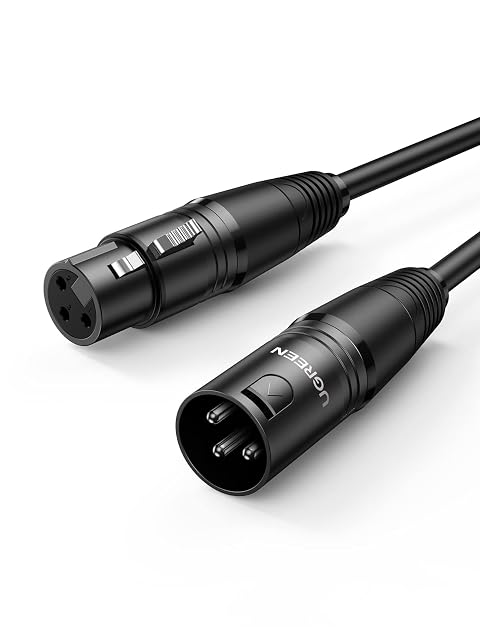
A three-meter three-pin XLR lead. Balanced, so it rejects interference over distance — and the only cable type that carries 48 V phantom power from an interface to a condenser microphone.
UGREEN XLR Cable 3 m
A three-meter three-pin XLR lead. Balanced, so it rejects interference over distance — and the only cable type that carries 48 V phantom power from an interface to a condenser microphone.
Connector
3-pin XLR, male to female
Length
3 m (10 ft)
Signal
Balanced
Carries phantom power
Yes — 48 V from the interface to the microphone
Amazon reference
B016D50A1Y (identical on 6 markets)
EAN
6957303827114
Balanced: it can run across a room without collecting the hum a jack lead would
The locking connector will not fall out of a microphone mid-take
No US offer at the time of writing, and the Spanish price stood at roughly double the German one
Best for: Any XLR microphone into an interface or a mixer.
Every question in the “my microphone does not work” category comes back to this cable and what it carries.
An XLR lead is balanced: it sends the signal twice, once inverted, and the receiving end cancels anything picked up along the way. That is why a microphone can sit five meters from an interface without humming, where a jack lead at the same length would.
It also carries phantom power — the 48 V an interface sends up the cable to run a condenser microphone’s electronics. No other common cable does this. An XLR-to-jack adapter breaks it, which is why a condenser plugged in that way stays completely silent while a dynamic microphone works.
Three meters suits a desk setup; the locking connector means the cable does not fall out when the stand is nudged.
The questions players ask
Why does my XLR microphone make no sound?
Three usual reasons, in order: phantom power is not switched on at the interface (the button marked 48V or P48), the microphone is plugged into a line input rather than the microphone input, or the gain is at zero. The cable is almost never the fault.
Can I use an XLR-to-jack adapter instead?
It will pass audio and it will not pass phantom power, so a condenser microphone stays silent. It also breaks the balanced connection. For a condenser, use XLR end to end.
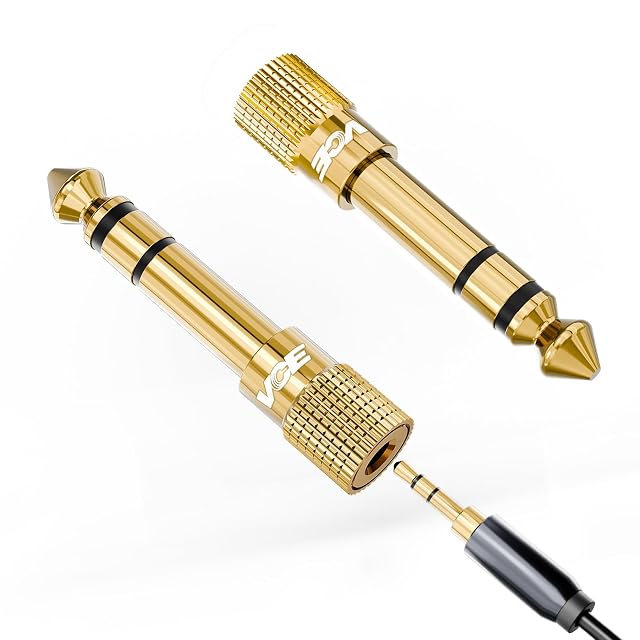
The same job as the single adapter here, done twice for less money each, in solid brass — and the only adapter on this shelf whose listing says TRS, which is what decides whether a stereo signal survives it.
Direction
6.35 mm (0.25 in) male to 3.5 mm (0.14 in) female — a 1/4-inch stereo port connects to a 3.5 mm (0.14 in) plug (maker’s bullet)
Contacts
TRS — a precision-engineered TRS interface, stated to deliver true stereo (maker’s bullet). The only adapter on this shelf that states a contact type
Pack
Two pieces, at $6.39 for the pair — $3.20 a piece, the lowest per-piece price on this shelf (from the title)
Body
Solid brass, with knurled 360-degree grip treads described as non-slip even in tight spaces behind amplifiers or mixers (maker’s bullet)
Plating
24K gold-plated connectors, stated to resist corrosion and minimize signal loss (maker’s bullet)
Size
45 × 10 × 10 mm (1.77 × 0.39 × 0.39 in) in the product record — the only adapter here with published dimensions
Named compatibility
Electric guitars, bass amps, keyboards, digital pianos, studio monitors, AV receivers and mixers (maker’s bullet)
Manufacturer reference
W9776-2P
Weight
17 g (0.6 oz) in the product record
Amazon reference
B01EJ5UV3C
EAN
0751570405190
Two in the packet, at the lowest per-piece price on this shelf — which is the whole answer to a lost adapter
The only adapter here whose listing states TRS, so a stereo path is not a guess
Brass is softer than steel, and a knurled finish wears smooth with heavy use
Best for: A desk or a gig bag that needs the adapter to exist in two places at once.
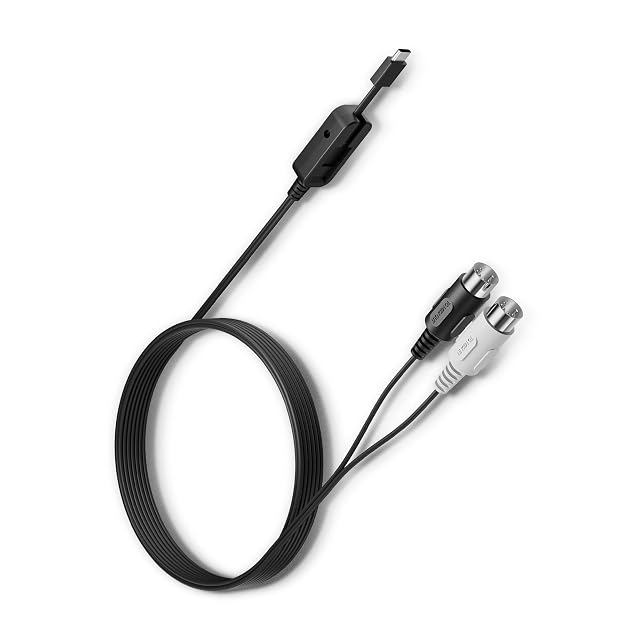
A USB-C MIDI cable with a 32-bit processor inside it. It can filter, remap and route MIDI through free software, and in its second mode it links two instruments directly with no computer in the chain.
Mode 1
USB MIDI interface — computer to MIDI hardware over USB-C (maker’s bullet)
Mode 2
Smart MIDI Cable — links two MIDI devices directly, without a computer, powered from the MIDI Out port. The only cable on this shelf that works with no computer (maker’s bullet)
Processor
32-bit — the only processor published on this shelf (maker’s bullet)
Processing
Routing, filtering and mapping, configured in the free UxMIDI Tools software for macOS, Windows, iOS and Android. The only configuration software on this shelf (maker’s bullet)
Message support
Stated to transmit all MIDI messages including clock, sysex, MTC and MPE — the only listing on this shelf to name a message type (maker’s bullet)
Platforms
macOS, Windows, iOS, Android, Linux and Chrome OS (maker’s bullet)
Plug
Retractable USB-C, with dual-tone MIDI connectors (maker’s bullet)
Channels
CME puts nothing in writing on this. Both other MIDI cables on this shelf publish 16
Length
CME puts nothing in writing on this. One of the three MIDI cables here publishes a length
Manufacturer reference
S-F000C12
Weight
89 g (3.1 oz) in the product record
Amazon reference
B0DQYJJ3L2
EAN
8885011101517
Connects two instruments with no computer in the chain — nothing else on this shelf does that
Filtering, mapping and routing in a cable, configured from a phone as well as a computer
Five times the price of the least expensive item on this shelf, for a cable
Best for: A rig where a controller has to drive a synthesizer without a laptop, or where incoming MIDI has to be filtered before it arrives.
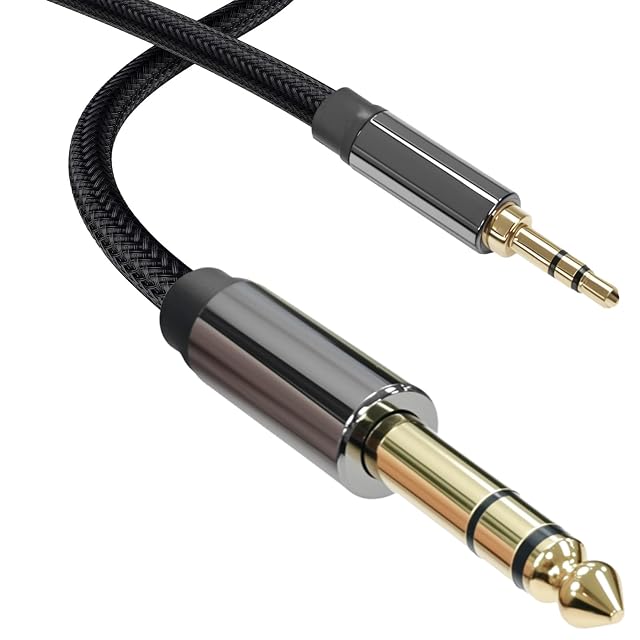
A three-and-a-bit-foot stereo lead in oxygen-free copper under a braided jacket. The shortest cable on this shelf, which on a desk is the point rather than a compromise.
Connection
3.5 mm (0.14 in) TRS to 6.35 mm (0.25 in) TRS, stereo, male to male (from the title)
Length
3.3 ft — the shortest length published on this shelf (from the title)
Conductor
Oxygen-free copper with shielding — the only listing on this shelf to name oxygen-free copper (maker’s bullet)
Signal
Stated to support balanced to unbalanced transmission, with strong anti-interference capability (maker’s bullet)
Jacket
Braided outer cover with gold-plated connectors (maker’s bullet)
Named compatibility
Yamaha, Casio and Roland keyboards, digital pianos, bass amplifiers and home theatre systems (maker’s bullet)
Shielding
Described as shielded. No layer count or coverage is published; one cable on this shelf publishes two layers (maker’s bullet)
Manufacturer reference
190 0027
Weight
30 g (1.1 oz) in the product record
Amazon reference
B0FPQZ3SZQ
EAN
0826341058438
The shortest lead on this shelf, which on a desk means no coil on the floor and less aerial
TRS at both ends and said so, where most listings here describe stereo without naming contacts
3.3 ft will not reach from a desk to an amplifier across a room
Best for: A desk: interface to monitor, or laptop to a 1/4-inch input, with nothing left over.
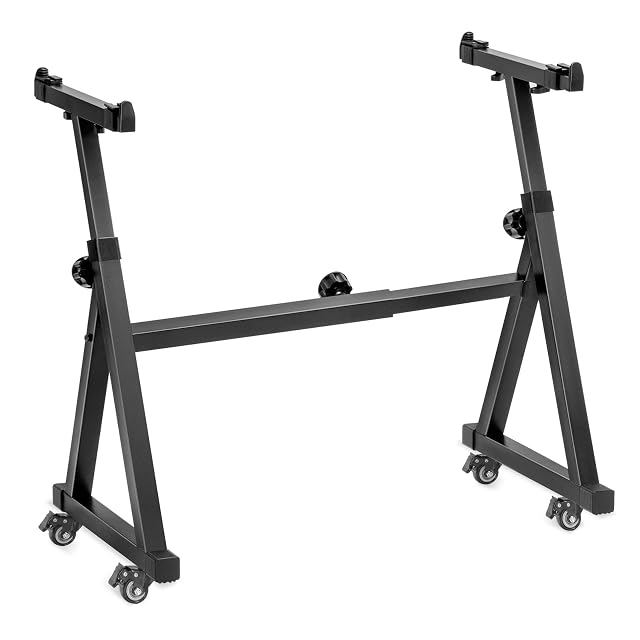
The same Z-frame as the maker’s AS-ZK with locking wheels added, at two dollars more. It is the cheapest wheeled stand on this shelf — and the listing publishes neither of the two adjustment ranges its own twin gives.
Frame
Z-style in high-strength steel, stated to minimize wobble during play (maker’s bullet)
Wheels
Locking wheels, for movement and then secure placement. Three of the twelve stands on this shelf have wheels (maker’s bullet)
Height
AODSK puts nothing in writing on this. The same maker’s AS-ZK, two dollars cheaper, publishes 21.2 to 32.4 in
Width
AODSK puts nothing in writing on this beyond *flexible*. The AS-ZK publishes 21.8 to 35.2 in. Both listings state 61 to 88 keys
Load rating
AODSK puts nothing in writing on this. Another page on this shelf states the rule: where the maker publishes no figure, this site does not invent one
Stated use
Home, studio and stage, for children and adults (maker’s bullet)
Manufacturer reference
AS-ZKW
Weight
4,082 g (144 oz) in the product record, which is 9 lb exactly — a shipping figure, and lower than the 10 lb recorded for the same stand without wheels. Nothing here is ranked on it
Amazon reference
B0DPW9NWQL
EAN
6974012229091
The cheapest wheeled stand on this shelf, at two dollars over the same frame without castors
Locking castors: it rolls out of a room and then stops rolling, which a stand on feet cannot do
Publishes neither a height range nor a width range, where its own cheaper twin publishes both
Best for: A keyboard that has to leave the room it is played in, more than once a week.
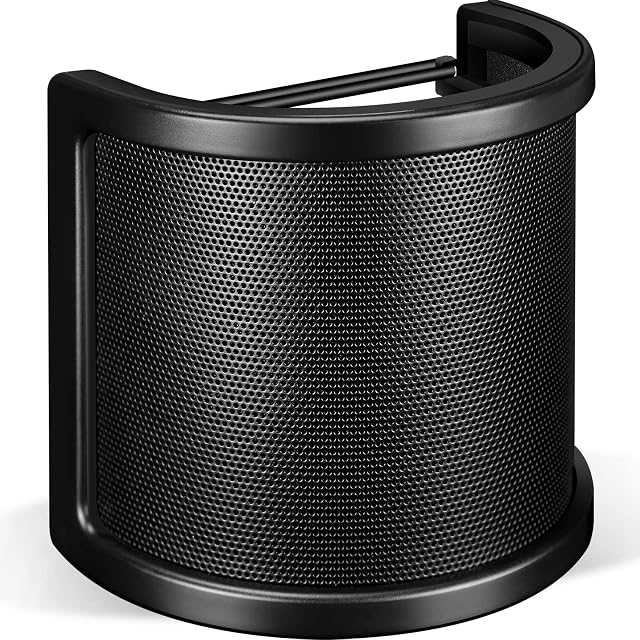
A pop filter combining a mesh screen with a foam layer. The foam adds protection against moving air and takes a little off the top end — a trade that suits speech more than singing.
Type
Pop filter with foam windscreen layer
Use
Studio recording, podcasting
Amazon reference
B07QP2FXTB (identical on 6 markets)
EAN
0854289008185
Nine dollars on the American store, and almost no spread across the six measured
The foam layer adds a second stage against plosives on very close speech
Foam takes a little high frequency with it — audible on sung vocals
Best for: Podcasting and streaming, where speech is close and consistent.
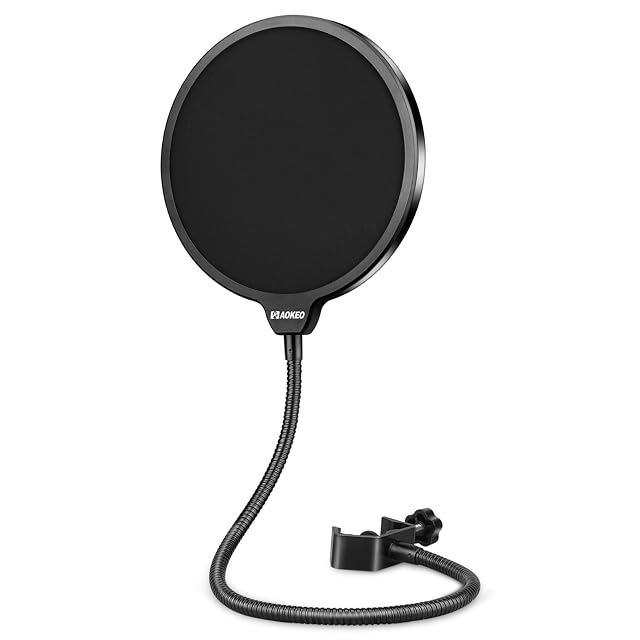
A pop filter on a gooseneck with a clamp, sized for common USB microphones. It stops the burst of air from a P or a B reaching the capsule; it does nothing about the room.
Type
Pop filter on a gooseneck
Mount
Clamp
Stated compatibility
Blue Yeti, Snowball, HyperX QuadCast and other microphones
Amazon reference
B01N21H9WY (identical on 6 markets)
EAN
0859830006269
Fixes plosives, which are the single most audible amateur recording problem
A gooseneck holds position rather than drifting mid-session
It does nothing about room reflections — that is a different product
Best for: Any spoken-word or vocal recording where P and B sounds are thumping.