Skip to content

The best electronic drum kit for a flat

Mesh heads solve the airborne noise. What reaches the flat below is the kick beater and the rack transmitting into the floor, and that is what these three are judged on.

The snare is the pad you hit

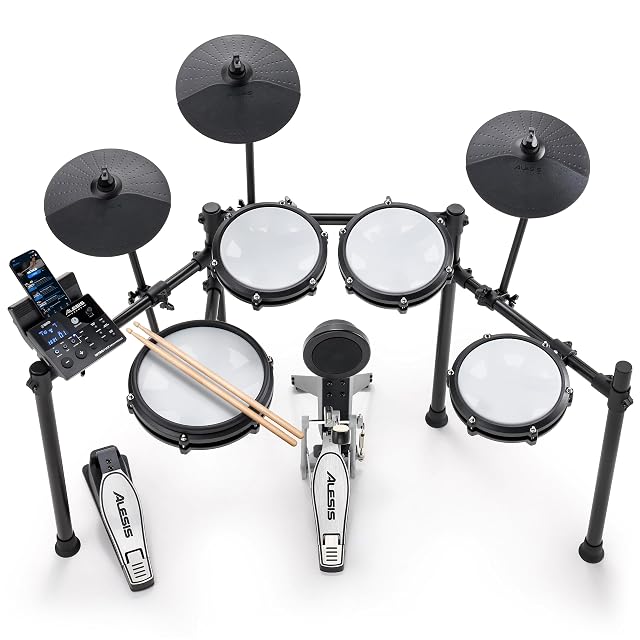
The Alesis Nitro Max is first because its snare is a 10-inch dual-zone mesh head rather than the usual 8-inch. That is the pad most strokes land on, and the extra size is what makes the kit feel like an instrument. The module adds 32 BFD kits, Zildjian samples and USB to a computer.

The complete box

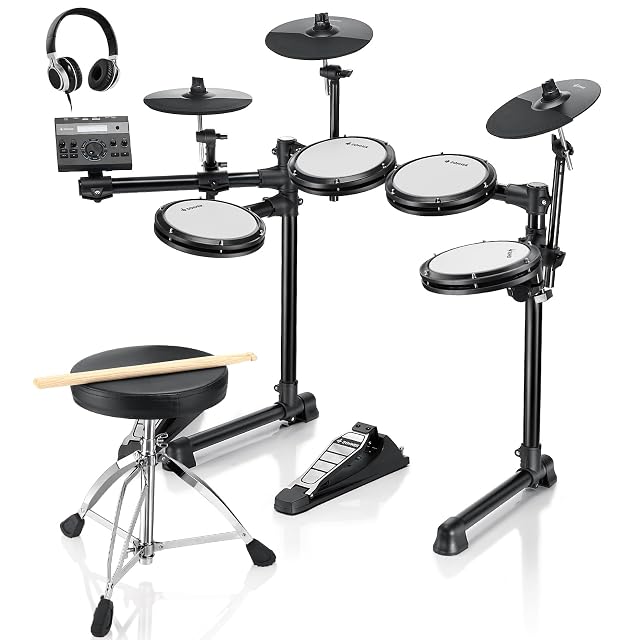
The Donner DED-200Lite includes the throne, the headphones, the sticks and the pedals — everything needed on the day it arrives — with 450 sounds, USB-MIDI and a stated absence of any subscription attached to its lessons.

When space decides

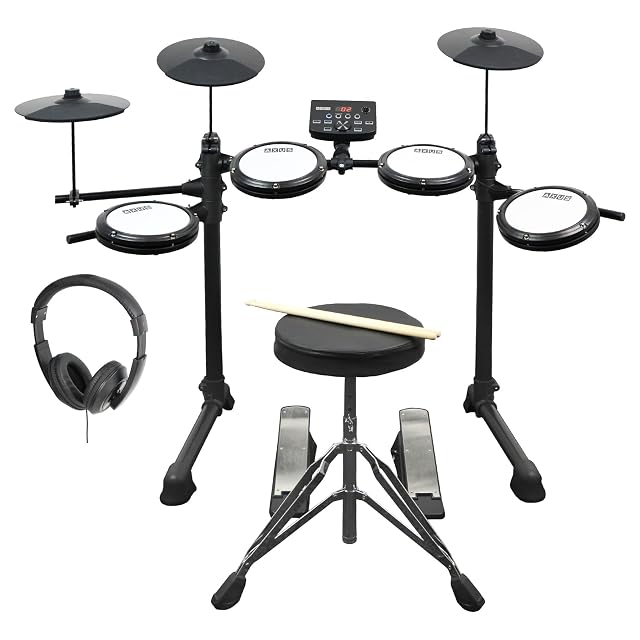
The Axus AXK4 publishes its assembled footprint: 102 cm (40.2 in) high, 117 cm (46.1 in) wide, 46 cm (18.1 in) deep, or 96 cm (37.8 in) with the throne. For a small room that is the specification that decides the purchase, and it is the one nobody else prints.

What we would not do

We would not buy rubber pads to save money. Mesh is the entire reason an electronic kit is playable in a flat.

Which instrument fits how you play?

You live above neighbors
The pads are the quiet part; the noise that travels is the footwork through the floor.
You want realistic feel
Mesh heads and a real hi-hat stand change the experience more than the module does.
You are learning from scratch
A modest kit with mesh heads and headphones covers the first years.
You want to record
The module’s outputs and USB decide how easily the kit reaches a computer.

Picking by how you play

Practicing silently

The reason the format exists. It works for the pads and much less for the pedals, which is the point most buyers discover late.

Learning coordination

Pad layout and a real hi-hat pedal matter here, because they are what technique is built on.

Playing along to music

An auxiliary input on the module, which is how most home practice actually happens.

Recording

USB or MIDI out, which turns the kit into a controller for drum software. It is the format’s quiet superpower.

The things you will notice while playing

Mesh heads versus rubber
Mesh feels closer to a drum and is quieter acoustically. Rubber pads are louder in the room and harder on the wrists over long sessions.
The kick pedal arrangement
A beater striking a pad transmits through the floor. A pedal without a beater reduces that considerably, and in a flat it is the decisive feature.
The hi-hat
A pedal-controlled hi-hat on a stand behaves like the real thing; a simple switch pedal does not. It is the part that most affects learning.
Module sounds and expandability
The module decides what you hear and whether pads can be added later. Its outputs decide whether you can record.
Isolation from the floor
A riser or isolation platform is what actually solves the neighbor problem. It is not part of the kit and it should be part of the budget.

Which figure for which playing

Your constraintWhat helpsWhat does not
Neighbors belowFloor isolation and a quiet pedalTurning the headphones down
Realistic feelMesh heads, real hi-hat standMore sounds in the module
Small roomA compact rackA full-size layout
RecordingUSB or MIDI outBuilt-in speakers

The mistakes players make

Assuming electronic means silent
The pads are quiet; the impact through the floor is not. The pedals are what neighbors below actually hear.
Buying rubber pads for long practice
Rubber is louder in the room and less forgiving on the wrists. Mesh is the meaningful upgrade in this format.
Accepting a switch hi-hat
Hi-hat control is central to drumming. A simple open-or-closed switch teaches a technique that does not transfer.
Skipping floor isolation
It is the part that solves the actual problem, and it is almost never included with the kit.

By the musician you are

The flat dweller
Mesh heads, a quiet pedal arrangement and a proper isolation platform. The last item is the one that matters to neighbors.
The learner
A real hi-hat stand and a comfortable layout, because that is what technique is built on.
The home recordist
Module outputs and MIDI. An electronic kit is one of the easiest instruments to record cleanly at home.

Care, keys and how long it stays good

An electronic kit is maintained through its cables, its mesh heads and the tightness of its rack. Loose rack clamps let pads drift out of position over a session, and mesh heads stretch and eventually tear like any drum head.

  • Check rack clamps periodically; pads that move mid-session are usually a loose clamp.
  • Retension or replace mesh heads when the feel changes.
  • Inspect the trigger cables, which flex constantly and fail at the connector.
  • Keep the module away from drink and dust.

Safety

Headphones at close range and repetitive impact on the wrists.

  • Set safe headphone levels: drum practice runs long and the temptation is to turn up.
  • Warm up and stop if wrists or forearms hurt rather than pushing through.
  • Secure the rack so it cannot walk across the floor during playing.
  • Route cables so they cannot be caught by a pedal or a stand leg.

The choices, and the reasoning

  1. Alesis Nitro Max

    8-piece mesh · 10" snare · Bluetooth · BFD sounds

    An eight-piece mesh kit with a 10-inch dual-zone snare, three 8-inch toms, three cymbals and a kick tower with pedal, on a folding rack — with Zildjian cymbal samples and Bluetooth in the module.

    Best for: A serious first kit that will be recorded as well as practiced on.

    8.4/10

    ≈ $400

  2. Donner DED-200Lite

    7-piece mesh · 450 sounds · throne and headphones included

    A seven-piece mesh kit sold as a complete package — throne, headphones and sticks included — with 450 sounds, 31 kits, USB-MIDI and 40 Melodics lessons.

    Best for: A complete first setup in a flat, bought as one order.

    7.8/10

    ≈ $300

  3. Axus AXK4

    15 sounds · mesh pads · throne and headphones · 102 × 117 cm (40.2 × 46.1 in)

    A compact mesh starter kit with published assembled dimensions — 102 cm (40.2 in) high, 117 cm (46.1 in) wide — plus a throne, headphones, sticks, a quarter-inch output and USB for recording.

    Best for: A small room where the footprint is the deciding constraint.

    7.8/10

    ≈ $725

The questions players ask

Will the neighbors hear it?

They will hear the kick pedal through the structure, not the pads through the air. A riser or isolation platform under the rack is the fix, and no pad type substitutes for one.

Do I need a throne and headphones too?

Yes, and two of these three include both. A kit without a seat is a kit that waits for a second delivery.

Are electronic drums really quiet?

The pads are; the impact through the floor is not. In a flat the pedals are what neighbors hear, and floor isolation is what addresses it.

Mesh or rubber pads?

Mesh feels closer to a drum, is quieter acoustically and is kinder to the wrists over long sessions. Rubber is the budget option.

Does the hi-hat matter?

A great deal. A pedal-controlled hi-hat teaches technique that transfers; a simple open-or-closed switch does not.

Can I record with it?

Easily, through USB or MIDI into drum software. It is one of the format’s strongest and least advertised advantages.

Do I need an isolation platform?

In a flat with neighbors below, it is the item that actually solves the problem. It is rarely included and belongs in the budget.

Will it teach me to play acoustic drums?

Largely, especially with mesh heads and a proper hi-hat. The rebound and the room sound remain different.

Each instrument, and the player it answers

Alesis Nitro Max · $400

For players who: A serious first kit that will be recorded as well as practiced on.

Its finest point: A 10-inch dual-zone snare is the pad that gets played most, and only one kit here publishes a larger one

Its weakest point: The kick is a tower with a pedal, so a beater still strikes a surface — a beaterless pedal transmits less

Read the full review →

Donner DED-200Lite · $300

For players who: A complete first setup in a flat, bought as one order.

Its finest point: The throne and headphones are included, which four kits on this shelf do and four do not

Its weakest point: Bundled headphones are a starting point rather than a destination

Read the full review →

Axus AXK4 · $725

For players who: A small room where the footprint is the deciding constraint.

Its finest point: Published assembled dimensions, so you can measure the corner before ordering

Its weakest point: Fifteen sounds is the shortest list in this group by a long way

Read the full review →

What to get with it

Stands, pedals and cables from the same aisle, at the price we read. Confirm they suit the instrument you choose before ordering: it turns on the fitting and the part number, which the product page gives.

If you want one line

Comparisons worth hearing out

Instrument against instrument, where that page is already written.

What stands behind this ranking

What is listed is taken from the catalog of this site. Specifications come from the manufacturer and from the Amazon listing; prices are what Keepa reported on the date shown, and both move. The order follows declared specifications, stated strengths against stated limits, and price. Nothing here has been played or recorded with by us, and no page pretends otherwise.

Last checked on

Prices quoted in these summaries are dated readings. The live price is shown next to each product.

The tool we use ourselves

Chosen your instrument? Now buy it at the right price.

Digital pianos and electronic drum kits swing by a hundred dollars or more across the year, and the biggest "discounts" often land at prices the same model sold for six weeks earlier. UniverTrack tracks the real price history across retailers, spots fake reductions, and alerts you when it is genuinely the moment to buy.

Real price historyBuy-now alertsAI buying assistant
Try free for 14 days →
No commitment · Cancel in one click · 5 languages