The least expensive full-size keyboard on this shelf, and the only one with two MIDI output sockets — published in two bullets that between them say more than three listings here manage in five.
What it amounts to Two bullets, and they contain more than three listings on this shelf manage in five: 61 full-size keys, two MIDI outputs, a pedal socket and real wheels. There are no pads, no faders and no software, and the key action is a single adjective.
Sixty-one full-size keys, touch-sensitive, with 61 notes able to sound at once. Pitch and modulation wheels. A data entry wheel and a MIDI/select mode toggle. A sustain pedal socket. USB-B, carrying both the MIDI and the power. And two MIDI output sockets.
The listing is two bullets long, and it is worth saying that those two bullets contain more usable specification than the five-bullet and two-bullet listings further up this shelf — one of which, at $399, says 88-Key MIDI Controller and Blk.
The two MIDI outputs are the thing nothing else here has. One socket drives one chain; two can send to a sound module and a drum machine independently, or split the keyboard across two instruments with no thru box in between. Six controllers on this shelf publish no MIDI socket at all — they talk to a computer over USB and to nothing else. For a desk with hardware on it this is a hub rather than a controller.
Full-size keys at $99 is the other half. Everything cheaper on this shelf has mini keys, and the pages for those say the same thing each time: mini keys teach a spacing a piano does not have. Sixty-one of them is two hands and most of what a part needs.
The sustain pedal socket completes it. Two controllers on this shelf publish one, and without it a 61-key keyboard plays staccato.
What is not here is everything else. No pads — six controllers on this shelf publish eight. No faders — one publishes nine. No bundled software, where four here include instruments or a DAW and one page describes the bundle as worth a substantial fraction of the price. No arpeggiator, no screen, no chord mode.
And the key action is published as sensitive and nothing more. Not semi-weighted, not hammer, not graded. On a 61-note keyboard that is the figure that decides how it plays, and it is the one this listing leaves out.
The product record gives 2,908 g (102.6 oz).
Availability
Read on the day this page was built: $99 at the American Amazon shop.
Read from Keepa on the day this page was last revised; stock and price both move without notice.
Prices quoted in this text were read on 2026-10-07. The live price is at the top of the page.
In its favor, and its limits
Strengths
The least expensive full-size keyboard on this shelf — everything cheaper here has mini keys
The only controller here with two MIDI output sockets, so it can drive two sound modules at once
A sustain pedal socket and real pitch and modulation wheels, in two bullets
Compromises
No pads, no faders and no bundled software, where most of this shelf has at least one
No key action published beyond touch-sensitive — not semi-weighted, not hammer
Two bullets in total, so anything not listed above is unknown
Specifications
Keys
61 full size, touch-sensitive, with 61 notes able to sound simultaneously
MIDI out
Two MIDI output sockets — the only controller on this shelf with more than one
Wheels
Pitch bend and modulation
Controls
A data entry wheel and a MIDI/select mode toggle
Pedal
A sustain pedal socket — one of two controllers here to publish one
Connection
USB-B, used both to send MIDI and to power the keyboard
Pads
midiplus puts nothing in writing on this. Six controllers on this shelf publish eight pads
Faders
midiplus puts nothing in writing on this. One controller here publishes nine
Software
midiplus puts nothing in writing on this. Four controllers here bundle instruments or a DAW
Manufacturer reference
i61
Amazon reference
B00WU6H78A
EAN
4713809432250
The questions players ask
Why do two MIDI outputs matter?
Because one socket drives one chain. With two, a keyboard can send to a sound module and a drum machine independently, or split a keyboard across two instruments without a MIDI thru box in between. No other controller on this shelf publishes more than one output, and six publish none at all — they talk to a computer over USB and nothing else. For a desk with hardware on it, that is the difference between a controller and a hub.
Full-size keys at this price — what is the catch?
Everything else. No pads, no faders, no bundled software, no arpeggiator, no screen. Six controllers on this shelf publish eight pads and four bundle instruments or a DAW; this publishes keys, wheels, two MIDI sockets and a pedal input. The key action is described only as touch-sensitive — not semi-weighted and not hammer — which on a 61-note keyboard is the figure that decides how it plays.
Accessories confirmed for this instrument
Shown because the accessory names this instrument itself.
Who should pick this one, among music instruments and gear
A player who wants 61 full-size keys and a socket to drive hardware, and already owns the software.
Sources
Specifications: the manufacturer sheet for musical instruments and gear and the matching Amazon product page. Prices and availability: Keepa. Every figure on this page names its source.
25 mini keys · pressure-sensitive MPC pads · full-color screen · USB-C · MIDI Out
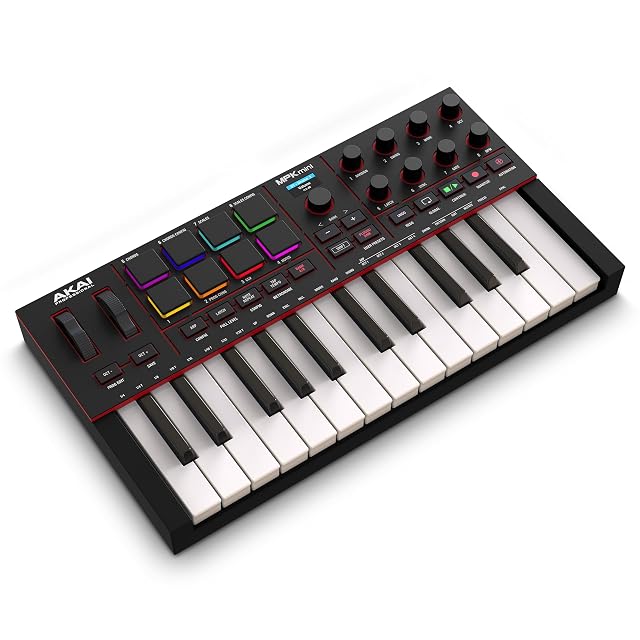
The fourth generation of the MPK Mini, and the only controller here whose pads sense pressure as well as velocity — with a full-color screen, a push/turn encoder, USB-C and a full-size MIDI output.
Best for: Finger-drumming and beat work on a desk, where the pads matter more than the keys.
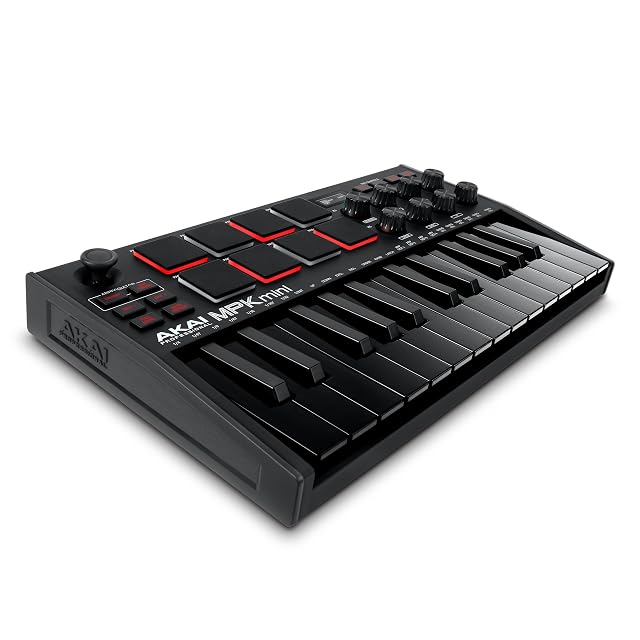
The default small controller: 25 velocity-sensitive mini keys, eight backlit MPC pads, eight 360-degree knobs, a four-way thumbstick, an arpeggiator and NKS integration.
Best for: Beat making and production on a laptop, where pads matter as much as keys.
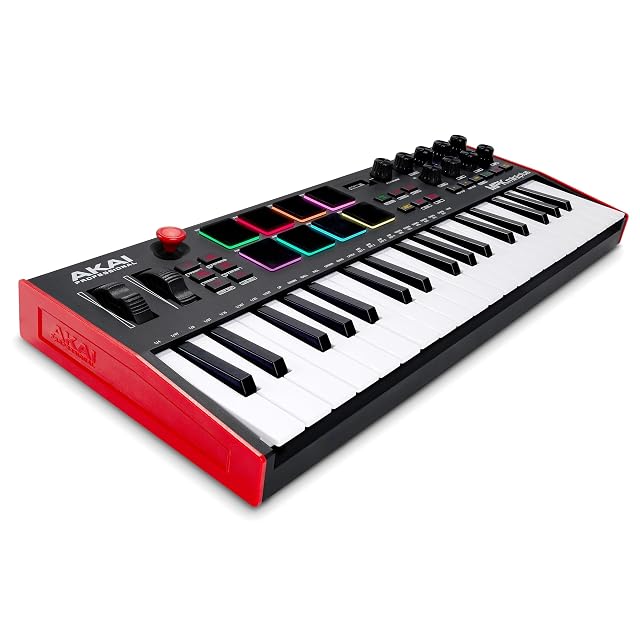
The only controller on this shelf with CV/Gate and the only one with a sequencer: 37 keys, MIDI in and out, a 64-step sequencer with separate drum and melody tracks, and eight RGB MPC pads.
Best for: A desk with hardware on it: a synth, a module or a modular rack that needs a keyboard and a sequencer.